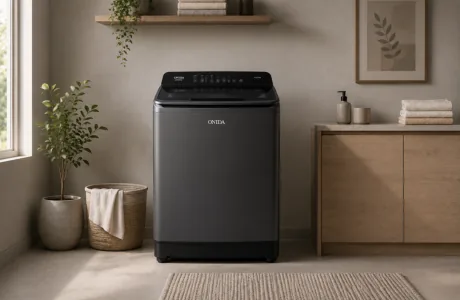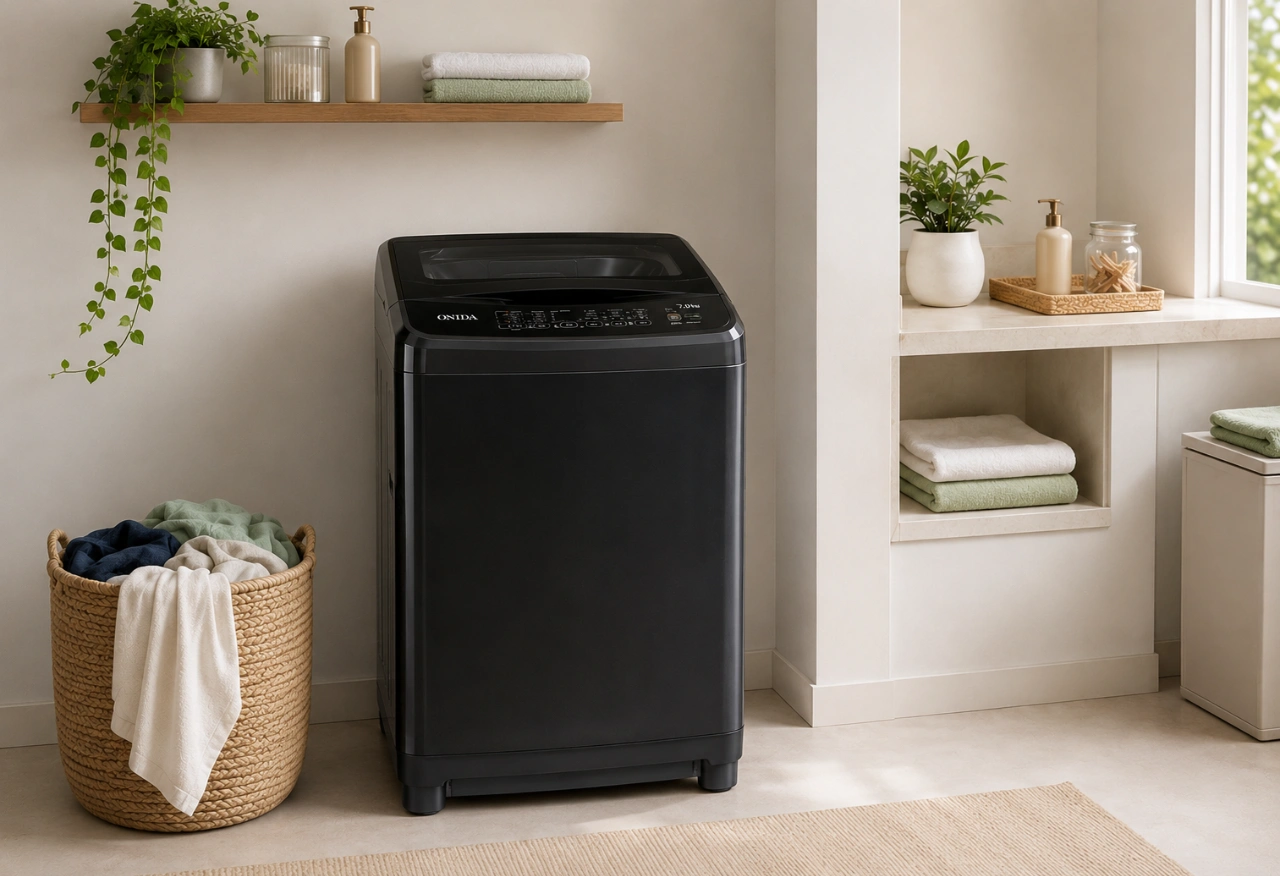

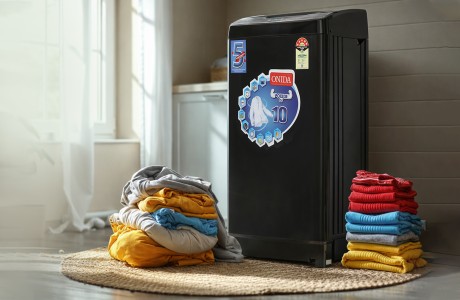
As winter engulfs India in cold, beloved woollens like cashmere jumpers and merino scarves face their yearly challenge—shrinkage from improper washing that turns favourites into unusable keepsakes. Top-load washing machines now address this with specialised wool cycles that offer cold-water washes at 40°C and gentle agitation to protect fibre integrity, as advised by The Woolmark Company.
Onida examines how fully automatic washing machine technology outperforms traditional methods, emphasising top-load washing machine features that prevent felting and stretching. This guide offers practical steps, cycle settings, and explains why the latest washing machine from Onida appeals to discerning Indian households managing premium wool collections.
Wool fibres, made of keratin scales, undergo irreversible contraction when exposed to heat above 40°C, excessive agitation, or alkaline detergents—common issues in standard washing machine cycles that can cause up to 10% to 30% of the wool's size to decrease, according to Woolmark research (2021).
Top-load washing machine models address this issue with "Wool" programmes, typically lasting 50-75 minutes and featuring slow tumbling that mimics hand washing. Unlike front-loaders, top-load washing machines' impellers generate vertical water flow, crucial for preventing scale interlocking that felts wool. Onida's automatic washing machine incorporates sensors that monitor suds and load balance, halting if the risk of shrinkage increases.
Real-world insight: A 2025 study in the Current Book Chapter in Recent Progress in Materials found that even manufacturer "wool" programmes in washing machines fail to fully prevent shrinkage, with area contraction rising 10-15% from 30°C to 40°C due to mechanical agitation and heat-induced scale interlocking on wool fibres.
Explore the mechanics: A top-load washing machine's wool cycle begins with a pre-soak in 20-30°C water, followed by a 10-minute gentle pulsation at 40-50 RPM—much slower than standard cycles' 200 RPM. Cold rinses at 15°C occur afterwards, with fabric softener dispensers releasing wool-safe conditioners mid-cycle to relax fibres.
Onida's fully automatic washing machines, such as the Grandeur 8 KG model, feature Crystal Drum technology that ensures effective washing while gently caring for clothes. The crystal-shaped ridges on the inner wall ensure that even delicate fabrics are washed thoroughly without damage. It also provides even detergent distribution without tangling, addressing a gap in older designs of washing machine in India. Spin speeds are limited to 750 RPM, which extracts 25% less moisture than the standard 1200 RPM, which can stretch wool. After the cycle, anti-crease features gently vibrate the drum to prevent set-in wrinkles.
What this means for you: Onida's top-load washing machine wool cycle delivers family-sized loads (up to 8kg) with 25% moisture extraction at safe 750 RPM, saving 2-3 hours weekly on hand-drying while preserving wool shape—ideal for busy Indian homes managing winter wardrobes without salon visits for stretched knits.
Turn wool items inside out to protect outer fibres, fasten zips and buttons, and empty pockets. Pre-treat stains with wool enzyme sprays, and avoid bleach, which can damage lanolin.
Load loosely: Fill the top-load washing machine to half capacity (e.g., 3-4 sweaters in a 7kg drum), using mesh bags for delicates. Overloading decreases agitation, raising the risk of shrinkage.
Select "Wool/Delicate" mode on your washing machine—Onida's latest model defaults to a 30°C wash, cold rinse, and no spin setting. Add 30ml of wool detergent (pH 5.5-6.5) via the dispenser; initially, avoid fabric softeners as they coat fibres.
Pro Tip: Enable "Zero Pressure Fill" on the Onida washing machine in India for consistent temperatures in low-pressure apartments, a common Mumbai challenge.
Remove immediately, then roll in absorbent towels to blot (never wring). Reshape flat on drying racks. Allow to air-dry away from direct heat or radiators—this takes 24-48 hours but maintains 100% shape, whereas tumble drying has an essential effect on the dimensional stability and distortion of weft knit fabrics.
Store folded in breathable cotton bags with cedar blocks; refresh by airing outdoors weekly, and reduce wash frequency to every 2 months.
India's inconsistent water quality and power fluctuations require durable machines. Top-load washing machine self-clean impellers resist hard-water scale better than front-load bellows, and Onida models feature a Crystal Drum that ensures effective washing while treating clothes gently.
| Feature | Top-Load Washing Machine (Onida) | Front-Load Washing Machine |
| Wool Agitation | Vertical tumble (low friction) | Horizontal roll (higher shear) |
| Water Usage | 120L/load (efficient) | 80L/load (but longer cycles) |
| Power Stability | Voltage protection (140-290V) | Sensitive to fluctuations |
| Service Reach | 5000+ Washing machine centres in India | Urban-biased |
Mistake 1: Hot Water Selection – Users accidentally select 40-60°C cycles, causing 20-30% shrinkage; solution: Verify the "Wool" icon and enable temperature lock on the automatic washing machine.
Mistake 2: Overloading – Packing drums to capacity increases friction; limit to 50% capacity with mesh bags for even flow.
Mistake 3: Powder Detergents – Suds cause felting; switch to liquid wool formulas (pH 6 max).
Fix: Onida automatic washing machine LCDs warn of temperature mismatches. Ignoring low-spin results in dripping overload; programme short spins after rinsing.
Example: A user's cashmere sweater collection shrank 20% after overloading the "Wool" cycle on her top-load washing machine—excess friction caused felting
Most Onida models offer dedicated wool cycle or gentle wash settings: these use controlled spins and cold water to prevent stretching or shrinkage. Onida washing machines now feature up to 10 wash programs, including a gentle option for silks and woollens. Choose the wash program, use ‘wool/gentle’ for sweaters and shawls. These specialised, gentle/woollen programs clean and dry winter wear without damage. Use cold water or preset wool cycles for delicate items.
Compared to rivals, Onida's 5-star BEE rating reduces annual electricity bills by 25%, essential for daily wool washing in Himalayan regions.
Monthly tub cleans with citric acid prevent residue buildup that affects wool rinses. Check filters bi-weekly.
An annual service stabiliser for unstable grids protects electronics, extending the washing machine's lifespan.
Dry cleaning suits heavy coats but strips oils; home washing with a fully automatic washing machine preserves natural water-repellency. Steam wardrobes quarterly for sanitisation without water.
What this means for you: Invest in Woolmark-certified detergents and use them with Onida for comprehensive care.
Mastery of top-load washing machines ensures winter wool lasts, blending technology with tradition. Onida provides this advantage across all washing machines in India.
Explore Onida Washing MachinesMachine-wash only items with care labels; handwash superfine merino. Use the wool cycle at 30°C for safety.
No, wool cycles prevent it through cold rinses and gentle action. Avoid using hot water.
Yes, wool cycles with 30°C cold washes and low RPM prevent felting; use mesh bags for extra protection on luxury items.
Bi-monthly; air it in between washes for odour control.
Use Woolmark-certified liquids (pH 5.5-6.5), such as Eucalan; avoid powders that produce suds, as they increase the risk of 40% more shrinkage.
Roll in towels to blot, then reshape flat on racks—air-dry 24-48 hours away from heat to retain 100% of the original shape.



Please dispose of e-waste and plastic waste responsibly.
For more information or e-waste pick up, please call 7490 9555 55 or
click here for more details.