
Choosing an air conditioner isn't just about deciding how much cooling you need. One of the first decisions is often much simpler: split AC or window AC?
Both are designed to cool a room, but the way they are installed, the space they occupy, the noise you experience and the flexibility they offer can be quite different.
A window AC can be a practical choice when you have a suitable window opening and want a compact, single-unit system. A split AC separates the indoor and outdoor components, giving you more flexibility with placement and keeping the compressor outside the room.
So which one should you choose?
The answer depends less on which type is "better" and more on your room, usage, installation possibilities and priorities. Here's how the two compare.
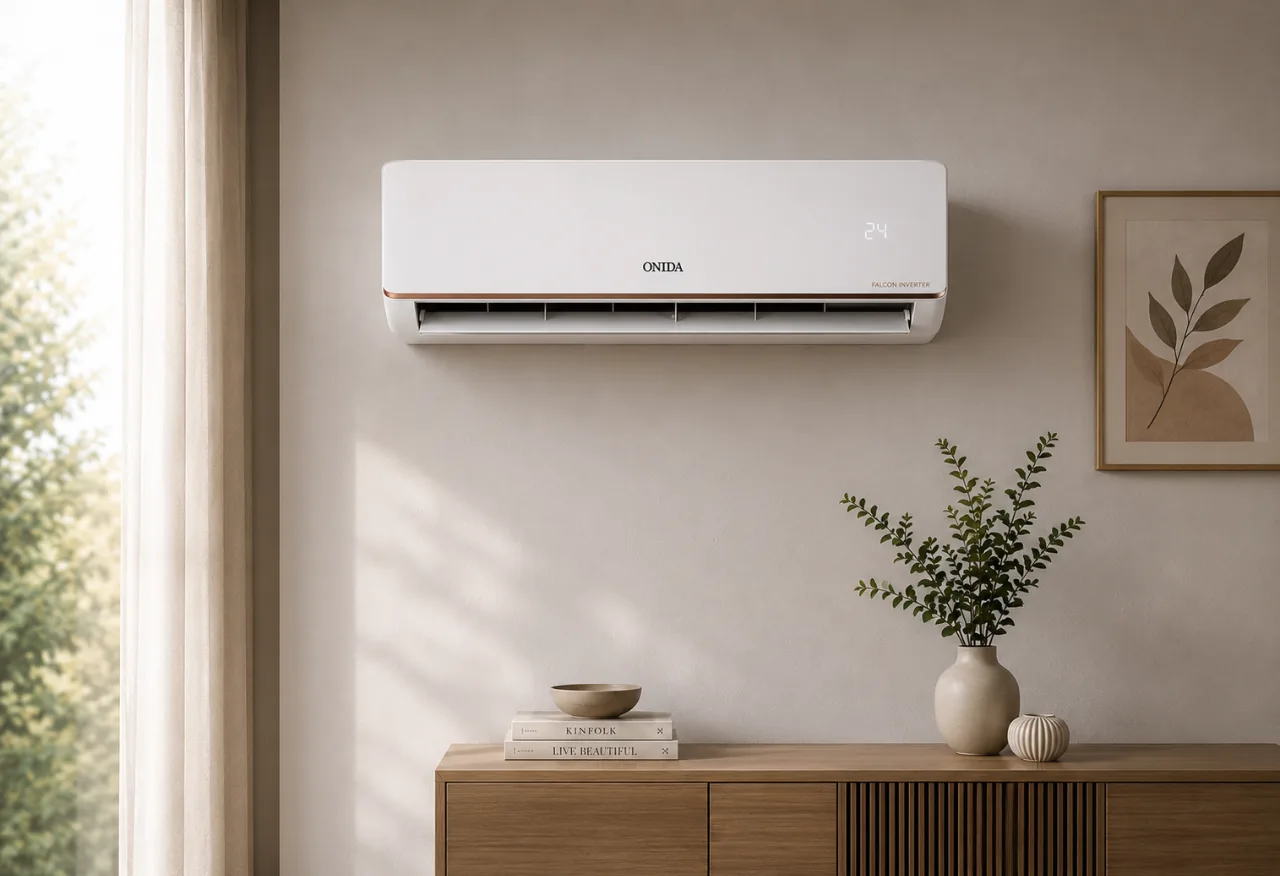
A split air conditioner consists of two main units.
The indoor unit is mounted inside the room and delivers cool air. The outdoor unit houses components including the compressor and is installed outside the room.
The two units are connected through refrigerant piping and electrical connections.
Because the system is divided, the indoor unit can usually be installed on a suitable wall rather than requiring a dedicated window opening.
This flexibility is one reason split ACs are common in modern bedrooms, living rooms and offices.
Onida's current AC portfolio includes split inverter ACs across capacities such as 1 ton, 1.5 ton and 2 ton, allowing buyers to choose based on their room and cooling requirements.
Explore the Onida inverter AC range to compare current options.
A window air conditioner combines the major components into a single unit.
It is typically installed in a window or a suitable opening in an external wall, with part of the unit facing inside the room and the remaining portion exposed outside.
Because everything sits within one unit, installation can be relatively straightforward when the room already has a suitable opening.
That simplicity can make a window AC practical for certain bedrooms, rented homes, smaller rooms or spaces where a dedicated window AC provision already exists.
However, the installation requirement also creates its biggest limitation: you need the right opening in the right place.
If your room doesn't have one, a split AC may offer significantly more placement flexibility.
| Factor | Split AC | Window AC |
| Design | Separate indoor and outdoor units | Single integrated unit |
| Installation | Requires indoor and outdoor installation | Requires suitable window/wall opening |
| Indoor noise | Generally quieter because compressor is outside | Compressor is part of the installed unit |
| Placement flexibility | Higher | Depends on available opening |
| Space inside room | Wall-mounted indoor unit | Occupies window/wall opening |
| Aesthetics | Cleaner, more integrated appearance | More functional appearance |
| Maintenance access | Indoor and outdoor units require access | Components contained within one unit |
| Best suited to | Bedrooms, living rooms and regular home use | Rooms with suitable openings and simpler installation needs |
These are broad differences. The actual performance and efficiency of an AC depend on the individual model, capacity, energy rating, technology and how well it is installed.
Installation is one of the clearest differences between the two.
A window AC needs an opening large and strong enough to accommodate the unit safely.
If your room already has a window AC provision, installation can be relatively straightforward. The entire unit sits in one location, so you don't need to identify separate positions for indoor and outdoor units.
But if there is no suitable window or wall opening, installing one may require modifications.
There's another trade-off: installing the AC in a window can reduce the amount of usable window space and natural light.
A split AC requires more planning.
The indoor unit needs an appropriate wall position, while the outdoor unit needs a safe, ventilated location. The two then need to be connected correctly.
Installation should be handled by trained technicians, particularly because positioning and piping can affect performance.
The advantage is flexibility. You aren't limited to a window opening, which makes split ACs easier to integrate into many room layouts.
If you use your AC while sleeping, working or watching television, noise matters.
A window AC contains the compressor within the same unit installed in the room opening. That means compressor vibration and operational sound are physically closer to you.
With a split AC, the compressor is housed in the outdoor unit.
The indoor unit is therefore generally quieter during operation, although actual noise levels vary by model and fan setting.
For bedrooms, home offices and other spaces where lower indoor noise is a priority, this is one of the strongest practical advantages of a split system.
Onida's current split AC range includes models designed for silent operation, making noise worth comparing alongside capacity and star rating when choosing an AC.
The format alone doesn't determine cooling performance.
A correctly sized window AC can cool a suitable room effectively, just as a correctly sized split AC can.
The bigger question is whether the AC's capacity matches the room.
A small AC trying to cool a large room may run continuously and still struggle to reach the desired temperature. An oversized unit isn't automatically better either.
Room size is only the starting point. Cooling requirements can also be affected by:
This is why two bedrooms with the same floor area may not always need identical cooling capacity.
Onida's current split AC portfolio includes capacities from 1 ton through 2 ton, giving households options for different room requirements.
For example, Onida's Magnus 1.5 Ton 5 Star Split Inverter AC lists a cooling coverage area of 120–150 sq. ft., while other capacities are available for different room requirements.
Choosing the right tonnage is more important than simply choosing the biggest AC available.
You can't determine electricity consumption from the AC format alone.
A split AC isn't automatically efficient because it's split, and a window AC isn't automatically inefficient because it's a single unit.
Look at the BEE star rating, efficiency metrics and expected annual electricity consumption of the specific model you're considering.
Inverter technology is another important factor.
Instead of repeatedly operating the compressor at full power and switching it on and off to maintain temperature, an inverter AC can adjust compressor speed according to the cooling requirement.
This can help maintain a more consistent temperature while managing power consumption efficiently, particularly when the AC runs for longer periods.
Onida currently offers both 3-star and 5-star split inverter ACs, allowing buyers to choose based on their usage and energy-efficiency priorities.
If your AC is going to run for several hours every day during summer, energy efficiency deserves more attention than simply comparing the initial purchase price.
A window AC occupies a physical window or wall opening.
For some rooms, that's perfectly fine. If the opening exists and isn't particularly valuable for light or ventilation, the installation can make practical sense.
For others, giving up part of a window is a bigger compromise.
A split AC's indoor unit is mounted higher on the wall, leaving windows free. This can help preserve natural light and gives you more flexibility when arranging furniture.
However, don't forget the outdoor unit.
It needs an appropriate installation location with adequate airflow and access for servicing. Apartments may also have rules or designated locations for outdoor AC units.
Before buying either type, check where the unit can actually be installed. A specification sheet can't solve an impossible installation.
This is subjective, but it matters when you're installing something you'll see every day for years.
Split AC indoor units are typically designed to sit relatively discreetly high on a wall. Since the larger mechanical components are outside, the indoor unit can have a cleaner appearance.
A window AC is bulkier because the entire system sits within a single cabinet.
For a utility room or a space where function matters more than appearance, that may not matter at all.
In a carefully designed bedroom or living room, a split AC may integrate more naturally.
The right choice is the one that works with the room rather than fighting it.
Both split and window ACs need regular maintenance.
Filters need cleaning, components need inspection and the system should be serviced as recommended to maintain cooling performance.
The difference lies partly in accessibility.
With a window AC, the system is contained within one unit. With a split AC, technicians may need access to both the indoor and outdoor units.
That makes outdoor-unit placement important. Installing it somewhere extremely difficult to reach may create unnecessary headaches when servicing is required.
With either type, don't wait until the AC stops cooling properly before thinking about maintenance.
Keeping filters and components clean can help maintain airflow and cooling performance.
Modern air conditioners can offer far more than basic temperature control, and this is where comparing actual models becomes more useful than comparing only "split" and "window".
Depending on the model, features may include:
For example, Onida's current split inverter range includes models with 5-in-1 convertible cooling, allowing cooling capacity to be adjusted according to requirements.
Select Onida models also offer features such as 4-way swing, 100% copper coils, Deep Clean, AI-based cooling control and Magic Neem Filter.
Rather than buying based on the longest feature list, focus on what will make a difference in your room.
If the AC runs all night, energy efficiency and noise may matter more.
If your living room gets crowded on weekends, flexible cooling capacity and airflow may be more useful.
If you're in a region with particularly harsh summers, high-ambient cooling capability deserves attention.
For many bedrooms, a split AC is likely to be the more comfortable option if installation is possible.
The compressor being outside helps reduce indoor operational noise, which matters when you're trying to sleep.
You also don't need to sacrifice a window opening, and the indoor unit can be positioned to distribute air effectively through the room.
Capacity still matters.
A smaller bedroom may need a different AC capacity from a large master bedroom, particularly if the room receives strong afternoon sunlight or is located on the top floor.
Don't automatically assume every bedroom needs a 1.5 ton AC. Match the cooling capacity to the actual space and conditions.
Living rooms often present a more demanding cooling challenge.
They're usually larger than bedrooms, may have bigger windows and frequently accommodate more people at once.
That makes capacity and airflow particularly important.
A split AC gives you greater flexibility with indoor-unit placement and is available across different capacities for larger spaces.
Features such as multi-directional airflow can also help distribute cool air across the room instead of concentrating it in one area.
Onida's split AC range includes options up to 2 ton, along with convertible cooling models that can adjust cooling output based on requirements.
For larger spaces, choosing the right capacity should come before deciding which extra features you want.
A window AC can often involve a simpler installation setup when a suitable opening already exists, while split AC installation involves separate indoor and outdoor units.
But purchase price alone doesn't tell you which AC will cost less over time.
Consider:
Purchase cost + installation + electricity consumption + maintenance + expected usage.
If you use the AC occasionally, your priorities may be different from someone running it for eight hours every night throughout summer.
Energy efficiency becomes increasingly important as usage rises.
Rather than choosing purely on the lowest upfront price, think about how the AC will actually be used over several summers.
Choose a window AC if you have a suitable window or wall opening, want a compact single-unit system and your room and installation setup make it practical.
Choose a split AC if you want quieter indoor operation, greater installation flexibility, a cleaner wall-mounted appearance and access to a wider range of capacities and modern features.
For many modern homes, a split AC offers a strong balance of cooling, comfort, flexibility and features.
But whichever type you choose, get the fundamentals right first:
Choose the right capacity. Compare energy efficiency. Check installation feasibility. Then compare the features you'll actually use.
If a split AC fits your home, explore the Onida air conditioner range to compare current inverter models across capacities, star ratings and cooling features.
Neither is universally better. A window AC can be practical when you already have a suitable opening and want a single-unit system. A split AC offers greater placement flexibility and generally quieter indoor operation because the compressor is outside.
Not simply because it is a split AC. Electricity consumption depends on factors including capacity, energy efficiency, compressor technology, temperature settings, usage and room conditions. Compare the BEE rating and energy-consumption information of the specific models.
A split AC can be particularly suitable for bedrooms because the compressor is located outdoors, helping reduce indoor operational noise. It also doesn't occupy a window opening.
Capacity depends on room area as well as ceiling height, sunlight, floor level, occupancy and other heat sources. Use room size as a starting point, but consider the complete cooling requirement before selecting tonnage.
If you use your AC regularly or for long periods, inverter technology can be valuable because the compressor adjusts its speed according to cooling demand rather than repeatedly operating at full output and switching on and off.
Start with cooling capacity and installation feasibility. Then compare BEE star rating, inverter technology, annual energy consumption, airflow, noise, useful cooling modes, maintenance requirements and warranty terms for the specific model.



Please dispose of e-waste and plastic waste responsibly.
For more information or e-waste pick up, please call 7490 9555 55 or
click here for more details.