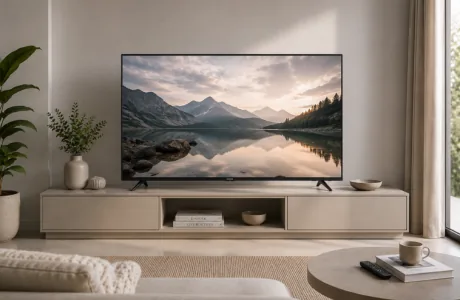

If you've been shopping for a new television lately, you've almost certainly come across the term Mini LED TV. It appears everywhere on product pages, comparison sites, and in conversations about the best TV brand in India for premium viewing. But what exactly is a Mini LED TV, and why does it keep being described as having superior HDR performance compared to regular LED televisions?
The short answer: it comes down to light. Specifically, how many individual light sources are behind the screen, how precisely they can be controlled, and how that control transforms the way highlights and shadows appear on screen. This guide breaks down the science in plain language — and explains why Mini LED TV technology represents a meaningful leap forward for anyone who watches movies, cricket, or streams content in 4K HDR.
A Mini LED TV is not a completely new type of display panel. It is, at its core, still an LCD television — the same fundamental technology that has been in Indian living rooms for over a decade. What makes it different is what's behind the panel: instead of a small number of large LEDs for backlighting, a Mini LED TV uses thousands of microscopic LED chips, each measuring just 100 to 200 microns in size.
This might sound like a minor engineering detail, but it has a profound impact on what you see on screen. Because there are so many more light sources packed behind the same display area, the TV can control which parts of the screen are bright and which are dark with far greater precision than was ever possible with standard LED backlighting.
Onida's Mini LED Series is designed around exactly this principle — exceptional contrast, brightness, and colour control that elevates everyday viewing into a cinematic experience, whether you're in a darkened home theatre or a well-lit living room.
To understand why a Mini LED TV delivers better HDR performance, you need to understand a concept called Full-Array Local Dimming, or FALD. This is the mechanism that makes Mini LED transformative.
In a standard LED TV, the backlight either illuminates the entire screen uniformly, or is divided into a small number of broad zones — sometimes just 8 to 32 zones across the entire panel. When a scene has a bright white element (like a streetlight at night), the entire surrounding zone has to light up too, causing a visible glow or 'halo' effect around bright objects on dark backgrounds. This is called blooming, and it's one of the most common complaints about non-Mini LED HDR televisions.
Mini LED dramatically solves this problem. Because Mini LED TVs pack hundreds to thousands of independently controlled dimming zones behind the panel, each zone covers a much smaller area of the screen. When a scene requires a bright highlight in one corner and deep black in another, the TV can achieve both simultaneously — without one compromising the other. The result is a picture that feels more three-dimensional, more realistic, and far closer to what the content creator intended.
HDR, or High Dynamic Range, is a technology that allows a TV to display a wider range of brightness levels — from the deepest shadows to the most dazzling highlights — in the same frame. The two most widely supported HDR formats today are HDR10 and Dolby Vision, both of which are supported by premium Mini LED TVs.
However, HDR is only as good as the hardware behind it. A TV that claims HDR support but uses edge-lit backlighting with few dimming zones cannot truly deliver the contrast that HDR content demands. The highlights may not be bright enough, or the dark areas may look washed out because the backlight can't be turned down in one region while staying bright in another.
This is where the Mini LED TV's thousands of dimming zones make all the difference. Peak brightness on a capable Mini LED panel can exceed 1,000 nits — and some premium models push above 2,000 nits. This means the TV can render a blindingly bright sun in one corner of the screen while keeping the surrounding sky inky dark, exactly as it would appear to the human eye in real life. That combination of extreme brightness and precise dark control is the foundation of genuine, high-performance HDR.
When evaluating a Mini LED TV in India, it helps to see how it stacks up against the other display technologies available in the market today:
| Feature | Standard LED TV | Mini LED TV | OLED TV |
| Backlight Type | Edge-lit / Full-array | Full-array Mini LED | Self-emissive |
| Dimming Zones | Tens of zones | Hundreds to thousands | Per-pixel |
| Peak Brightness | 300–500 nits | 1,000–2,000+ nits | 500–900 nits |
| Black Levels | Limited | Deep & precise | Near-perfect |
| HDR Performance | Basic HDR10 | HDR10, Dolby Vision | HDR10, Dolby Vision |
| Burn-in Risk | None | None | Possible over time |
| Blooming Effect | Visible | Minimal | None |
| Price Range | Budget-friendly | Mid to premium | Premium+ |
Specifications vary by model. Refer to individual product pages for confirmed ratings.
The table above highlights why the Mini LED TV occupies such a compelling middle ground. It delivers brightness levels that OLED struggles to match — a real advantage in India's often brightly lit living rooms — while producing black levels and contrast that standard LED TVs simply cannot achieve. And unlike OLED panels, Mini LED TVs carry no risk of burn-in, making them a more durable long-term investment for households where the TV runs for many hours daily.
Beyond local dimming and HDR support, a well-engineered Mini LED TV brings together several features that work in concert to deliver the best possible picture. Here's what to look for when considering a Mini LED TV online or in store:
India's viewing habits are diverse — cricket on weekday evenings, Bollywood and OTT content on weekends, and increasingly, 4K HDR streaming across platforms like Netflix and Disney+ Hotstar. All of these content types benefit enormously from Mini LED's capabilities.
Cricket, in particular, is a sport where contrast matters enormously. The bright white of the pitch against the green outfield, the ball in bright sunlight against a dark crowd — these are exactly the kinds of high-contrast scenes that a Mini LED TV renders with much greater fidelity than a standard LED panel.
Indian homes also tend to have significant ambient light during the day. Unlike OLED panels, which can look washed out in a bright room, Mini LED TVs' high peak brightness ensures a vivid, punchy picture even when sunlight enters the room. This practical advantage makes a Mini LED TV in India especially well-suited to the real conditions in which most viewers actually watch television.
Onida's Mini LED Series is specifically designed for this reality — a display technology that performs brilliantly both in dark-room cinematic viewing and in the everyday brightness of an Indian living room, at a price point that makes premium picture quality genuinely accessible.
Onida has been a part of Indian homes since 1981 — one of the few consumer electronics brands that has grown up alongside Indian consumers, rather than entering the market as an outsider. When Onida designs a Mini LED TV, it does so with an understanding of how Indians watch television: the hours, the content, the room conditions, and the value expectations.
The Onida NEXG series represents this thinking in practice — combining cutting-edge display technology with Google TV's smart platform, Dolby Audio, and a bezel-less design that suits both modern apartments and traditional family living rooms. Whether you're exploring Mini LED TV options online or visiting a store, Onida's range offers a compelling answer to the question of which is the best TV brand in India for those who want genuine HDR performance without stepping into stratospheric price territory.
Onida's Mini LED TVs are designed for exceptional contrast, brightness, and colour control — making them ideal for dark-room viewing, gaming, and the increasingly HDR-rich world of streaming content available to Indian audiences today.
Frequently Asked Questions (FAQs)
What is a Mini LED TV and how is it different from a regular LED TV?
A Mini LED TV uses thousands of microscopic LED chips (100–200 microns each) as its backlight, compared to the small number of large LEDs in a standard LED TV. This allows the screen to be divided into hundreds or thousands of independently controlled dimming zones, enabling much more precise control over brightness and darkness across the picture — which is the foundation of superior HDR performance.
Why do Mini LED TVs have better HDR than standard LED TVs?
HDR content requires a TV to simultaneously display very bright highlights and very deep shadows in the same frame. Standard LED TVs, with few dimming zones, cannot achieve this without visible blooming (halos around bright objects). Mini LED TVs, with their many fine-grained dimming zones and high peak brightness (often exceeding 1,000 nits), deliver true HDR contrast that standard LED panels simply cannot match.
Is a Mini LED TV better than OLED for Indian homes?
It depends on your room conditions and usage. OLED offers perfect per-pixel contrast and near-infinite black levels, but can look washed out in bright rooms and carries a risk of burn-in with static content. Mini LED TVs offer significantly higher peak brightness — making them better suited to India's naturally bright living environments — with no burn-in risk, and at a more accessible price point. For most Indian households, a Mini LED TV is the more practical and durable premium choice.
What Mini LED TV features should I prioritise when buying?
Prioritise the number of local dimming zones (more is better), peak brightness (look for 1,000 nits or above), HDR format support (HDR10 and Dolby Vision), resolution (4K), and the smart TV platform (Google TV offers the widest app ecosystem). If gaming is part of your use case, also check for a high refresh rate and low input lag in Game Mode.
What is the Mini LED TV price in India, and is it worth it?
Mini LED TV prices in India vary by screen size, zone count, and brand. Entry-level Mini LED models begin in the mid-range segment, while premium options with higher zone counts and Quantum Dot enhancement sit in the upper price bracket. Given the substantial improvements in HDR performance, contrast, and brightness that Mini LED delivers over standard LED — and its practical advantages over OLED in bright Indian rooms — it represents strong value for anyone who watches a significant amount of premium or HDR content.
Does Onida make a Mini LED TV in India?
Yes. Onida's Mini LED Series is designed specifically for Indian viewers seeking exceptional contrast, brightness, and colour control. Paired with Google TV, 4K Ultra HD resolution, and Dolby Audio, Onida's Mini LED TVs bring cinematic picture quality into Indian homes at competitive pricing. You can explore the full range of Onida Mini LED TVs online at onida.com.
The television market has reached a point where picture quality differences between display technologies are genuinely visible and meaningful — not just in spec sheets, but in the everyday experience of watching cricket, films, and streaming content. A Mini LED TV sits at the sweet spot of that landscape: delivering HDR performance that standard LED panels cannot match, at a price that doesn't require choosing between a TV and everything else.
If you're in the market for a new television and HDR quality, brightness, and contrast matter to you, a Mini LED TV deserves serious consideration. Onida's Mini LED Series brings this technology to Indian buyers with the reliability, smart features, and value that 40+ years of making products for India have taught us to deliver.
Explore Onida's full TV range — including Mini LED, QLED, and 4K Smart TVs — at onida.com.



Please dispose of e-waste and plastic waste responsibly.
For more information or e-waste pick up, please call 7490 9555 55 or
click here for more details.