
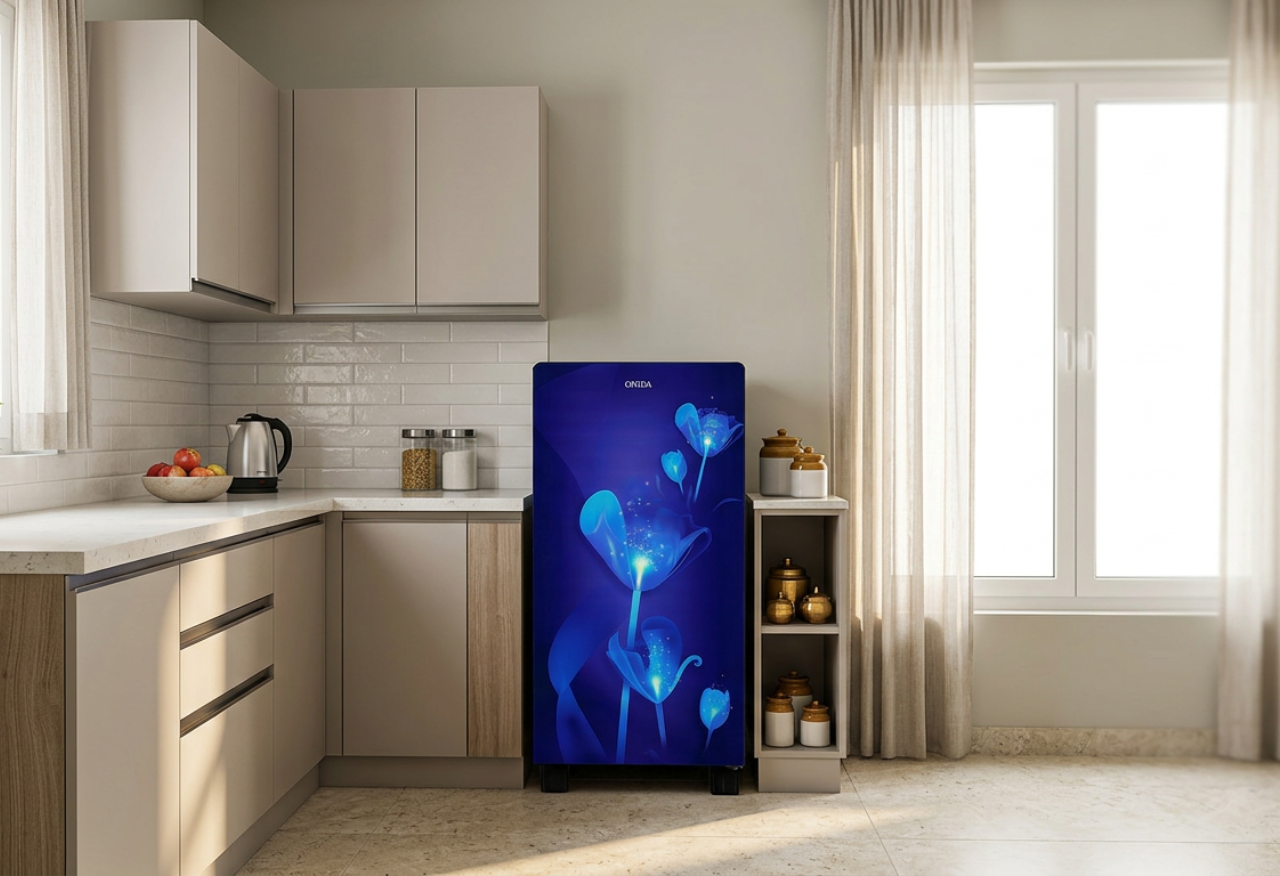
When most people buy a refrigerator, they instinctively look for a bigger one. More space seems like a better deal until monthly electricity bills rise for a mostly empty fridge that takes up too much space in a small kitchen. The reality is that a small fridge is not a compromise. For the right household, a small refrigerator model is genuinely the smarter buy: it costs less upfront, is cheaper to run, and fits how millions of Indians actually use their kitchens. Whether you live alone in a studio flat, are a couple in a 1BHK, or just have a compact kitchen that can’t fit a full-sized double door unit, consider a small fridge seriously, not as an alternative, but as a smart option. At Onida, we've made refrigerators in various sizes for every Indian home. We know the right size is the one that fits your household's needs, not just the biggest one that can fit through the door.
In this blog, Onida guides you through everything you need to know about choosing the right small fridge: what capacity ranges are available, how to match litre size to your household needs, the actual running costs of smaller fridges, and the real benefits of a single door fridge or compact model for Indian kitchens. By the end, you’ll know exactly which size to buy and why smaller might really be better for you.
A small fridge, usually between 80 litres and 230 litres, is right for singles, couples, bachelors, and households of up to three people who shop often and have a small kitchen.
As a general rule, Indian fridge sizing works like this: allow 80 to 100 litres per person for households that shop every 2 to 3 days, or 100 to 120 litres per person for those that shop weekly. A 180 L fridge works well for one to two people, while a 230 L fridge fits two to three people. Larger families of four or more typically need 300 litres or more.
Beyond household size, choosing a small fridge comes down to three main points: lower electricity use, a smaller kitchen footprint, and a lower purchase price. A single-door small fridge of 180 to 200 litres costs between ₹10,000 and ₹18,000, compared to ₹25,000 and up for a double-door model. It uses around 100 to 150 units of electricity per year at a 5-star BEE rating, while larger double-door fridges use 200 to 350 units. For households that don’t need the extra room, those savings come without losing performance.
Litre capacity is the most important figure on a fridge specification sheet, but many buyers are unsure what it really means. The litre number shows the total usable interior space of the refrigerator, including shelves, door compartments, and the freezer section.
The most useful rule is: multiply the number of people in your household by 100 litres, then add 20-30 litres for guests and bulk buying. This calculation usually helps Indian buyers find the right capacity without going overboard.
The single-door fridge is the most common small fridge design in India, and there’s a good reason for that. It combines a small footprint, simple operation, and low running costs in a setup that suits most Indian kitchens.
A single-door fridge has one exterior door that opens to access the main refrigerator section, and a small built-in freezer box at the top. This design is called a direct-cool refrigerator, meaning it uses natural convection to circulate cold air rather than a fan-driven frost-free system.
A single-door refrigerator is not a lesser choice; it is the most energy-efficient and cost-effective fridge type for households of 1 to 3 people. Onida's single-door fridge range covers 80 litres to 230 litres, with 4-star and 5-star BEE-rated models across the lineup. Browse Onida's single-door refrigerator collection to compare capacities and features.
| Factor | Small Fridge (80–230 L) | Large Fridge (300 L+) |
| Type | Single door (direct cool) | Double door / side-by-side (frost-free) |
| Price range (India) | ₹10,000–₹18,000 | ₹25,000–₹80,000+ |
| Electricity use (annual) | 90–150 units/year | 200–400 units/year |
| Annual electricity cost | ~₹630–₹1,050 | ~₹1,400–₹2,800 |
| BEE star rating | 3–5 star | 2–5 star |
| Kitchen footprint | 50–55 cm wide | 60–90 cm wide |
| Ideal household size | 1–3 people | 4+ people |
| Freezer capacity | Small (15–30 L) | Large (50–100 L+) |
| Defrosting | Manual (monthly) | Automatic (frost-free) |
| Food moisture retention | Higher (direct cool) | Lower (frost-free airflow) |
| Best for | Singles, couples, compact kitchens | Families, large kitchens, bulk storage |
| Voltage sensitivity | Lower risk | Higher (more components) |
No, a small fridge uses much less electricity than a large one, and the difference is often bigger than buyers realise. A 5-star BEE-rated single-door fridge of 180 to 200 litres uses about 100 to 130 units of electricity per year. At ₹7 per unit, that’s around ₹700 to ₹910 each year, or less than ₹80 per month to run.
A frost-free double-door fridge of 300 to 340 litres, rated at 3 stars, consumes about 250 to 320 units a year—₹1,750 to ₹2,240 annually. The difference of ₹800 to ₹1,300 a year might seem small, but over the typical 10 to 12-year lifespan of a refrigerator, that can add up to ₹8,000 to ₹15,000 in total electricity savings just by choosing the right size.
The BEE star rating on a small fridge greatly affects running costs compared to larger models, so it’s wise to choose 4-star or 5-star rated models, even at the lower end of the range.
Indian summers demand more from refrigerators. In cities like Delhi, Nagpur, and Jaipur, where temperatures exceed 40°C for months, a fridge’s compressor runs more often to keep things cool. A smaller, well-insulated direct cool refrigerator small size model can manage these temperature challenges well. Its compact space reaches stable temperatures faster after the door opens, cutting recovery time and compressor load.
Onida's small fridge range is designed for Indian climates, with compressors that work in temperatures up to 43°C and wide voltage tolerances to protect the appliance during the common power fluctuations in India. Explore Onida's energy-efficient refrigerator range to compare BEE ratings by capacity.
Choosing the right refrigerator small size for your home depends on four practical factors. Go through each one, and you'll find the best model for your needs.
For one person who shops every 2 to 3 days, 80 to 150 litres is sufficient. For two people who shop twice a week, aim for 150-200 litres. If two to three people shop weekly, 200-250 litres works well. A small fridge for bachelors in PG or hostel accommodations typically needs no more than 80-100 litres.
Measure the width and height of the space for the fridge, adding 5 cm on each side and 10 cm at the back for ventilation. A fridge placed too close to walls or cabinets can’t effectively release heat, reducing its efficiency and potentially shortening the compressor's life. Also, measure your kitchen doorway to ensure the fridge can fit through before buying.
If you often freeze meat, ice cream, or batch-cooked meals, check the freezer compartment's size. A 180 L fridge typically has a 15-20 L freezer section, which is enough for ice and small portions. If you frequently need freezer space, a 230 L fridge offers a larger dedicated freezer without having to switch to a full double-door model.
Always select the highest BEE star rating you can afford. The difference in annual electricity costs between a 3-star and a 5-star model of the same size can be ₹300 to ₹600 per year. In areas with frequent voltage changes, confirm that the fridge can operate within a wide voltage range (typically 135V to 290V) without an external stabiliser.
For a refrigerator in a small kitchen, first match the capacity to the household's actual needs. Then, optimise for the BEE rating. This approach offers the best long-term value. Visit onida.com/refrigerators to filter by capacity, star rating, and dimensions to find the right model for your space.
A single-doo0072 fridge of 150 to 200 litres is the best choice for a small kitchen. These models usually measure 50 to 55 cm wide and 120 to 145 cm tall, fitting nicely into compact kitchen layouts without overwhelming the space. A 180 L fridge is the most popular option for small kitchens in Indian 1BHK and studio apartments, providing practical storage without taking up too much room.
A 180 L fridge to a 230 L fridge is ideal for two people. This range, based on 100 litres per person plus a buffer, comfortably holds a week's worth of vegetables, dairy, drinks, condiments, and cooked meals for a couple. A single-door small fridge in this capacity range typically has the lowest running costs, with annual electricity bills of under ₹1,000 at a 5-star BEE rating.
No, a small fridge uses very little electricity. A 5-star BEE-rated single-door fridge of 180 to 200 litres consumes about 100 to 130 units of electricity per year, costing ₹700 to ₹910 annually at standard Indian rates. This is 40-50% less than a comparable frost-free double-door model. Choosing a refrigerator small size with a high BEE rating is one of the best ways to lower home electricity costs.
A single-door fridge is more energy-efficient, generally cheaper to buy, and better at keeping food moist compared to frost-free double-door models. Its direct-cool technology uses natural convection instead of a fan, helping maintain humidity inside the fridge. This keeps fruits and vegetables fresh for longer. It also takes up less space and has fewer mechanical parts, making it easier and cheaper to maintain.
A 200-litre fridge is sufficient for a family of two to three people, but it may feel cramped for a family of four who cook daily and shop weekly. For four or more people, a fridge of 300 litres or more is recommended. A 230 L fridge offers a good middle option for a small family of three that shops often and doesn’t need much freezer space.
Start by calculating your capacity needs: multiply the number of household members by 100 litres, then add 20-30 litres as a buffer, and match that to available sizes. Next, check the BEE star rating and prioritise 4-star or 5-star models. Make sure the dimensions fit your kitchen with enough space for ventilation. Finally, check the voltage compatibility. Onida's range of small fridges lists all specifications, capacity, BEE rating, dimensions, and voltage range, making it easy to compare before you buy.
Yes, small fridges from well-known brands are completely safe when used properly. Ensure there’s sufficient ventilation around the appliance. Avoid placing it near heat sources or in tightly sealed cupboards. Don't overload the door shelves beyond their weight limit. In Indian homes with fluctuating voltage, choose a small fridge designed to handle a wide voltage range. Onida's fridges are built to operate safely in India's variable conditions without an external stabiliser.



Please dispose of e-waste and plastic waste responsibly.
For more information or e-waste pick up, please call 7490 9555 55 or
click here for more details.