
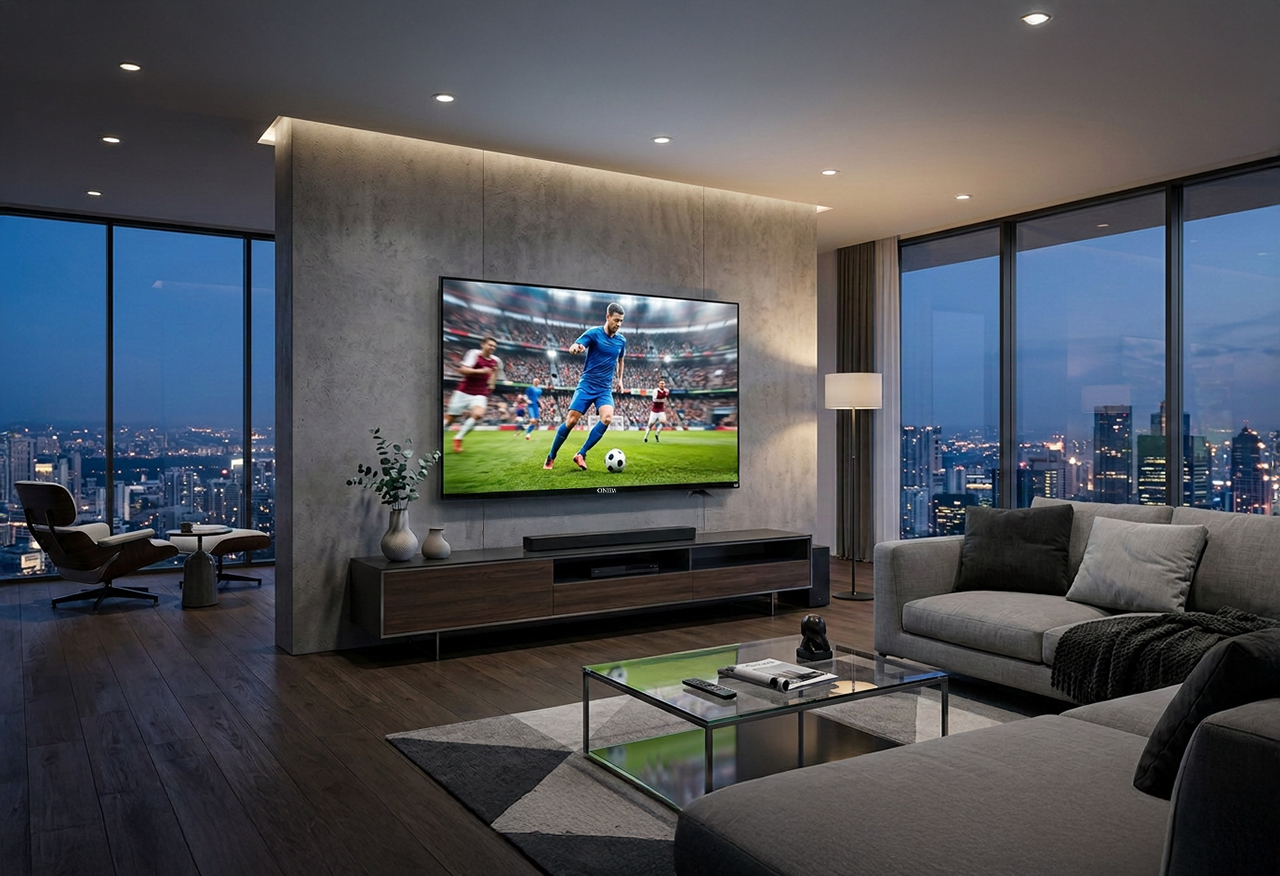
120Hz on a 4K Ultra HD TV means the screen refreshes 120 times per second, twice the rate of a typical 60Hz panel. If you’re gaming on a PS5 or Xbox Series X, then yes, you definitely need it. For watching films, streaming content, and standard television, a good quality 60Hz 4K TV with MEMC performs well for most content. The difference is most noticeable in fast-paced sports, competitive gaming, and films shot at 24 fps, rather than in everyday streaming.
In this guide, Onida explains what refresh rate means for a 4K Ultra HD TV, when 120Hz is worth the extra cost, and how MEMC in Onida's NEXG 4K range provides smooth motion without a true 120Hz panel.
Refresh rate measures how often a TV updates the image on screen, shown in Hertz (Hz). A 4K TV at 60Hz refreshes 60 times per second. At 120Hz, it refreshes 120 times per second. The benefit is that faster refresh rates reduce motion blur, making fast-moving images, like a racing car or a sprinting footballer, look sharper and smoother.
This matters because most content is filmed at 24–60 frames per second, not at 120 fps. Films run at 24 fps, while TV shows and broadcasts range from 25 to 60 fps. When displaying 24 fps content, both panel types need to either repeat or interpolate frames. A 120Hz panel handles 24fps content smoothly because 24 evenly divides 120, avoiding the slight "judder" effect that 60Hz panels struggle to cover up.
The best choice depends on how you plan to use your Ultra HD TV:
| Factor | 60Hz 4K TV | 120Hz 4K TV |
| Screen refreshes per second | 60 times | 120 times |
| Movies (24fps content) | 3:2 pulldown — minor judder possible | 24fps divides evenly into 120Hz — no judder |
| Standard streaming (30/60fps) | Excellent — content matches panel rate | Excellent — no visible difference for this content |
| Live sports (50/60fps broadcast) | Good — MEMC can assist motion | Better inherent motion clarity |
| Gaming (PS5 / Xbox Series X 120fps) | Capped at 60fps — 120fps modes not usable | Full 120fps support — lower input lag |
| Input lag | Higher — less ideal for competitive gaming | Lower — better gaming responsiveness |
| HDMI 2.1 required for 4K 120fps | No — HDMI 2.0 handles 4K 60Hz | Yes — 4K 120fps requires HDMI 2.1 |
| Price difference (India) | ₹10,000–₹25,000 lower in the equivalent category | ₹10,000–₹25,000 premium in equivalent size |
| Best for | Streaming, movies, casual TV, budget buyers | Gamers, sports fans, cinephiles |
The main reason to pick a 120Hz TV is gaming. Both the PS5 and Xbox Series X can output 120fps in supported games. A 60Hz TV cannot display that content, as it is limited to 60 fps. For everything else, streaming, films, and casual TV watching, the difference is either small or unnoticeable, especially when a quality 60Hz panel features well-tuned MEMC.
MEMC (Motion Estimation and Motion Compensation) is a technique found in many 4K Ultra HD TVs. It analyses consecutive frames and adds interpolated frames to smooth motion without needing a native 120Hz panel. Onida's NEXG 4K range includes MEMC along with the Pixa Visual Engine.
MEMC works well for sports but can create the "soap opera effect" on films if used too intensely. Good implementations let users adjust or turn it off. High-quality MEMC on a well-calibrated 60Hz 4K TV is perfect for most Indian homes, where 120fps gaming or 120fps source content is not the main focus. MEMC uses a 60Hz panel but does not allow for 120fps pass-through for gaming consoles. Only a true 120Hz panel with HDMI 2.1 can provide that feature.
The price difference between a 120Hz TV and a similar 60Hz model in the Indian market ranges from ₹10,000 to ₹25,000. Whether that extra cost is worth it depends on three questions:
For most Indian buyers, deciding on the best TV focuses on picture quality, display technology, HDR performance, and sound, rather than only on refresh rate. Onida's NEXG 4K range offers the Pixa Visual Engine, HDR10, Dolby Vision (on select models), and MEMC across sizes from 43 to 75 inches. For customers who specifically need 120Hz, Onida’s Mini LED TV range offers 120Hz and 144Hz with HDMI 2.1 on 50-inch and 55-inch models.
A 120Hz 4K Ultra HD TV justifies its higher price in certain situations. If any of the following apply to your household, upgrading makes sense:
For casual OTT and broadcast TV viewers, these benefits are not evident in day-to-day use. A solid 60Hz 4K TV with good HDR and MEMC usually performs better overall than a budget 120Hz panel.
Refresh rate is just one detail to think about when buying a 4K TV. When looking at the latest TV options in India, consider refresh rate alongside these factors:
Onida's 4K Ultra HD TV range spans sizes from 43 to 75 inches, with NEXG QLED and Mini LED models featuring Google TV, Dolby Vision, HDR10+, MEMC, and the Pixa Visual Engine. Mini LED models come with 120Hz/144Hz and HDMI 2.1 for gaming and sports.
120Hz means the screen refreshes 120 times per second, which is twice the rate of a 60Hz panel. In a 4K TV, this provides smoother motion in fast-moving content. This benefit is most obvious for gaming at 120fps and for 24fps film content, which divides evenly into 120Hz without any stutter.
No. A 60Hz 4K Ultra HD TV with MEMC handles streaming and broadcast TV well. Netflix, Prime Video, and most Indian OTT platforms stream at 24-30fps, which is well within what a quality 60Hz panel can deliver. A 120Hz TV is primarily useful for gaming and sports on large screens.
A 60Hz TV refreshes 60 times per second, while a 120Hz TV refreshes twice as often. For gaming, this difference is significant: a 60Hz TV limits you to 60fps, regardless of the console's output. For movies and streaming at 24-60fps, the difference is small or unnoticeable on a quality panel.
Yes, and this is especially true for PS5 and Xbox Series X owners. Both consoles can achieve 120 fps in supported games. A 120Hz Ultra HD TV with HDMI 2.1 allows you to use the full frame rate and reduces input lag. A 60Hz TV limits all output to 60fps, regardless of what the console can produce.
For gamers and sports fans with large screens, yes, the extra cost of ₹10,000-₹25,000 is justified. For households that prioritise streaming, a 60Hz 4K TV with HDR and MEMC offers better value. Onida's Mini LED range offers 120Hz and 144Hz options for gamers and motion performance enthusiasts.
For sports, a 120Hz TV offers better motion, though a quality 60Hz TV with MEMC significantly reduces the gap. For films at 24 fps, 120Hz effectively eliminates stuttering. For most Indian households, a well-equipped 60Hz 4K Ultra HD TV provides better overall value. Discover the right model at onida.com/televisions.
These include PS5 and Xbox gaming at 120 fps, competitive multiplayer gaming (which benefits from lower input lag), large-screen sports viewing, and watching 24 fps cinematic films. For OTT streaming and standard broadcast TV, a 60Hz 4K TV with strong HDR and MEMC is generally the better value option for most Indian buyers.



Please dispose of e-waste and plastic waste responsibly.
For more information or e-waste pick up, please call 7490 9555 55 or
click here for more details.