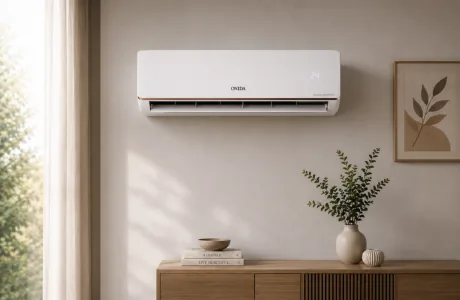

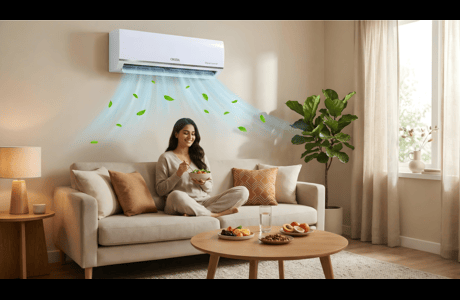
As summers in India grow hotter, the demand for cooling conflicts with sustainability goals. Inverter split ACs are vital in green home design. These systems exceed traditional cooling by intelligently adjusting compressor speed. This minimises energy waste while maintaining consistent comfort, essential for environmentally conscious households. Onida examines the significant influence of split inverter air conditioners on sustainable homes. It discusses how these units operate, their environmental advantages, and their role in modern households. From powerful 3-ton split ac to small units for bedrooms, see how inverter AC technology promotes eco-friendly living without sacrificing luxury.
Split inverter ACs improve home cooling by using variable-speed compressors that adjust according to real-time needs. This leads to a 30-50% reduction in electricity consumption compared to fixed-speed models. Instead of turning on and off suddenly, which wastes energy, inverters keep temperatures stable, reducing overall energy use and easing pressure on the power grid, making them ideal for those seeking the latest AC models. These systems also lower carbon footprints by using efficient R32 refrigerants with a low global warming potential (GWP 675 compared to R410A's 2088). 2-ton inverter split AC units demonstrate this effectively. They combine durable copper coils with anti-bacterial filters that reduce indoor pollutants. Onida's designs focus on IGBC-compliant features, ensuring a silent air conditioner for bedroom operation (under 30 dB) without harming the environment. Durability boosts sustainability, and fewer replacements lessen manufacturing impact. The latest air conditioners with Anti-Bacteria Filter technology target allergens, creating healthier homes that attain green certifications.
Yes, inverter split ACs are better for the environment than non-inverter split ACs. They reduce energy consumption and use more eco-friendly refrigerants. Non-inverters cycle on and off constantly, wasting energy and increasing CO2 emissions. In contrast, inverters adjust their operation, achieving up to 44% energy savings in unpredictable climates. A split AC with 100% copper coils enhances heat transfer and boosts efficiency, while recyclable copper further extends the product's lifespan. Which split air conditioner is best for sustainability? Inverter models equipped with PM2.5 filters and eco modes help reduce particulate matter. Onida integrates these features for better environmental performance. Lifecycle studies favour inverters: they last 12-15 years compared to 8-10 years for other types, reducing e-waste.
ISEER ratings (3.5-5.2) measure the efficiency of split inverter air conditioners. The top cooling air conditioners in India, such as Onida's models, achieve 5-star ratings and use 20-30% less electricity than 3-star non-inverters. Variable speed eliminates high startup power (70%), optimising 2-ton inverter split ACs for hot and humid conditions in India. When choosing the best AC to purchase in India, inverter models offer genuine savings of around ₹5,000-8,000 annually on 1.5-ton units used for 8 hours each day. The latest AC model prices reflect high efficiency (₹45,000+ for 5-star models). Copper coils improve thermal conductivity by 30%, reducing runtime. Smart thermostats in the latest models learn user habits, reducing idle power consumption.
Certainly. Inverter AC modulation reduces household emissions in accordance with energy savings, while R32’s low GWP enhances environmental benefits. A 3-ton split AC inverter can replace three individual room units, increasing efficiency and reducing grid demand.
Onida's silent air conditioners for bedrooms use ozone-safe gases, aligning with net-zero targets. Over their lifespans, inverters produce 40% less CO₂ than non-inverters. Want to reduce your carbon footprint? 5-star inverters compatible with solar power are ideal.
Architects include inverter split ACs in sustainable designs because of their ductless flexibility, which helps maintain insulation. Split ACs with 100% copper coils resist corrosion in coastal areas and withstand humid conditions. The best AC to purchase in India for eco-friendly homes is Onida's latest air conditioner with Anti-Bacteria Filter technology, which combines HEPA filtration for better indoor air quality without using extra power. Passive solar shading works alongside inverter adjustments, further lowering energy consumption. For example, IGBC Gold homes in Mumbai achieved a 50% reduction in cooling energy consumption through inverter split ACs.
Beyond efficiency, inverter ACs encourage sustainability through durability and smart features. AC models in India with IoT capabilities enable occupancy-based modulation, turning off when rooms are empty, saving 15%.
Silent air conditioners for bedrooms concentrate on low noise levels, enhancing sleep quality without using extra power. Anti-bacterial filters help reduce VOCs, supporting WELL building standards.
Absolutely, inverter ACs are good, especially for long-term living. The higher initial costs are recovered within 1-2 years. The best cooling air conditioner in India, like Onida's 5-star models, performs well during monsoons, effectively managing humidity.
Do inverter ACs help reduce electricity consumption long-term? Yes, their continuous modulation ensures they last longer than fixed-speed alternatives.
AI-optimised latest models predict energy requirements based on weather data, pushing efficiency boundaries further. The newest air conditioning models feature Phase Change Materials for enhanced passive cooling.
Onida sets the standard with R290 refrigerants, ensuring a future-proof solution with zero ozone depletion potential.
Yes, their superior modulation and green refrigerants result in 30-50% lower emissions.
Yes, through energy savings and low-GWP refrigerants, they significantly do.
Yes, they are ideal because they meet IGBC/LEED standards with their efficiency and indoor air quality improvements.
Longevity, smart controls, and reduced reliance on the grid promote eco-friendly practices.



Please dispose of e-waste and plastic waste responsibly.
For more information or e-waste pick up, please call 7490 9555 55 or
click here for more details.