
If your split AC is not cooling, the most common reasons are a dirty filter, a blocked outdoor unit, or a wrongly set thermostat. All of these can be fixed in minutes. In the harsh Indian summer (40–45°C, high dust), these three issues account for most AC cooling problems. If these do not resolve the issue, the issue might be low refrigerant, a dirty evaporator coil, or a compressor fault, which requires a licensed technician.
In this guide, Onida highlights 10 common reasons a split AC may not be cooling properly. It also explains when you need professional AC repair and maintenance. You can act without unnecessary service calls and ensure your best cooling air conditioner works well during the Indian summer.
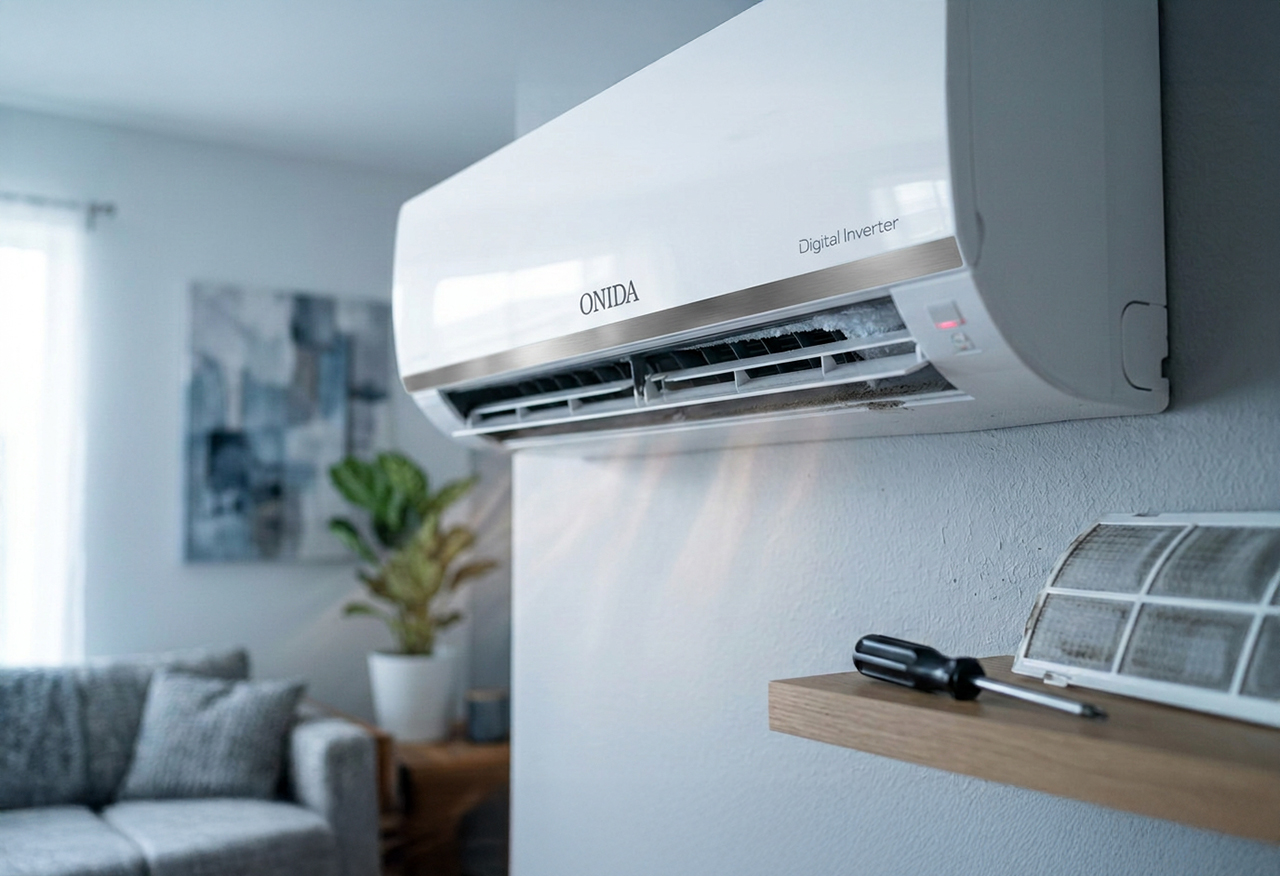
A clogged air filter is the main reason a split AC is not cooling effectively, and it's also the easiest to fix. A blocked filter reduces airflow, stops the evaporator coil from exchanging heat, and lowers cooling output. In dusty cities like Delhi and Ahmedabad, filters can clog in just 2–3 weeks during peak summer.
Clean filters every 2–4 weeks. A blocked filter can increase electricity consumption by 10–25%. Turn off the AC, remove the filters, rinse them with lukewarm water, air dry, and reinstall. Onida's inverter range includes filter cleaning alerts on selected models.
If the AC is running but the room stays warm, check the thermostat. The Fan Only mode (which often activates after a power cut) circulates air but does not cool. Set it to Cool at 24°C; temperatures above 26°C provide minimal cooling.
- Check 1: Ensure the mode is set to Cool, not Fan, Dry, or Auto.
- Check 2: Set the temperature to 24°C or lower. If it's set above 26°C, the compressor may not turn on.
- Check 3: Replace the remote batteries if the signals are erratic. This is a common cause of missed commands.
The outdoor condenser coil is responsible for expelling heat from the room. If it's blocked by a wall, overgrowth, or debris, heat can't escape, and the system loses cooling power. Maintain a 30cm clearance. At 45°C, a blocked unit can reduce the cooling capacity of a 1.5-ton AC by up to 20%.
Remove any obstructions around the outdoor unit. A unit that sits in direct afternoon sun can run 5–10% less efficiently. You can rinse the outer fins with a low-pressure hose to remove surface dust, but cleaning the internal condenser coil requires a professional. Annual coil washing as part of AC maintenance prevents long-term efficiency loss.
Refrigerant absorbs heat from the room air and releases it outside. If the refrigerant level drops due to a leak, the cooling capacity of the 1.5-ton AC in watts decreases, resulting in continuous running without reaching the set temperature. This is not a DIY fix since gas handling requires certified equipment and training.
- Symptom: A hissing or bubbling sound indicates gas escaping from a joint or pipe.
- Symptom: Ice on the indoor unit suggests low refrigerant has dropped the evaporator coil below freezing.
- Symptom: The AC runs constantly, but the room never reaches the set temperature. The compressor runs continuously, and cooling is permanently reduced. This is a classic sign of refrigerant deficiency.
- Symptom: The outdoor unit is warm, but the indoor unit is not cooling. This means the compressor runs but cannot finish the heat exchange.
If you suspect low refrigerant, do not delay. Running the AC with insufficient gas can stress the compressor and cause permanent damage. Contact a licensed technician for leak detection, repairs, and refrigerant recharge. Onida's inverter ACs use R32 refrigerant, which has zero ozone-depletion potential and is less harmful to the environment than R22 systems.
The table below summarises each split AC cooling problem, whether it's safe to fix at home, and the recommended action:
| Problem | DIY Safe? | Action |
| Dirty air filter | Yes | Clean or replace the filter yourself |
| Wrong thermostat mode/setting | Yes | Reset to Cool mode, 24°C |
| Outdoor unit blocked/dirty | Partial — fins only | Clear debris; call tech for coil wash |
| Clogged drain pipe (water dripping) | Yes | Flush the drain pipe with water or a wire |
| Room too large for the AC tonnage | Yes — adjust use | Add curtains, seal the room, and run a fan |
| Ice forming on the indoor unit | Partial | Turn off, let thaw, clean filter; call if recurring |
| Low refrigerant/gas leak | No — needs certification | Call a licensed technician immediately |
| Compressor not starting/tripping | No | Call technician — electrical fault |
| Unusual hissing or bubbling noise | No | Refrigerant leak — call a technician |
| Voltage fluctuation is causing trips | Partial | Check stabiliser; call an electrician if recurring |
The rule of thumb is that anything involving refrigerant, the compressor, or electrical components is not a DIY task. These require specialised tools and can be dangerous. Filter cleaning, drain flushing, and thermostat checks are safe to do yourself.
To keep your best cooling air conditioner working well during the Indian summer, follow a structured AC maintenance checklist. Most expensive technician visits can be avoided with routine care.
- Every 2–4 weeks: Remove and rinse the indoor unit filters. Air dry them before reinstalling.
- Before summer (February–March): Schedule a full service that includes coil washing, drain flushing, refrigerant check, and electrical inspection.
- Monthly during summer: Check for and clear debris or overgrowth around the outdoor unit.
- When starting up after a long gap: Run the AC for 10 minutes. Cool air should flow within 5 minutes. If it doesn't, clean the filter and check the thermostat.
- Annually: A technician should check the refrigerant level. Onida's inverter range uses copper coils, which resist corrosion better than aluminium.
For AC maintenance services near you, Onida's authorised service network covers all major Indian cities. You can book through onida.com. Onida's inverter models come with a 1-year comprehensive warranty, a 5-year PCB warranty, and a 10-year compressor warranty. Check out the range at onida.com.



Please dispose of e-waste and plastic waste responsibly.
For more information or e-waste pick up, please call 7490 9555 55 or
click here for more details.