
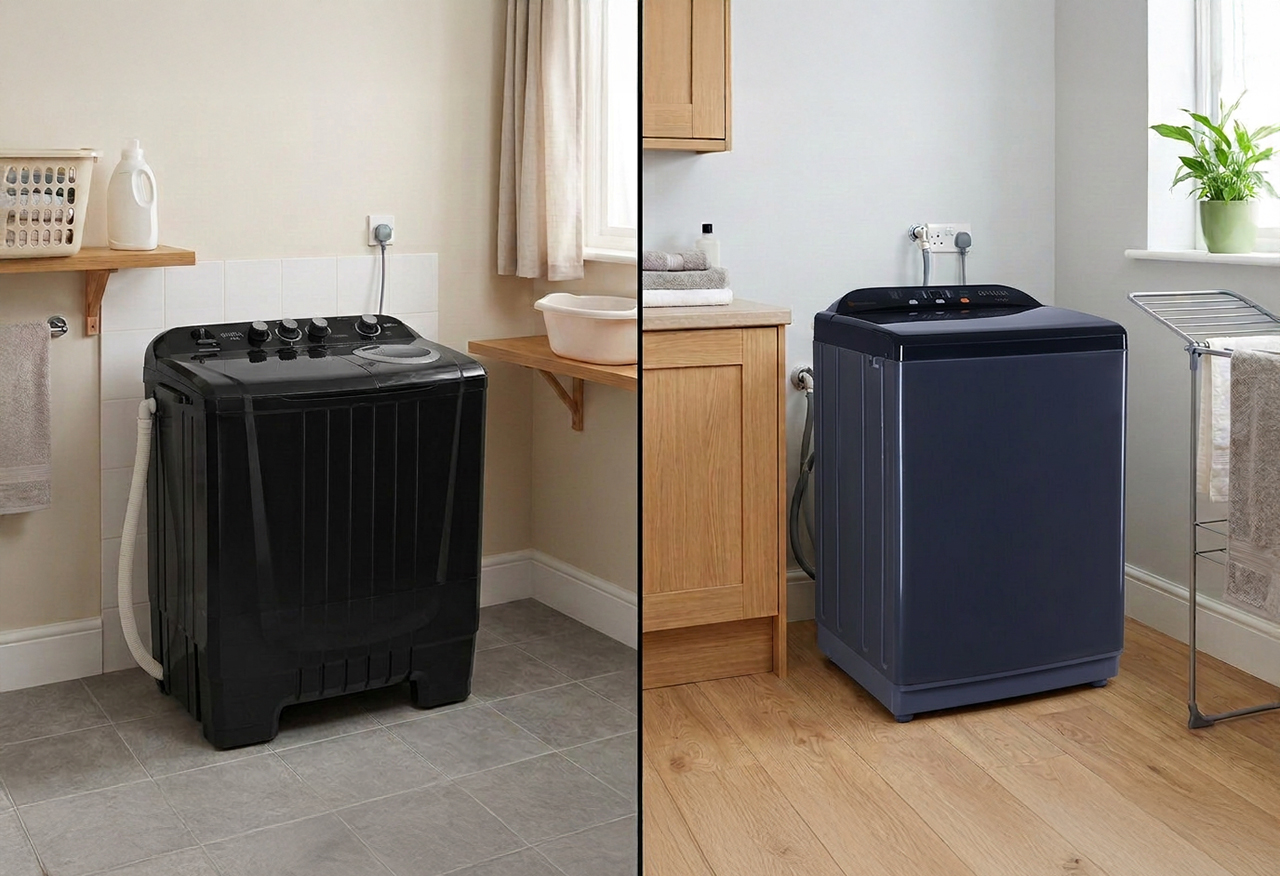
Buying a washing machine is one of the smartest investments an Indian household can make. However, choosing between a semi-automatic washing machine and a fully automatic washing machine can be quite confusing. Both clean your clothes. They come in various capacities and price points. But they operate differently, fit different lifestyles, and have distinct effects on your water bill, electricity use, and daily effort. At Onida, we know that for many Indian families, from small urban apartments with limited water supply to larger homes, with help, the best washing machine isn't necessarily the most expensive but rather the one that fits your actual lifestyle.
In this blog, Onida explores the automatic vs semi-automatic washing machine debate across all important areas: upfront cost, running costs, water use, ease of use, and long-term value. Whether you are considering a semi-automatic model for a tight budget or a fully automatic option for hands-free use, this guide will help you make a confident choice.
A fully automatic washing machine is better for urban households with a reliable water supply and a desire for convenience. A semi-automatic is better for homes with inconsistent water supply, tighter budgets, or lower daily laundry needs.
A semi-automatic washing machine needs manual input; you fill the water, transfer clothes between the wash and spin tubs, and drain the water yourself. It costs between ₹8,000 and ₹18,000 and uses 30–40% less water than a comparable automatic model. A fully automatic washing machine, whether top load or front load, handles the entire process without your help once the load is set, with prices starting at ₹18,000 for dependable top-load models. If your household has steady water and consistent electricity, the fully automatic machine may justify the additional cost. If water supply is unreliable or you are working with a strict budget, Onida’s semi-automatic washing machine provides great cleaning without extra expense.
A semi-automatic washing machine is a twin-tub unit: one tub washes, while a smaller, separate tub spins and drains. You manually fill the wash tub, add detergent, set the timer, and after the wash cycle, move the clothes by hand to the spin tub to extract water.
Typical features of a semi-automatic washing machine include:
- Twin-tub design (wash tub + spin tub)
- Manual water fill and drain
- Wash and spin timers
- Multiple wash programs (gentle, normal, strong)
- Capacity range: 6–10 kg
- Price range: ₹8,000–₹18,000
The semi-automatic washing machine's key strength is its independence from plumbing, making it a practical choice for Indian homes with unreliable water supply. Onida’s semi-automatic washing machines feature powerful motors and stainless-steel spin tubs, designed to handle hard water and voltage fluctuations common in many regions of India.
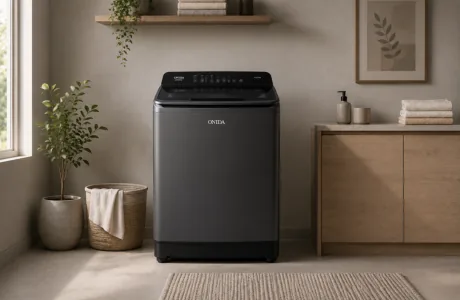
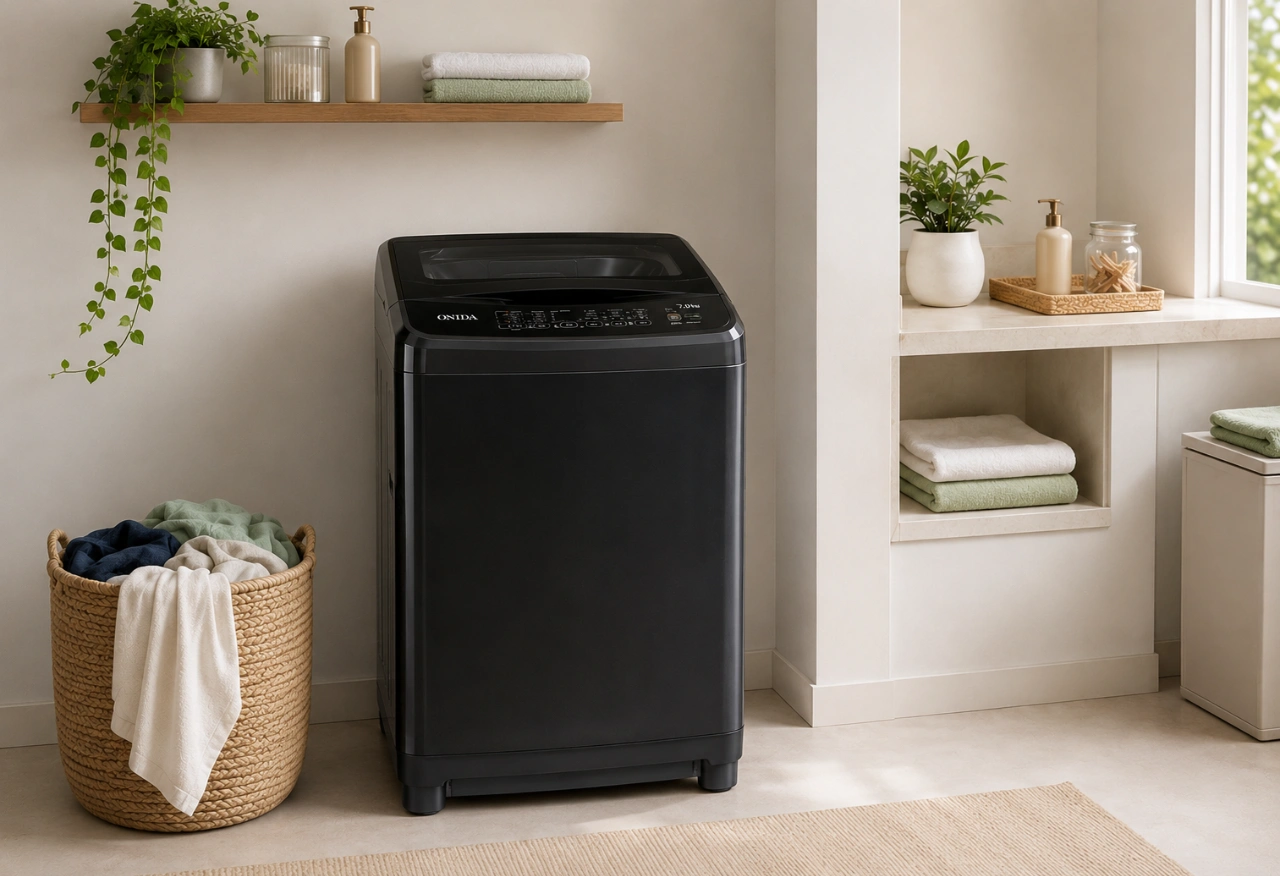
A fully automatic washing machine, whether top-load or front-load, is a single-tub appliance that performs washing, rinsing, and spinning in a single automated sequence. You load the clothes, add detergent, choose a program, and the machine takes care of the rest.
The types of washing machines in the fully automatic category include:
- Fully Automatic Top Load Washing Machine: Loaded from the top, these machines are faster, easier to use, and the most popular automatic washing machine type in India. Prices start around ₹18,000–₹22,000 for reliable branded models.
- Front Load Fully Automatic: These models use 40–60% less water per cycle than top-load models and are gentler on fabrics. Many include a built-in dryer function. Prices range from ₹28,000 to ₹65,000 and higher.
Features of automatic washing machines typically include multiple wash programs, direct water inlet connection, built-in sensors, delay start, child lock, and BEE star ratings of 3–5 stars on leading models.
A fully automatic washing machine eliminates manual effort from laundry, but requires a steady water supply and a stable power supply to work properly. Onida’s range includes fully automatic top-load and front-load options with BEE-rated motors and voltage protection made for Indian grid conditions.
Water use is crucial for Indian households, especially where supply is metered or affected by seasonal shortages.
A semi-automatic washing machine uses about 80–120 litres per cycle, as water is added manually, and users typically fill only as much as needed. A fully automatic top-load washing machine uses 130–180 litres per cycle. Front-load fully automatics are the most efficient, using just 45–65 litres per cycle through tumbling action.
For homes in water-scarce cities like Chennai, Bengaluru, or Hyderabad, a semi-automatic or front-load fully automatic machine offers the best water efficiency. Onida’s semi-automatic washing machines are designed for effective cleaning with lower water amounts, reducing waste without compromising wash performance.
| Factor | Semi-Automatic Washing Machine | Fully Automatic Washing Machine |
| Operation | Manual water fill, tub transfer | Fully automated, one-touch |
| Price range (India) | ₹8,000–₹18,000 | ₹18,000–₹65,000+ |
| Water per cycle | 80–120 liters | 45–180 litres (front-load lowest) |
| Electricity consumption | 300–500W | 400–2,000W (varies by type) |
| Works with intermittent supply | Yes | No |
| Manual effort required | High | None |
| Wash programs | Basic | Multiple (cotton, delicate, quick, steam) |
| Dryer function | No | Yes, on front-load models |
| BEE star rating | Not applicable | 3–5 star |
| Plumbing needed | No | Yes |
| Portability | High | Fixed |
| Best for | Budget buyers, irregular water supply | Urban homes, stable water and power |
A semi-automatic washing machine is ideal for homes with irregular water supply or overhead tanks, common challenges in many Tier-2 and Tier-3 cities and rural India. It is also a good choice for buyers with a budget below ₹18,000, for renters who prefer a portable appliance, and for families who want to wash heavily soiled clothes separately from lighter loads.A semi-automatic washing machine provides excellent value and quality cleaning when your household’s setup and daily routine suit the manual process. Onida’s models come in 6.5 kg, 7.5 kg, and 8 kg capacities, with stainless-steel spin tubs and motors that work well with hard water. Check Onida’s semi-automatic washing machine range to compare capacities and programs.
A fully automatic washing machine is suited for urban households with a reliable municipal water connection, steady electricity, and busy lifestyles. Dual-income families and working professionals will find that a fully automatic model takes one of the more time-consuming household tasks off their hands.A fully automatic top-load washing machine provides a practical entry point. It has faster cycle times and easier operation, starting at ₹18,000–₹22,000. Front-load models with dryer functions are ideal for high-humidity cities like Mumbai or Kolkata, where air-drying clothes during the monsoon is impractical.An inverter motor fully automatic washing machine cuts electricity use by 30–40% compared to non-inverter models of the same size, making the BEE star rating an essential factor to consider before buying. Onida’s automatic machines include BEE-rated inverter models with voltage protection. Explore Onida’s fully automatic washing machine range to find the right fit for your home.
Considering these four factors will guide you to the right choice across all types of washing machines:- Water supply: Continuous municipal connection? Choose fully automatic. Overhead tank or supply cuts? Choose semi-automatic.- Budget: Under ₹18,000 — semi-automatic. ₹18,000–₹28,000 — fully automatic top load. Above ₹28,000 — front-load automatic with dryer.- Family size: 2–4 members: 6–7 kg. 4–6 members: 7.5–8.5 kg. Larger families: 9–10 kg.- BEE rating and voltage: For fully automatic, prioritise 4-star or 5-star BEE-rated models with inverter motors. In cities with frequent voltage changes, select a model with built-in protection. Onida washing machines are designed to handle India's fluctuating power supply without the need for an external stabiliser.The key factor in choosing a washing machine is your home’s water supply, which determines whether a fully automatic model is feasible before considering budget or features. Visit onida.com/washing-machines to filter by type, capacity, and BEE rating.
A semi-automatic washing machine requires manual water filling and moving clothes between the wash and spin tubs. In contrast, a fully automatic washing machine completes the entire wash-rinse-spin cycle with a single button press. Semi-automatics cost ₹8,000–₹18,000 and are ideal for homes with irregular water supply; fully automatics start at ₹18,000 and require a stable water source.
A front-load, fully automatic washing machine uses the least water. It needs about 45 to 65 litres per cycle, compared to 130 to 180 litres for a top-load automatic and 80 to 120 litres for a semi-automatic washing machine. For water-scarce Indian cities like Chennai or Bengaluru, a front-load automatic is the most efficient choice. A manually filled semi-automatic follows closely behind.
Yes, a semi-automatic washing machine is definitely worth it for the right household. It costs much less upfront, uses less water, doesn't require direct plumbing, and is easy to repair. For families in Tier-2 or Tier-3 cities, or those with a budget under ₹18,000, Onida's semi-automatic washing machine range delivers reliable wash quality at truly accessible prices.
Yes, a semi-automatic washing machine is designed to be filled with water directly, which is how it is meant to operate. Most models also have an inlet pipe for tap or tank supply, but buckets of stored water can work just as well. This flexibility is why semi-automatic washing machines remain popular in Indian homes with an inconsistent water supply.
The water supply is the most important factor. A fully automatic washing machine cannot work without a steady, direct water connection. After confirming the supply, prioritise capacity that matches family size, the BEE star rating for electricity costs, and whether a washing machine with a dryer function is needed for high-humidity areas or homes without outdoor drying space.
For urban Indian homes with a steady water supply, a fully automatic top-load washing machine offers the best balance of convenience, wash quality, and price. For homes with irregular supply or tighter budgets, a semi-automatic washing machine is a better fit. Onida offers strong options across both types of washing machines and a range of capacities to suit different Indian households.



Please dispose of e-waste and plastic waste responsibly.
For more information or e-waste pick up, please call 7490 9555 55 or
click here for more details.