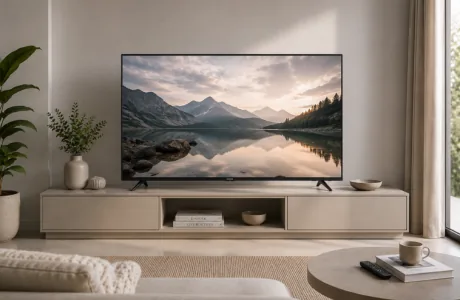

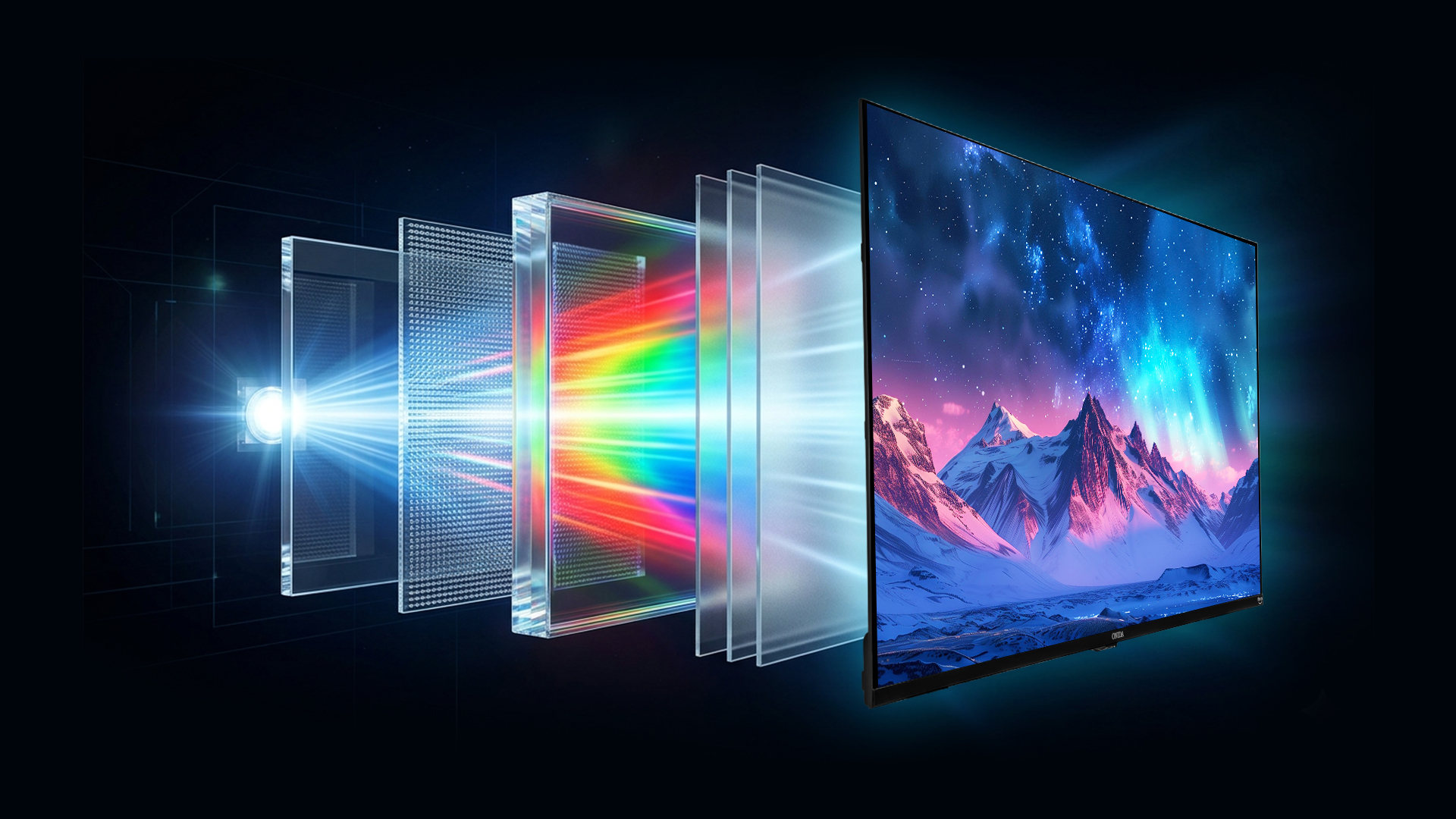
In this guide, Onida explains what makes a QLED TV look different from a standard LED TV, why this difference matters in an Indian living room, and how to choose the right screen size and model from the Onida NexG QLED range. The term "quantum dot" has become one of the most commonly used and misunderstood terms in the TV industry. This guide provides the technical details behind it in simple terms.
A QLED TV improves picture quality over a standard LED TV by adding a layer of quantum dots, which are semiconductor nanocrystals, between the LED backlight and the LCD panel. This setup allows the TV to cover up to 100% of the DCI-P3 colour space, reach peak brightness of 1,000 to 2,000 nits in HDR content, and maintain colour accuracy across a wider range of brightness levels compared to a typical LED panel. The result is richer reds, deeper greens, and more precise blues, especially noticeable in HDR films, bright sports events, and sunlit scenes. Onida's NexG QLED range, available in 32-inch, 43-inch, 50-inch, and 55-inch formats, brings this technology to Indian homes starting from ₹15,990. Here is how it works.
A quantum dot is a semiconductor nanocrystal, a particle measuring between 2 and 10 nanometres in diameter. At this scale, quantum mechanical effects determine how it interacts with light. When light from an LED backlight hits a quantum dot, the dot absorbs that energy and emits a very specific wavelength of coloured light. The emitted colour depends entirely on the dot's size: smaller dots emit blue light, medium dots produce green, and larger dots emit red.
In a QLED TV, a film with millions of these quantum dots sits between the blue LED backlight and the LCD panel. The blue LEDs excite the quantum dot film, converting that energy into a near-perfect, full-spectrum white light, which is a blend of red, green, and blue at precise, consistent wavelengths. This full-spectrum white light enables the LCD panel's colour filters to accurately reproduce billions of colours. A standard LED TV without quantum dots produces less pure white light, limiting the range of colours the display can reproduce.
Quantum dot technology was commercially introduced in 2013 and has since been adopted across the TV industry. Onida's NexG series uses Quantum Dot display technology along with the Pixa Visual Engine, a real-time image processing layer that improves contrast, colour accuracy, and reduces noise across all types of content.
The improvement from a standard LED TV to a 4K QLED TV occurs in three main areas: colour volume, peak brightness, and colour accuracy.
Colour volume refers to a display's ability to reproduce accurate, saturated colours in both bright and dim/mid-tone scenes. A standard LED TV covers about 70-80% of the DCI-P3 colour space used in streaming and cinema. A good QLED TV approaches 100% of the DCI-P3 colour gamut. In practice, the deep red of a sunset, the vibrant green of a cricket pitch, and the vivid blue of the ocean appear as rich as HDR content is intended to show, rather than as washed-out versions.
HDR content has peak brightness information that standard LED TVs cannot display. A typical LED TV reaches 300-500 nits of peak brightness. A QLED TV with local dimming can reach 1,000 to 2,000 nits in HDR highlight areas, making bright highlights, like sunlight on water or stadium floodlights, look vibrant instead of flat. For Indian living rooms that have strong ambient light during the day, this brightness advantage is significant; a QLED panel remains clearly visible and vivid even in sunlight.
Because the quantum dot film produces purer primary colours than a regular LED backlight, the LCD panel's colour filters have more accurate light to work with. Mixed colours, such as skin tones, gradients, and varying hues, are reproduced with greater precision. Onida's Pixa Visual Engine, integrated into the NexG QLED range, adds real-time processing that enhances contrast and reduces noise across all content types.
For buyers considering a QLED TV in India versus standard LED or high-end OLED options, the comparison below covers all aspects that affect real picture quality, price, and longevity.
| Feature | Standard LED TV | QLED TV | OLED TV |
| Display technology | LED backlight + LCD panel (no quantum dots) | LED backlight + Quantum Dot film + LCD panel | Organic self-emitting pixels — no backlight |
| Peak brightness | 300–500 nits typical | 1,000–2,000 nits (HDR models) | 600–1,000 nits (modern OLED); historically dimmer |
| Black levels | Limited — backlight bleeds into dark areas | Improved with local dimming; not true black | True black — individual pixels switch off |
| Colour volume | 70–80% DCI-P3 typical | ~100% DCI-P3 colour space | Wide and accurate — no saturation boost needed |
| Contrast ratio | 1,000:1 to 4,000:1 | 6,000:1 to 50,000:1 (local dimming) | Infinite — pixel off = true black |
| Screen burn-in risk | None | None — inorganic quantum dot materials | Low in normal use; risk with static images |
| Viewing angle | Narrower — colour shifts beyond 30–45° | Up to 170° before colour/brightness drop | Up to 178° — most consistent off-axis picture |
| Lifespan | 50,000–60,000 hours | 50,000+ hours — inorganic dots are stable | 50,000–100,000 hours (modern OLED) |
| India price range (43"–55") | ₹18,000–₹35,000 | ₹26,000–₹60,000+ (varies by brand/size) | ₹80,000–₹2,50,000+ (entry to premium) |
| Best for | Budget buyers; bedrooms; HD content | Bright living rooms; sport; HDR; Indian sunlight | Home cinema, dark rooms, cinephiles, premium gaming |
| Onida models available | Yes — Nexg 4K Ultra HD Google TV series | Yes — NexG QLED (QZ32HI, QZ43UI, QZ50UI, QZ55UI) | Not in the current Onida range |
This mainly depends on one factor: the room's ambient light. OLED panels offer better black levels and nearly infinite contrast, making them the preferred choice for home cinema in dark environments. In a dark room, an OLED's pixel-level light control produces blacks that a QLED panel cannot fully match.
However, Indian living rooms are rarely dark during the day. Most Indian homes have open windows and natural light coming in from different directions for much of the year. In these settings, a QLED TV's brightness edge, reaching up to 2,000 nits compared to a typical OLED's 600 to 800 nits, is a significant advantage. A QLED panel in a bright room looks more vibrant than an OLED panel, which can appear washed out by ambient light. This makes QLED the better option for daytime viewing, live sports, and family use in an average Indian living room, all at a lower cost than comparable OLED models.
There’s also the burn-in concern. OLED panels use organic materials that can suffer from permanent image retention with continuous static content, such as news tickers or sports scoreboards. QLED TVs use inorganic quantum dot materials, which do not suffer from burn-in, providing peace of mind for households that use their TV for long hours with varied content.
A QLED TV can be more comfortable for long viewing sessions than a standard LED panel for two main reasons: its better colour accuracy and improved local dimming, which address backlight uniformity issues.
Eye strain from watching TV usually occurs due to excessive brightness relative to surrounding light, backlight flickering, or colours that the eye has to adjust to over time. In terms of brightness, a QLED TV with adaptive brightness adjusts its peak brightness to match the room's lighting, reducing contrast between the screen and its surroundings. Onida's NexG QLED range supports HDR10, which uses ambient light data to optimise brightness on compatible content.
Regarding colour accuracy, QLED TVs produce more accurate primary colours, resulting in a white balance closer to the 6500K standard, which looks most natural to the human eye. Watching on an inaccurately calibrated LED panel, where whites can appear slightly blue or yellow, can lead to gradual visual fatigue during long sessions. The Onida NexG 55 and 50 QLED models support Dolby Vision and HDR10, ensuring content displays as intended by its creators.
QLED lifespan is one of the biggest advantages of this technology. Since quantum dots are made from inorganic materials, they don’t degrade as organic compounds do. QLED TVs are rated for 50,000 hours of use over 17 years, with 8 hours of daily viewing, without significant loss in colour or brightness. Standard LED TVs have similar lifespans because both use comparable inorganic backlights.
OLED TVs, which use organic materials in their self-emitting pixels, are rated for 50,000–100,000 hours with current manufacturing methods. The main concern for OLED in Indian conditions is screen burn-in from prolonged static images, a risk that doesn’t apply to QLED technology at all.
Onida provides a one-year comprehensive warranty for its NexG QLED range. The NexG series, which represents Onida’s latest QLED TVs in India, is engineered for Indian power conditions, including the voltage fluctuations common in Indian cities, which can harm sensitive display electronics in lower-quality panels.
Onida's NexG QLED range is currently India's most affordable entry point for Quantum Dot display technology, starting at ₹15,990 for the 32-inch QLED TV (QZ32HI) and going up to ₹43,990 for the 55-inch KY Rock variant (QZ55UIT-R). All models run Google TV, include Google Assistant and Chromecast, support HDR10, and feature the Pixa Visual Engine for smart picture processing.
For a bedroom or guest room (up to 120 sq. ft.): The Onida NexG 32-inch QLED TV (QZ32HI, ₹15,990) is India’s first 32-inch QLED Google TV, offering Quantum Dot picture quality in a compact size, where most competitors have standard LED at this price. It features HD resolution with HDR10, Google TV, Chromecast, and the Pixa Visual Engine.
For a medium living or dining room (120–180 sq. ft.): The Onida NexG 43-inch QLED TV (QZ43UI, ₹30,990) and the 50-inch QLED TV (QZ50UI, ₹36,990) provide a 4K Ultra HD QLED display with 3840×2160 resolution, 60Hz refresh rate, HDR10, Dolby Vision, Dolby Atmos-tuned 24W speakers, MEMC motion smoothing, 4-way swing, and a bezel-less design.
For a large living room or hall (180 sq. ft. and above): The Onida NexG 55 4K QLED Google TV (QZ55UI, ₹42,990) features a 55-inch 4K QLED panel with full Dolby Vision and Dolby Atmos, 24W speakers, MEMC, and the Pixa Visual Engine. At ₹42,990, it offers great value in Onida's lineup for buyers seeking true Quantum Dot picture quality at a lower cost than premium global QLED brands for the same size.
You can explore the complete Onida QLED TV range or browse the full Onida TV range, including 4K Ultra HD, Full HD, and Mini LED options to find the best model for your room and budget.
Quantum Dot Technology uses semiconductor nanocrystals placed between the LED backlight and LCD panel. These nanocrystals convert backlight energy into purer red, green, and blue light, enabling the TV to display a wider, more accurate range of colours. The size of each dot determines the colour wavelength emitted: smaller dots emit blue, medium dots emit green, and larger dots emit red. This creates full-spectrum white light, helping the display cover nearly 100% of the DCI-P3 colour space used in cinema and HDR streaming content.
A QLED TV delivers richer colours, higher peak brightness, and better colour accuracy than a standard LED TV. The quantum dot film produces purer primary colours for the display's colour filters. Standard LED TVs usually cover 70–80% of DCI-P3 and achieve peak brightness of 300–500 nits. A good QLED reaches about 100% DCI-P3 and 1,000–2,000 nits in HDR highlights, which makes a noticeable difference in HDR films, sports, and content with bright, vivid colours.
OLED excels in black levels and contrast in dark rooms, while QLED shines in brightness, colour vibrancy, and performance in well-lit spaces, like typical Indian living rooms. OLED pixels turn off individually for true blacks, providing infinite contrast. QLED’s peak brightness reaches 2,000 nits, offering 100% colour volume and making it more vibrant in bright settings. For most Indian households, where rooms are bright for much of the day, QLED tends to deliver a more consistently impressive picture in real-world viewing conditions.
Yes, QLED TVs produce more vibrant, accurate colours and higher peak brightness than standard LED TVs. The quantum dot film allows nearly full coverage of the DCI-P3 cinema colour space, while peak brightness in HDR-capable models reaches 1,000–2,000 nits, compared to 300–500 nits in standard LED panels. The improvement is most noticeable in HDR streaming, live sports, and scenes with vivid colours.
QLED TVs in India range from about ₹15,990 for a 32-inch model to over ₹43,990 for a 55-inch version, based on Onida’s current NexG pricing. The Onida NexG QLED TV range, available in 32", 43", 50", and 55" sizes, starts at ₹15,990 (QZ32HI). Samsung, TCL, and other brands with QLED panels usually cost between ₹40,000 and ₹2,50,000 for comparable screen sizes, making Onida the most affordable option for QLED TVs in India.
A QLED TV is a good choice for anyone who frequently watches HDR content, views in a bright room, or wants more vivid colour than standard LED TVs offer, especially at a lower price than OLED TVs. The colour volume and brightness improvements are real and noticeable, particularly with HDR content, live sports, and movies. For Indian viewers in typical living-room environments, QLED’s brightness advantage and lack of burn-in make it a practical choice for everyday use.
Onida offers the most accessible QLED TVs in India for buyers seeking Quantum Dot quality without the premium brand cost. The Onida NexG QLED series (QZ32HI, QZ43UI, QZ50UI, QZ55UI) combines Quantum Dot display, Google TV, Pixa Visual Engine, Dolby Vision/Atmos, MEMC, and Google Assistant, starting from ₹15,990.
QLED TVs last around 50,000 hours, equivalent to over 17 years with eight hours of daily use, similar to standard LED TVs, because both use inorganic backlighting materials that don’t degrade much over time. The quantum dot film in QLEDs is made from stable inorganic semiconductors that don’t carry the burn-in or pixel degradation risks associated with organic OLED panels. Under typical household use, a QLED panel is among the most durable TV technologies available.



Please dispose of e-waste and plastic waste responsibly.
For more information or e-waste pick up, please call 7490 9555 55 or
click here for more details.