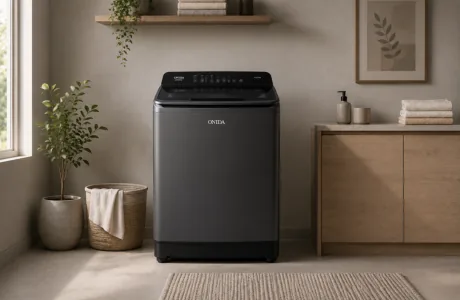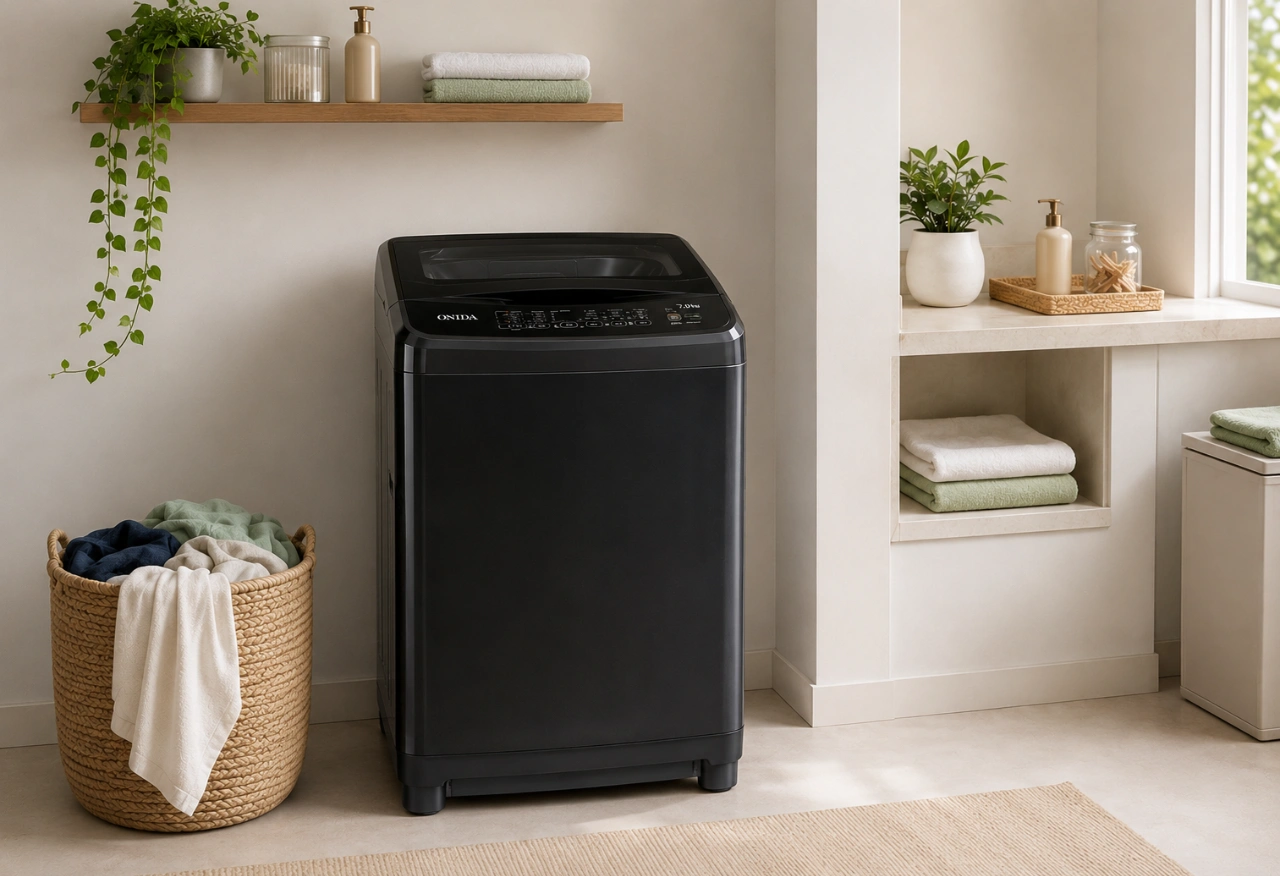

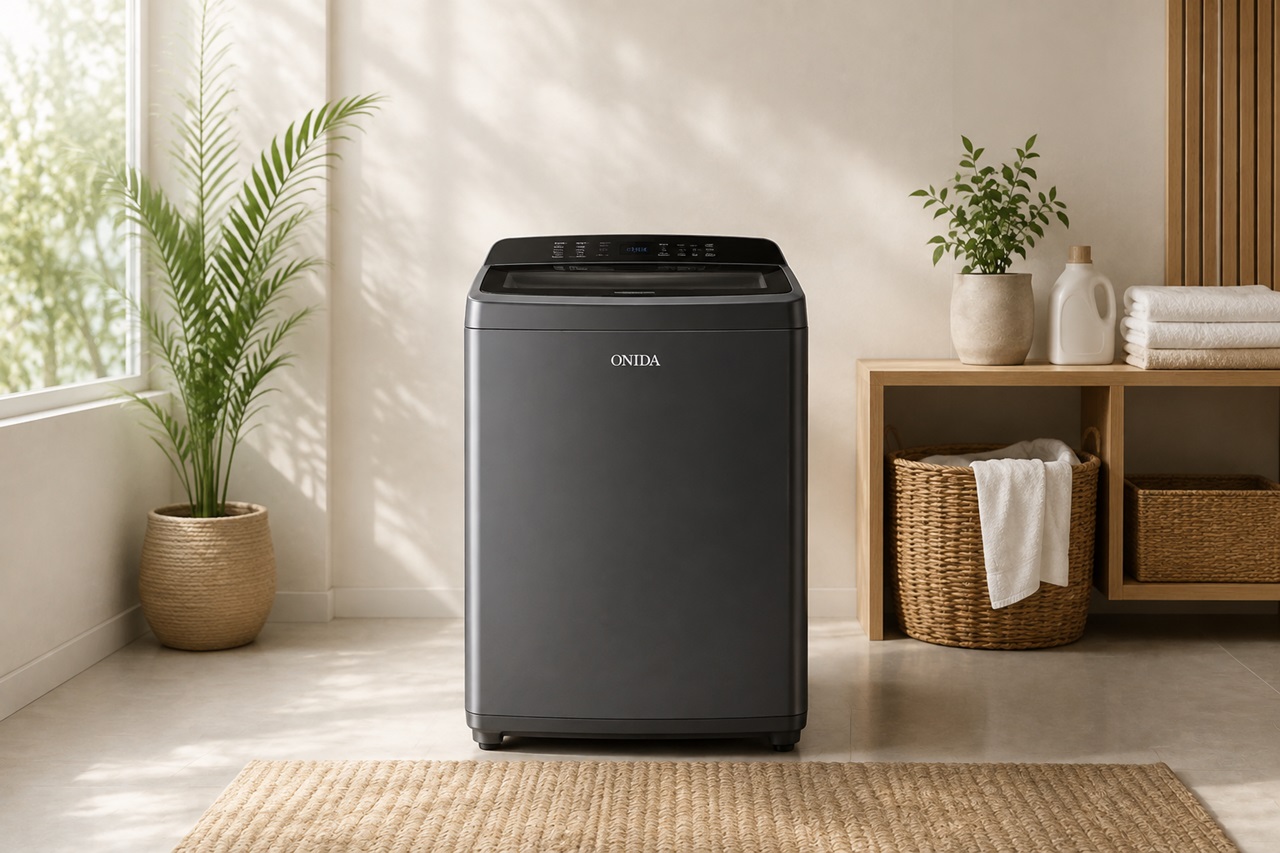
Doing laundry shouldn't be complicated, yet with so many types, capacities, and technologies available today, choosing the right washing machine can feel overwhelming. If you're exploring Onida washing machines for your home, this guide breaks down everything you need to know — from capacity and machine type to the technologies that make Onida a trusted name among washing machine companies in India.
Onida has built its washing machine range around a simple idea: laundry should be fast, fabric-safe, and energy-efficient, without unnecessary complexity. Whether you live alone, share a home with a partner, or manage laundry for a large joint family, there's an Onida model engineered around your routine rather than a one-size-fits-all approach.
Across the range, a few engineering choices stand out. Many Onida washing machines are built with a PCM metal body and anti-rust fibre construction, which helps the machine resist corrosion and hold up to years of daily use — an important consideration in humid Indian climates where lesser-built machines tend to rust quickly. Premium models add a toughened glass top, giving the machine a sturdier, more modern look without compromising durability.
This is usually the first fork in the road for any buyer.
Fully automatic washing machines handle washing, rinsing, and spinning in a single continuous cycle with minimal manual input. They're ideal if you want a "load it and walk away" experience. Onida's fully automatic range is available in both top load and front load formats, each equipped with multiple wash programs, energy-saving settings, and fabric-sensitive wash systems that adapt the cycle to the type of load you're washing.
Semi-automatic washing machines, on the other hand, give you more manual control over each stage — washing and spinning are handled in separate tubs. These machines tend to be more budget-friendly and use less water per cycle, making them a practical choice for households that are cost-conscious or have inconsistent water supply. Onida's semi-automatic lineup includes heavy-duty options built for large families with frequent, bulky loads.
If space and simplicity matter more than automation, Onida's single tub washers are worth a look. These compact machines combine washing and drying functions in one unit and are designed for students, working professionals, or small households that want a no-fuss laundry solution without a large footprint.
One of the most common buying mistakes is choosing a machine that's either too small (leading to overloading and poor wash quality) or too large (wasting water and electricity). Here's a simple way to think about it:
Getting the capacity right isn't just about convenience — it directly affects wash quality, energy consumption, and how often you need to run the machine.
Modern washing machines aren't just tubs with motors anymore, and Onida has packed in several features designed to improve both performance and fabric care:
Sensomatic Technology automatically senses the weight of your laundry load and adjusts the water level accordingly, so you're not wasting water on half-loads or under-filling for heavier ones.
Hexa-Crystal Drum design uses crystal-shaped ridges along the drum's inner wall to wash effectively while still being gentle on delicate fabrics — a detail that matters if your laundry includes anything beyond everyday cotton wear.
Waterfall technology, found across several models, creates dynamic water movement that helps dissolve detergent fully and improves foam formation, which in turn improves overall wash quality.
Air Dry / Power Dry technology helps remove excess moisture from clothes after washing, cutting down drying time without damaging delicate fabric — useful during monsoon months or in homes without outdoor drying space.
For families that want an extra layer of hygiene, select models come with an inbuilt heater, allowing you to wash with warm or hot water to help sanitize clothes and remove germs more effectively than a cold wash alone.
On the performance side, many models feature high-speed motors capable of spinning up to 1300 RPM, which shortens drying time by extracting more water during the spin cycle, while still operating quietly — some models run at noise levels as low as 56 decibels, roughly on par with normal background conversation.
Every washing machine you run adds to your monthly electricity bill, so the energy rating matters more than it might seem. When comparing options, check the BEE (Bureau of Energy Efficiency) star rating — Onida's fully and semi-automatic washing machines are BEE-tested and carry 5-star energy ratings, which translates to meaningful power savings over the life of the machine (note: single tub washers are exempt from BEE labelling requirements). Choosing a 5-star rated machine is one of the simplest ways to lower your long-term running costs while also reducing your environmental footprint.
There's no single "best" washing machine — only the one that's best suited to your household size, budget, and laundry habits. If you value hands-off convenience, a fully automatic top load or front load model is worth the investment. If you're looking to save on upfront cost and water usage, a semi-automatic machine gives you more control at a lower price point. And if space is tight, a compact single tub washer might be all you need.
Whichever route you take, features like Sensomatic Technology, a rust-resistant build, and a 5-star energy rating are worth prioritizing — they're the details that determine how well your machine performs years down the line, not just on day one. Explore the complete Onida washing machine range to compare capacities, formats, and features.
For a household of four to five members, a washing machine with a 7 to 8 kg capacity is generally recommended. This range comfortably handles daily laundry loads without overloading the drum.
A fully automatic machine completes washing, rinsing, and spinning in one continuous cycle with little manual intervention. A semi-automatic machine uses separate tubs for washing and spinning, requiring you to manually transfer clothes between stages, but typically at a lower cost and with lower water usage.
Yes. Onida's fully automatic and semi-automatic washing machines are BEE-certified and carry 5-star energy ratings, helping reduce electricity consumption over time. Single tub washers are not required to carry BEE labelling.
A standard wash cycle usually takes between 35 and 55 minutes, though the exact duration depends on load size, the wash program selected, and how heavily soiled the clothes are. Onida machines also offer quick wash options for faster turnaround.
Sensomatic Technology automatically senses the weight of your laundry load and adjusts the amount of water used for that cycle, helping avoid both water wastage and under-filling.
Onida washing machines are built with anti-rust fibre bodies and, in several models, a PCM metal body designed specifically to resist rust and corrosion, supporting long-term durability even in humid conditions.
Select Onida models come with an inbuilt heater that lets you wash with warm or hot water, which helps sanitize clothes and remove germs more effectively than a standard cold wash.
It depends on your priorities. A single tub washer is more compact and budget-friendly, suited to individuals or small households with simple laundry needs. A compact fully automatic machine offers more automation and wash programs but usually takes up more space and costs more.
Several Onida models are designed to operate at low noise levels — some as low as 56 decibels at maximum, which is roughly comparable to normal background conversation.
Top load machines are generally easier to load and often more affordable, while front load machines tend to offer more wash programs and can be gentler on fabrics. Your choice should depend on your budget, available space, and how many wash cycle options you want.



Please dispose of e-waste and plastic waste responsibly.
For more information or e-waste pick up, please call 7490 9555 55 or
click here for more details.