
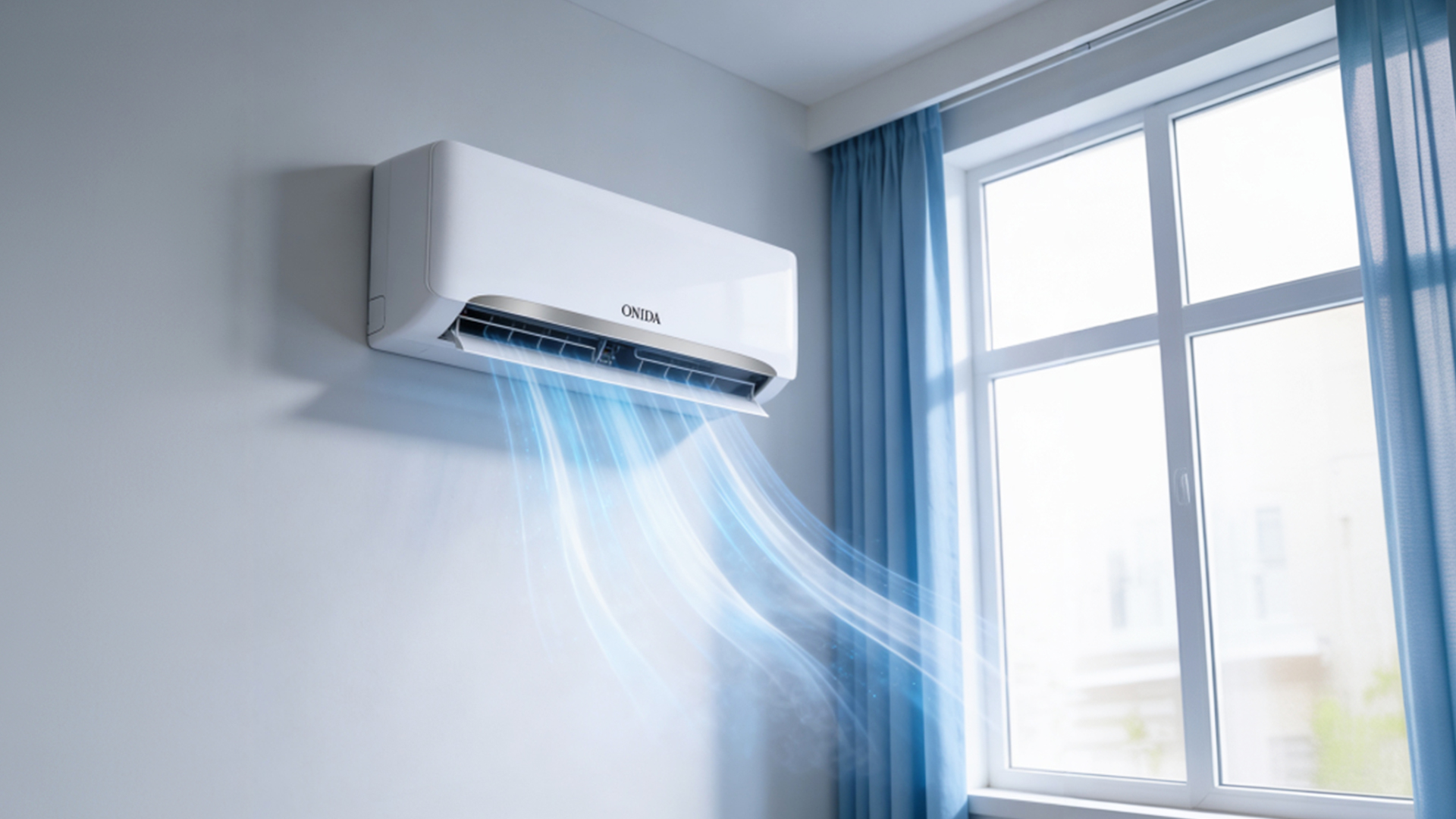
Your AC power consumption makes up 40 to 60% of your summer electricity bill, and the best solution costs nothing. Set the thermostat to 24°C instead of 18°C, and clean the filter every two to four weeks. Each degree below 24°C increases consumption by 6 to 8%; a blocked filter adds another 10 to 25%. These two simple habits alone can save you ₹400 to ₹700 every month before you spend a single penny on new equipment.
In this guide, Onida discusses everything that affects the energy use of a 1.5-ton split AC, including thermostat settings, filter care, differences between inverter AC vs non-inverter AC, and BEE star ratings. All figures use Indian electricity rates and BEE-published data.
The power consumption of a 1.5-ton split AC varies widely depending on the technology used. A standard non-inverter 3-star model consumes about 1.5 kWh per hour, while a 5-star inverter uses only 0.8 to 1.05 kWh. The same trend holds for 1-ton and 2-ton ACs; inverter technology consistently reduces consumption by 30-50% compared to fixed-speed models with the same cooling output.
| Capacity | Type & Star Rating | Approx. kWh/hr | Monthly bill (8 hrs, ₹7/unit) |
| 1 ton | Inverter 3-star | 0.7–0.9 | ₹1,176–1,512 |
| 1 ton | Inverter 5-star | 0.6–0.75 | ₹1,008–1,260 |
| 1.5 ton | Non-inverter 3-star | ~1.5 | ~₹2,700 |
| 1.5 ton | Inverter 3-star | 1.0–1.2 | ₹1,680–2,016 |
| 1.5 ton | Inverter 5-star | 0.8–1.05 | ₹1,344–1,764 |
| 2 ton | Inverter 3-star | 1.4–1.7 | ₹2,352–2,856 |
| 2 ton | Inverter 5-star | 1.1–1.4 | ₹1,848–2,352 |
Choosing a 5-star inverter over a 3-star non-inverter 1.5-ton model can save you ₹900 to ₹1,400 per month during peak summer. Always pick the tonnage that matches the room size first. An oversized AC cools too quickly and wastes power. Use a 1-ton unit for rooms up to 120 sq. ft., a 1.5-ton unit for 120 to 180 sq. ft., and a 2-ton unit for larger spaces.
Set your thermostat to 24°C, which is the BEE-recommended default. Every degree below 24°C increases your AC power consumption by 6 to 8%. Lowering the temperature from 24°C to 18°C increases the compressor load by 36-48%, and you are unlikely to notice a significant difference in comfort. Pair the AC with a ceiling fan. Fans help distribute cool air, allowing you to raise the thermostat by 2°C without feeling uncomfortable, saving an additional 12-16% on your bill.
Onida's Gloria Refresh and Majestic ranges include an iFeel sensor that detects room temperature at your location rather than the ceiling-mounted indoor unit, helping avoid unnecessary overcooling. This helps cut AC power consumption without manual adjustments. Explore the range at onida.com/product-category/air-conditioner/inverter-ac/.
Clean your AC filters every two to four weeks during peak summer. A clogged filter makes the unit work harder, increasing AC power consumption by 10-25%. In dusty Indian cities like Delhi, Pune, and Ahmedabad, cleaning them every two weeks is practical. Annual professional servicing booked in February or March, before the busy summer season, helps keep the coils and refrigerant in good working order, ensuring the AC operates all season efficiently.
Inverter ACs use 30-50% less electricity than fixed-speed non-inverter models in typical daily use in India. Inverter ACs now account for over 75% of all new AC sales in India, up from less than 1% in 2015. The variable-speed compressor adjusts its output continuously instead of switching on and off at full load, maintaining the temperature accurately and using power only as needed.
| Factor | Inverter AC | Non-Inverter AC |
| Compressor | Variable speed — adjusts to demand | On/off cycling at a fixed speed |
| kWh/hr (1.5 ton) | 0.8–1.2 | ~1.5 |
| Monthly bill savings | ₹700–1,300 less per month vs non-inverter | Higher running cost |
| BEE rating (Onida) | 3-star and 5-star | 2-star and 3-star |
| Voltage tolerance (Onida) | Stabiliser-free, wide voltage range | Narrower range; stabiliser often needed |
| Compressor warranty (Onida) | 10 years | Standard manufacturer warranty |
| Best for | Daily use 6+ hrs; heavy summer use | Occasional use; budget purchase |
Regarding maintenance, inverter compressors experience less wear due to on/off cycling, generally lasting longer. Onida covers all inverter AC compressors with a 10-year warranty, one of the longest available in India. For anyone using an AC more than 6 hours a day during the Indian summer, the inverter's electricity savings will pay back the higher initial cost within 3 to 6 years.
Beyond the basics of thermostat settings and filter maintenance, these habits can reduce daily AC power consumption at no cost to the equipment. Each tip works independently, but combining them can lead to greater savings.
Combining ceiling fan, curtain, and timer tips can reduce daily AC power consumption by 25-35% at no extra cost.
The BEE star label is the most reliable way to compare AC power consumption before buying. Every split AC sold in India since 2018 must show an ISEER (Indian Seasonal Energy Efficiency Ratio) value and annual energy use in kWh/year. A 5-star inverter model uses about 20-25% less electricity than a 3-star inverter of the same capacity. For a 1.5-ton model running 1,600 hours a year, that saves 200 to 250 kWh annually, which is worth ₹1,400 to ₹1,750 at ₹7/unit.
For low-power-consumption air conditioner models in 2025, Onida's Olympus (5-star, 1.5-ton), Majestic (3-star and 5-star, 1.5-ton), and Ziva (5-star, 1.5-ton) are worth comparing at beeindia.gov.in using their listed ISEER values. All Onida inverter models feature copper condenser coils and stabiliser-free operation to handle the voltage fluctuations common in India. Explore the full AC buying guide at onida.com/product-category/air-conditioner/.
Set the thermostat to 24°C, run a ceiling fan with the AC, and clean the filters every two to four weeks. These three habits can cut AC power consumption by 25-35% at no cost. For bigger savings, upgrade to a 5-star inverter model, which uses 30-50% less electricity than a non-inverter AC during the Indian summer.
24°C is the BEE-recommended setting. Every degree below 24°C adds 6-8% to your bill. Pair the AC with a ceiling fan to make 26°C feel like 23 °C. Raising the thermostat by 2°C saves 12-16% without sacrificing comfort. Onida's iFeel sensor models keep the temperature at your location precise, preventing over-cooling.
Yes, it does when outdoor temperatures drop below 27°C, which usually happens in most Indian cities outside of peak summer. Using a ceiling fan at night eliminates the AC's running costs entirely. In Delhi and coastal cities where temperatures are above 28°C at night, it's better to use sleep mode. This mode reduces overnight AC power consumption by 15-20% compared to a fixed 24°C setting.
Inverter ACs use 30-50% less electricity than fixed-speed (normal) ACs. A 1.5-ton inverter model with a 3-star rating uses about 1.0 to 1.2 kWh per hour, while a non-inverter 3-star model uses around 1.5 kWh. This can save you ₹700 to 1,000 per month if you run it for 8 hours each day. Onida offers both types; visit onida.com for their BEE-rated models.
You should clean the filters every two to four weeks during peak summer. Dirty filters can raise the AC's power consumption by 10 to 25%. In dusty Indian cities, it's practical to clean them every two weeks. Annual professional servicing, scheduled before March, keeps the coils clean and the refrigerant levels up, ensuring the AC runs at its rated BEE efficiency throughout the season.
For a 3-star non-inverter model, the monthly power consumption of a 1.5-ton split AC is about ₹2,700 when used for 8 hours a day at a rate of ₹7 per unit. In contrast, a 5-star inverter model costs between ₹1,344 and ₹1,764 per month, potentially saving you up to ₹1,350 monthly. The difference in electricity use for the 1.5-ton AC becomes even larger in hotter states, where the AC runs longer and at higher loads.
Yes, Onida's inverter range is designed for Indian conditions. It features stabiliser-free operation, cooling effective at 55°C, copper condenser coils, and BEE-certified 3-star and 5-star ratings. All inverter models include a 10-year compressor warranty. The Gloria Refresh and Majestic are popular 1.5-ton options, while the Olympus is the flagship 5-star model. Check onida.com for the latest models and pricing.



Please dispose of e-waste and plastic waste responsibly.
For more information or e-waste pick up, please call 7490 9555 55 or
click here for more details.