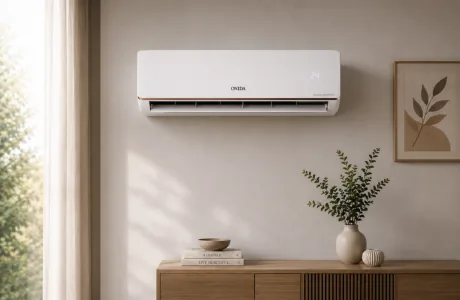

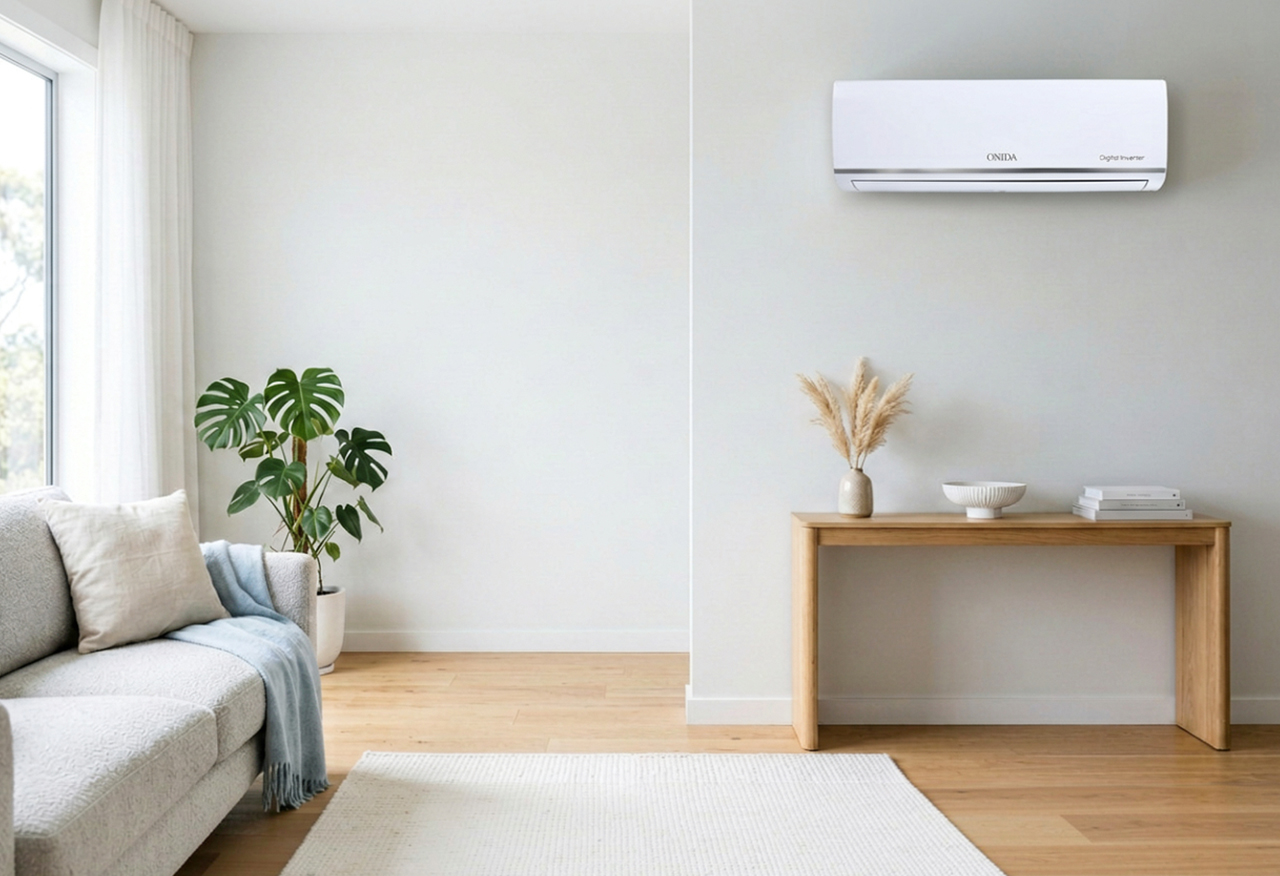
With Indian summers getting hotter every year, choosing the right air conditioner is no longer just about cooling it's about making a smart investment. Whether you're setting up a new home, upgrading an old unit, or shopping for a 1.5 ton AC for your bedroom or living room, the choices can feel overwhelming. Star ratings, inverter technology, copper coils, convertible modes — where does one even begin?
At Onida, we've been helping Indian families stay comfortable since 1981. As one of the most trusted names in the country, our range of energy-efficient inverter ACs is designed specifically for India's demanding climate. This guide will walk you through everything you need to know to make the right choice — and help you understand exactly how much electricity your new AC will consume.
The biggest upgrade you can make when buying an AC today is choosing an inverter model over a conventional fixed-speed unit. A traditional AC works like a switch — fully on or fully off. An inverter AC, by contrast, runs its compressor at variable speeds, continuously adjusting to maintain the exact temperature you set.
This makes all the difference for your electricity bill. When the room is almost at the desired temperature, an inverter compressor slows down rather than switching off and back on — which is the most energy-intensive moment in any AC's operation. The result: lower energy consumption, quieter operation, and a longer compressor life.
Onida's range of 1.5 ton inverter ACs are built with this core principle — smart, adaptive cooling that doesn't waste a single unit of electricity.
In India, the Bureau of Energy Efficiency (BEE) rates air conditioners on a 1-to-5-star scale. The higher the star rating, the more energy-efficient the unit. For inverter ACs, BEE uses the ISEER (Indian Seasonal Energy Efficiency Ratio) metric, which accounts for India's variable summer conditions.
Here's a simple way to think about it: a 5-star inverter AC consumes roughly 20–30% less electricity than a 3-star model running the same hours. Over a five-year period, that difference compounds into significant savings on your electricity bill.
Onida offers both 3-star and 5-star rated 1.5 ton split ACs. If you run your AC for more than 8 hours a day during summer, a 5-star model pays for its slightly higher price in energy savings within a couple of seasons.
One of the most common questions we hear is: "How much electricity does a 1.5 ton AC consume in 24 hours?" The honest answer depends on the star rating, the outdoor temperature, how well your room is insulated, and whether you're running the AC in energy-saving modes.
A 1.5 ton inverter AC generally uses between 0.7 and 1.0 units (kWh) per hour under typical Indian summer conditions. At ₹7 per unit (a common residential tariff across India), here's what your electricity bill looks like at various usage levels:
| Star Rating | Hours/Day | Units/Hour (approx.) | Daily Units (kWh) | Monthly Cost (₹@₹7/unit) |
| 3 Star | 8 hrs | 0.9–1.0 units | 7.2–8.0 units | ₹1,512–₹1,680 |
| 3 Star | 12 hrs | 0.9–1.0 units | 10.8–12.0 units | ₹2,268–₹2,520 |
| 5 Star | 8 hrs | 0.7–0.8 units | 5.6–6.4 units | ₹1,176–₹1,344 |
| 5 Star | 12 hrs | 0.7–0.8 units | 8.4–9.6 units | ₹1,764–₹2,016 |
| 5 Star | 24 hrs | 0.7–0.8 units | 16.8–19.2 units | ₹3,528–₹4,032 |
Figures are approximate. Actual consumption depends on room size, insulation, outdoor temperature, and thermostat settings.
The table above makes one thing clear: choosing a 5-star rated Onida inverter AC instead of a 3-star model can save you ₹300–₹500 every month during peak summer — adding up to ₹1,500–₹2,500 across a five-month season.
Running a 1.5 ton AC for 24 hours straight (as some households do in extreme heat) with a 5-star unit will consume approximately 16.8 to 19.2 units per day. While that sounds like a lot, it's significantly better than a non-inverter unit of the same capacity that would use 22–28 units for the same period.
Beyond star ratings and inverter technology, there are several features that separate a great AC from a good one. Here's a checklist of what Onida recommends looking for:
Key Features to Evaluate Before You Buy
Capacity matters as much as efficiency. An undersized AC will run at full load all day and consume more electricity. An oversized AC will cool the room too quickly without dehumidifying properly, leaving the air feeling clammy.
A 1.5 ton AC is ideal for rooms between 111 and 150 square feet — a standard Indian bedroom or mid-sized living room. If your room is smaller (under 100 sq. ft.), a 1 ton split AC may be sufficient. For larger living areas above 180 sq. ft., a 2-ton unit would serve you better.
Onida's range covers all these needs, with 1-ton, 1.5-ton, 1.6-ton, and 2-ton inverter models available — so you can match the capacity precisely to your room, and never pay for cooling you don't need.
Yes, significantly. During peak summer months (April–June) when temperatures in cities like Delhi, Nagpur, and Ahmedabad regularly cross 42–45°C, your AC's compressor works harder to maintain the set temperature. This means higher electricity consumption compared to milder months.
Onida's inverter compressor technology helps mitigate this by constantly modulating speed rather than running at full blast. However, good practices on your end also make a real difference: keeping curtains drawn during peak afternoon hours, using ceiling fans alongside the AC (which helps circulate cool air with less AC load), and setting the thermostat to 24°C rather than 18°C can reduce consumption by up to 30%.
The ideal thermostat setting recommended by BEE is 24°C — comfortable for most Indian adults and the single biggest lever you have on your electricity bill.
Since 1981, Onida has been present in Indian homes across every major city and town. While many global brands have entered the Indian market in recent years, Onida's advantage is straightforward: our products are designed for India, not adapted for it.
Our AC range features 100% copper coils as standard, extreme climate cooling that handles India's intense summers, anti-corrosive protection for coastal homes, and a service network that reaches across the country. The Everest and Olympus series of 1.5 ton split inverter ACs are consistently among the most favourably reviewed models in their price segment, praised for their reliable cooling, low noise levels (as quiet as 34 dB indoors), and responsive after-sales support.
If you're looking for the best AC for India — one that handles the heat, the humidity, the voltage fluctuations, and the long summers — Onida's inverter AC lineup is built from the ground up for exactly that.
Q1. How much electricity does a 1.5 ton AC consume in 24 hours?
A 1.5 ton inverter AC consumes approximately 16.8 to 19.2 units (kWh) when running continuously for 24 hours, assuming a 5-star rating. A 3-star unit in the same scenario would consume between 21.6 and 24 units. The actual figure varies based on outdoor temperature, room insulation, and thermostat setting.
Q2. What is the daily electricity cost of running a 1.5 ton AC for 8 hours?
At the common residential tariff of ₹7 per unit, an Onida 5-star 1.5 ton inverter AC running for 8 hours per day costs approximately ₹39–₹45 per day, or ₹1,170–₹1,350 per month. A 3-star model for the same usage would cost ₹50–₹58 per day, making the 5-star model the smarter long-term choice.
Q3. Is a 5-star inverter AC worth the higher price?
Yes, for most Indian households it is. If you run your AC for 6 or more hours daily during summer, a 5-star Onida inverter AC can save you ₹1,500–₹2,500 per season compared to a 3-star model. Over a 5-year lifespan, those savings more than offset the price difference, while you also benefit from quieter operation and longer compressor life.
Q4. What does 5-in-1 Convertible Cooling mean in Onida ACs?
Onida's 5-in-1 Convertible Cooling mode allows you to adjust the AC's cooling capacity across five levels — typically ranging from 40% to 110% of rated capacity. This means you can run the unit at a lower power setting when the room is lightly occupied or the weather is mild, reducing electricity consumption without sacrificing comfort. Onida's newer models offer up to 9-in-1 convertible modes for even finer control.
Q5. Does outdoor heat affect how many units a 1.5 ton AC consumes?
Yes. When outdoor temperatures exceed 40°C, your AC's compressor has to work harder to maintain the set indoor temperature, which increases electricity consumption. Onida's inverter ACs are engineered to operate efficiently even at extreme ambient temperatures up to 55°C, minimising the spike in consumption during peak summer. Setting your thermostat to 24°C also significantly reduces the load.
Q6. How can I calculate my monthly electricity bill for a 1.5 ton Onida AC?
The formula is straightforward: Monthly Bill = (AC wattage in kW) × (daily hours of use) × (number of days) × (electricity tariff per unit). For an Onida 5-star 1.5 ton inverter AC with an effective consumption of approximately 0.75 kW/hr, running 10 hours a day for 30 days at ₹7/unit: 0.75 × 10 × 30 × 7 = ₹1,575 per month. Actual consumption will vary, but this formula gives you a reliable estimate for budget planning.
Choosing an energy-efficient inverter AC isn't just about surviving the summer — it's about making an investment in comfort, savings, and sustainability. With Onida's range of 1.5 ton split inverter ACs, you get a product that's engineered for India's climate, backed by over four decades of trust, and designed to keep your electricity bills in check year after year.
Explore Onida's full range of inverter ACs at onida.com and find the model that's right for your room, your budget, and your lifestyle.
#IndiaKaOnida



Please dispose of e-waste and plastic waste responsibly.
For more information or e-waste pick up, please call 7490 9555 55 or
click here for more details.