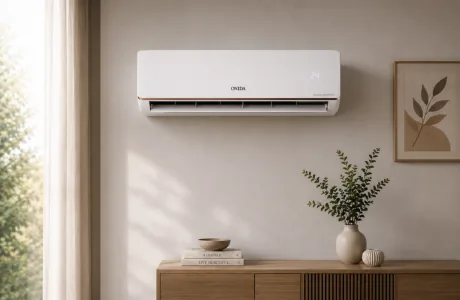

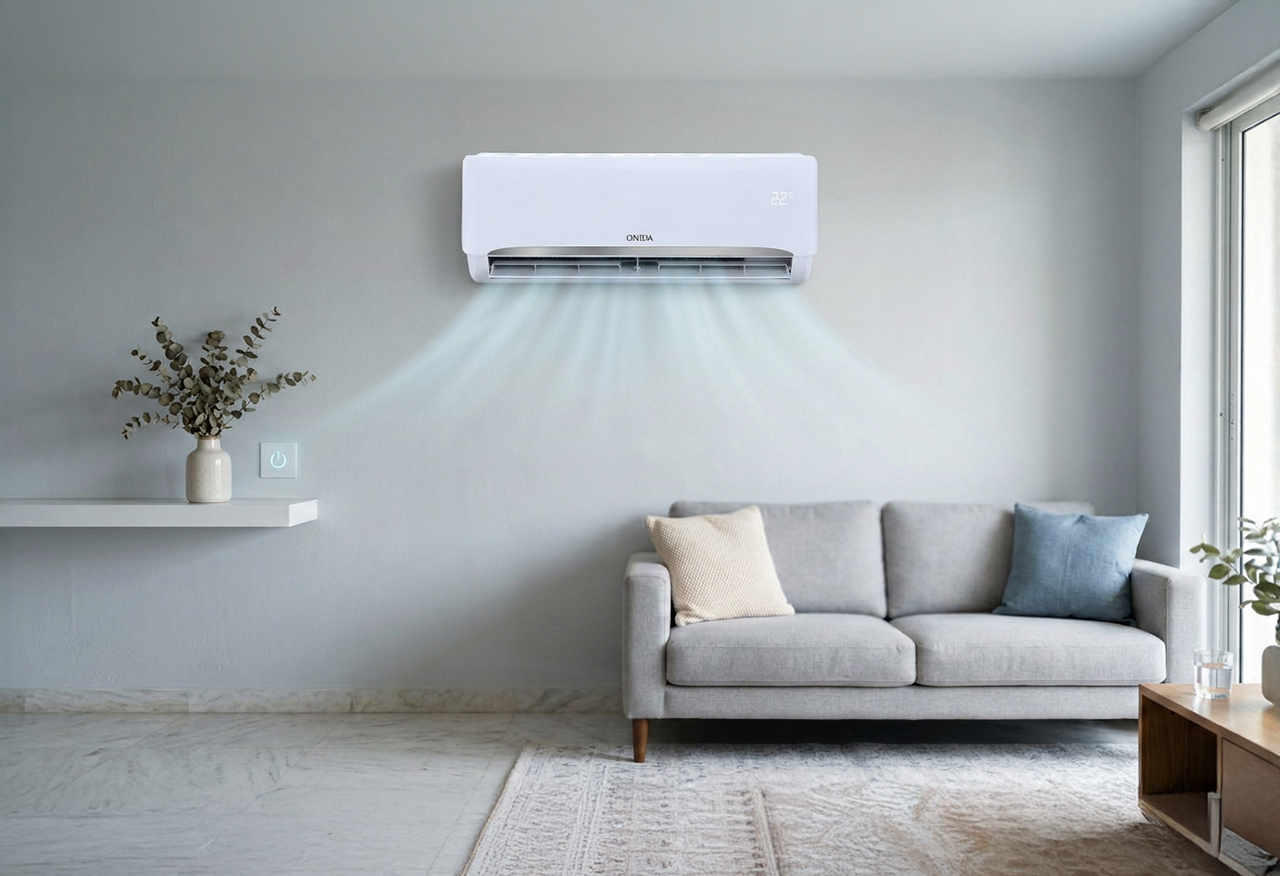
A 1.5-ton AC uses between 1.2 and 1.8 units (kWh) per hour, depending on its star rating, inverter technology, and room conditions. If you run a 1.5-ton AC for 24 hours, it consumes about 29-43 units (kWh), costing ₹203–₹302 at ₹7/unit. If you use it for 8 hours a day, it will consume 10-14 units, resulting in a monthly cost of ₹2,100–₹3,000. A 5-star inverter model is at the lower end, while a non-inverter 3-star is at the higher end.
In this guide, Onida details the exact daily power consumption of a 1.5-ton AC based on star rating and usage hours. You can learn how to calculate your electricity bill, which factors increase consumption during the peak Indian summer, and which Onida 1.5-ton inverter AC models have the lowest running costs in 2025–26. All figures in this blog are sourced from BEE-published ISEER data and verified State Electricity Regulatory Commission tariff orders.
To calculate the electricity use of a 1.5-ton AC per hour, use the formula: Power (kW) = (Tonnage × 3.517) ÷ ISEER. With current BEE-rated ISEER values for 1.5-ton models, this results in:
These are average figures. A 1.5-ton inverter AC does not run at a constant wattage. It changes compressor speed based on cooling demand. At startup or during peak afternoon heat (over 40°C), the draw can spike to 1,800W. As the room approaches the set temperature, it drops to 800–900W. The range of 1.2–1.8 kWh/hr reflects this variable draw, not a fixed amount.
The table below shows daily unit consumption and cost for a 1.5-ton AC at different usage durations. It uses a mid-range consumption of 1.3 kWh/hr (3-star inverter) and 1.8 kWh/hr (non-inverter / window AC) at ₹7/unit:
| Usage | Units consumed | Daily cost (₹7/unit) | Monthly cost (30 days) |
| 8 hours/day | ~10.4–14.4 units | ₹73–101 | ₹2,184–3,024 |
| 12 hours/day | ~15.6–21.6 units | ₹109–151 | ₹3,276–4,536 |
| 24 hours/day | ~31.2–43.2 units | ₹218–302 | ₹6,552–9,072 |
These numbers are based on the range of 1.3–1.8 kWh/hr (from a 3-star inverter to a non-inverter). They assume an average tariff of ₹ 7 per unit. State tariffs range from ₹6 to ₹ 9 per unit. Check desiutility.com/ac/bill-calculator for state-specific figures.
Running a 1.5-ton AC for 24 hours a day for a month costs ₹6,500–₹9,000 at ₹ 7 per unit. This highlights why thermostat settings and usage hours matter. For most Indian households that use an AC for 8–10 hours a day in the summer, the monthly bill for a 3-star inverter is around ₹2,200–₹2,800.
A 1.5-ton split AC can use 20–40% more electricity under certain conditions than its rated figure suggests. The BEE ISEER rating is measured at indoor and outdoor temperatures of 27°C and 35 °C, respectively. In peak summer, like in Delhi at 45°C or Rajasthan at 47°C, the compressor works much harder, pushing actual consumption towards the upper limit.
The main factor you can control is the thermostat temperature. Raising it from 18°C to 24°C can reduce daily consumption by 36–48%.
The formula is simple: Monthly Bill = (kW per hour × daily hours × 30 days) × ₹/unit. For a 1.5-ton 3-star inverter AC running 8 hours a day at ₹7/unit:
For a 5-star inverter at ~1.05 kWh/hr: 1.05 × 8 × 30 × ₹7 = ₹1,764/month. You save ₹420/month or ₹5,040/year. For a quicker check, find the annual kWh figure on your BEE label. Divide it by 1,600 (BEE's standard hours) to get average kWh/hr. Multiply this by your daily hours and ₹/unit rate to get a model-specific figure instead of a range. Always use the kWh figure from your label, not just the star rating. Two 4-star ACs can differ by over 100 kWh/year in actual use.
For anyone using a 1.5-ton AC for more than 6 hours a day in summer, the star rating greatly affects the monthly electricity bill. The table below compares verified consumption and cost data for 3-star inverter vs 5-star inverter models:
| Factor | 3-Star Inverter AC (1.5 ton) | 5-Star Inverter AC (1.5 ton) |
| kWh per hour (avg) | ~1.3 kWh/hr | ~1.05 kWh/hr |
| Annual consumption (BEE 1,600 hrs) | ~955 kWh/yr | ~726 kWh/yr |
| Annual cost (₹7/unit) | ~₹6,685 | ~₹5,082 |
| Monthly cost (8 hrs/day, 30 days) | ~₹2,184 | ~₹1,764 |
| Annual saving vs 3-star non-inverter | ~₹2,723/year | ~₹4,326/year |
| Onida range | Gloria Refresh, Fiesta, Carnival | Olympus, Majestic, Ziva |
If used for 8 hours daily over 6 months of summer, a 5-star inverter AC saves ₹2,500–₹4,300/year compared to a 3-star non-inverter AC, usually paying back the price difference in 2–3 years. Onida's Olympus and Ziva have ISEER ratings above 5.6 under 2026 BEE norms, the lowest consumption range for 1.5-ton inverter AC models.
The best AC in India for low running costs isn't always the one with the highest star rating. It's the one with the highest ISEER value that suits your usage pattern and is appropriately sized for your room. For a standard 120–180 sq. ft. bedroom that uses the AC 6–10 hours daily, a 1.5-ton split AC with a 5-star inverter is the most cost-effective option over 5 years. Key buying tips:
For those looking for the most efficient and valuable AC, Onida's 1.5-ton inverter AC range includes BEE-certified 3-star and 5-star models, copper coils, a 10-year compressor warranty, and stabiliser-free operation.
A 1.5-ton AC running for 24 hours uses about 29–43 units (kWh), costing ₹203–₹302 at ₹7/unit. A 5-star inverter uses around 25 kWh in 24 hours, while a non-inverter 3-star uses about 36 kWh. Actual usage varies based on ambient temperature, star rating, and thermostat setting.
At 8 hours of daily use, a 1.5-ton AC consumes about 10 to 14 units daily, costing between ₹70 and ₹98 at ₹7 per unit. A 5-star inverter (ISEER 5.6+) uses around 8.4 units, while a non-inverter 3-star uses about 12 units. The monthly bill for 8 hours per day ranges from ₹1,764 for a 5-star to ₹2,520 for a non-inverter 3-star.
A 1.5-ton AC uses between 1.05 and 1.8 kWh per hour. A 5-star inverter uses about 1.05 kWh per hour, a 3-star inverter uses around 1.3 kWh per hour, and a non-inverter 3-star uses about 1.5 kWh per hour. Inverter models can dynamically adjust their consumption.
Yes. The BEE ISEER rating is tested at 35°C outdoors. At 45°C, typical of Delhi or Rajasthan in May and June, compressor load increases and consumption rises by 10-20% above the rated figure. A higher ISEER model and a thermostat set to 24°C can significantly limit this increase. Onida's inverter models are rated for ambient temperatures up to 55°C.
At 8 hours per day and ₹7 per unit, a 3-star inverter costs around ₹2,184 per month, while a 5-star inverter costs about ₹1,764 per month. At 12 hours per day, the costs rise to approximately ₹3,276 and ₹2,646. State tariffs range from ₹6 to ₹9 per unit. Use your DISCOM rate for an accurate calculation.
Set the thermostat to 24°C, which is the BEE-recommended standard. Every degree below 24°C increases consumption by 6-8%. Lowering the setting from 24°C to 18°C increases the compressor load by 36-48%. Pairing the AC with a ceiling fan lets you raise the thermostat by 2°C without losing comfort, reducing your bill by 12 to 16%.
Onida's Olympus and Ziva models achieve an ISEER above 5.6 under the 2026 BEE norms, making them the lowest-consumption 1.5-ton AC options available. The Majestic and Gloria Refresh are both 3-star inverter choices. All inverter models feature copper coils and come with a 10-year compressor warranty. You can browse more at onida.com.



Please dispose of e-waste and plastic waste responsibly.
For more information or e-waste pick up, please call 7490 9555 55 or
click here for more details.