
How Long Does a Split AC Compressor Last? Lifespan & Maintenance
A split AC compressor in India usually lasts 10 to 15 years under average conditions. With proper care, an inverter AC compressor can last 12 to 20 years. Non-inverter compressors tend to wear out faster due to constant on/off cycling, lasting about 8 to 12 years. In severe Indian conditions, like temperatures above 45°C, dusty environments, salty air, and voltage issues, lifespans can drop to 5 to 8 years without regular servicing. The typical warranty for inverter models from major brands is 10 years, which serves as a useful guideline for minimum acceptable service life.
In this guide, Onida discusses how long a split AC compressor should last, what causes early failure, warning signs to look for, how to extend its life through maintenance, and the cost of replacing a 1.5-ton AC compressor in India. Facts about Onida products, including the 10-year warranty for inverter compressors, are verified from onida.com.
Average Lifespan of an AC Compressor in India by Type
The AC compressor compresses refrigerant to cool your room. Its lifespan is more affected by conditions and maintenance than most other AC parts:
| AC Type |
Compressor lifespan |
Warranty (typical India) |
Indian context |
| Inverter split AC |
12–20 years (well-maintained) |
10 years (inverter compressor) |
Variable speed = less mechanical stress |
| Non-inverter split AC |
8–12 years |
1–5 years (standard warranty) |
On/off cycling accelerates wear |
| Window AC |
8–12 years |
5 years (standard) |
Smaller, less robust compressor |
| Neglected / harsh conditions |
5–8 years |
— |
Coastal air, voltage issues, no service |
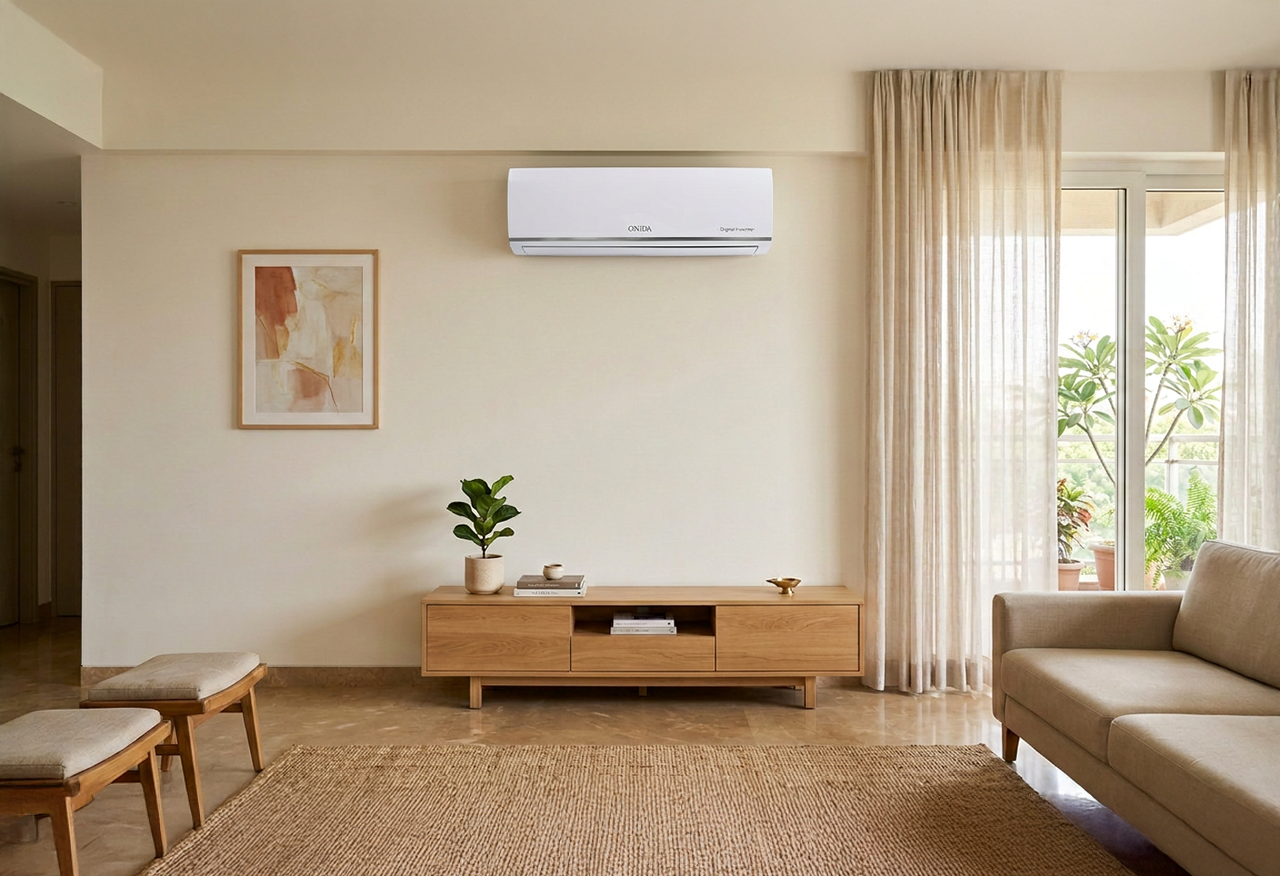
The advantage of an inverter compressor is not just its efficiency. Its variable-speed operation helps it avoid the constant start-stop stress that wears out fixed-speed compressors faster. Onida's inverter range, including the Gloria Refresh, Majestic, and Olympus, offers a 10-year compressor warranty. All models use copper coils, which resist corrosion better than aluminium in coastal Indian conditions.
Common Causes of Split AC Compressor Failure in India
Knowing what shortens the life of an AC compressor helps prevent costly failures. The most common reasons in India are:
- Low refrigerant (gas leak): This is the most frequent cause of failure. Low refrigerant makes the compressor run hotter and longer. A leak must be fixed before recharging. Adding refrigerant without repairing the leak will lead to repeated failures.
- Dirty condenser coil: A clogged outdoor coil blocks heat dissipation, forcing the compressor to work harder. Cleaning the coil annually is the most effective preventive maintenance step.
- Voltage fluctuations: Grid voltage dips below 200V during peak summer can stress the compressor motor and capacitor. Onida's inverter AC compressor works stabiliser-free from 140V to 290V, protecting it across India's voltage range.
- Blocked or dirty air filter: Reduced airflow can cause the evaporator coil to freeze, leading to liquid refrigerant returning to the compressor. This condition, called liquid slugging, can damage the compressor. Clean filters every 2 to 4 weeks.
- Overheating from high ambient temperature: When outdoor temperatures exceed 45°C, which is common in Rajasthan and Delhi, it can push compressor operating pressures above safe limits. Keep a 30cm clearance around the outdoor unit and avoid direct sunlight in the afternoon.
- Poor installation: An incorrect refrigerant charge, undersized pipes, or improper setup can shorten compressor life. According to ACHR News, about 30% of compressor failures are due to installation errors.
Gas leaks and dirty condenser coils are the most common causes of premature AC compressor failures in India, and both issues can be avoided with annual servicing.
Signs That Your Split AC Compressor Is Failing
Identifying split AC compressor problems early can prevent complete failure:
- AC runs constantly without reaching the set temperature: This means you may have low refrigerant or a failing compressor.
- Unusual noises, such as grinding, clanking, or hard starts: Grinding or clanking noises indicate wear in bearings, a failing capacitor, or internal damage. A healthy compressor should be nearly silent.
- Hissing or bubbling sounds near the indoor unit: This suggests refrigerant is escaping from a joint. Contact a technician immediately.
- Ice forming on the indoor unit: Low refrigerant can drop the coil temperature below freezing. Ice on the coil or refrigerant lines points to stress on the compressor.
- A sharp increase in your electricity bill: A struggling compressor uses more power. An increase of 20 to 30% without any change in usage is a warning sign.
- Outdoor unit trips the circuit breaker: This indicates the compressor is drawing too much current. Contact a technician and avoid repeatedly resetting the breaker.
Grinding noises or hard starts should be resolved within days. Continuing to operate a struggling compressor could turn a repairable issue into a full replacement.
How to Extend the Life of Your Split AC Compressor
The AC compressor is the most expensive part of the system. Replacing a 1.5-ton split AC compressor in India costs between 20,000 and 25,000, not including labour. Preventive maintenance can add 5 to 7 years to a compressor's life, making it worth the annual cost.
- Annual pre-summer service: This includes washing the coils, flushing the drain, checking refrigerant levels, testing the capacitor, and inspecting electrical components. Schedule this in February or March, before the peak season.
- Clean filters every 2 to 4 weeks: This prevents liquid slugging by ensuring clear airflow to the evaporator. In dusty areas, cleaning every two weeks is recommended.
- Check outdoor unit clearance monthly: Maintain a 30cm gap around all sides and remove debris and plants monthly.
- Avoid running the AC when there's a known gas leak: Fix the leak before recharging. Running on low refrigerant leads to progressive compressor damage.
- Ensure a stable power supply: Use a voltage stabiliser for older non-inverter ACs. Onida's inverter range protects compressors operating at 140-290V.
- Do not cover or block the outdoor unit: Never cover it; trapped heat and moisture can cause corrosion and reduce compressor life.
For AC compressor servicing, use Onida's authorised network through onida.com. Onida's inverter range comes with a 1-year comprehensive warranty, a 5-year PCB warranty, and a 10-year compressor warranty. Look at the range at onida.com.
When Should You Replace Rather Than Repair a Split AC Compressor?
The price to replace a 1.5-ton AC compressor ranges from ₹8,000 for a non-inverter model to ₹20,000 to ₹35,000 for a branded inverter AC compressor, with installation costs between ₹1,500 and ₹2,500. If the total exceeds 50% of a new AC price, replacing the entire unit is often the better choice, especially if the AC is 8 to 10 years old.
- Repair if: the AC is under 8 years old, still under warranty, and the failure is limited to parts like the capacitor, valve, or a repairable seal.
- Replace the entire AC if: the compressor has a motor burn, multiple components have failed, the AC is over 10 years old, or the repair cost is more than ₹15,000 to ₹20,000 for an older non-inverter model.
An inverter AC that's still under its 10-year compressor warranty is usually worth repairing since the replacement is covered at no cost. Onida's range of 1.5-ton split AC inverters starts at about ₹28,000 and goes up to ₹35,000, which can be similar to the cost of a branded compressor and installation on an older system.