
Your electricity bill spikes ₹5,000 to ₹10,000 every summer. Your AC runs all day, yet the cooling never feels quite enough. But here's the thing: the type of compressor in your air conditioner might be costing you twice as much as it should. In this guide, we'll explain the science behind inverter AC technology, show you real savings data, and help you choose the right AC for Indian summers.
The short answer? A good inverter AC uses 30-50% less electricity than a non-inverter AC with the same cooling capacity. Over a typical Indian summer (120 days, 8 hours of daily use), that's a saving of ₹5,000 to ₹8,000 on your electricity bill alone—money that stays in your pocket instead of going to the power company.
A conventional non-inverter AC works like a light switch. The compressor runs at full power until the room reaches your desired temperature, then it shuts off completely. It starts again from zero when the temperature rises. Each time it restarts, it uses a surge of electricity. In India, where ACs often run for 8 to 12 hours a day during summer, this constant cycling can add up quickly.
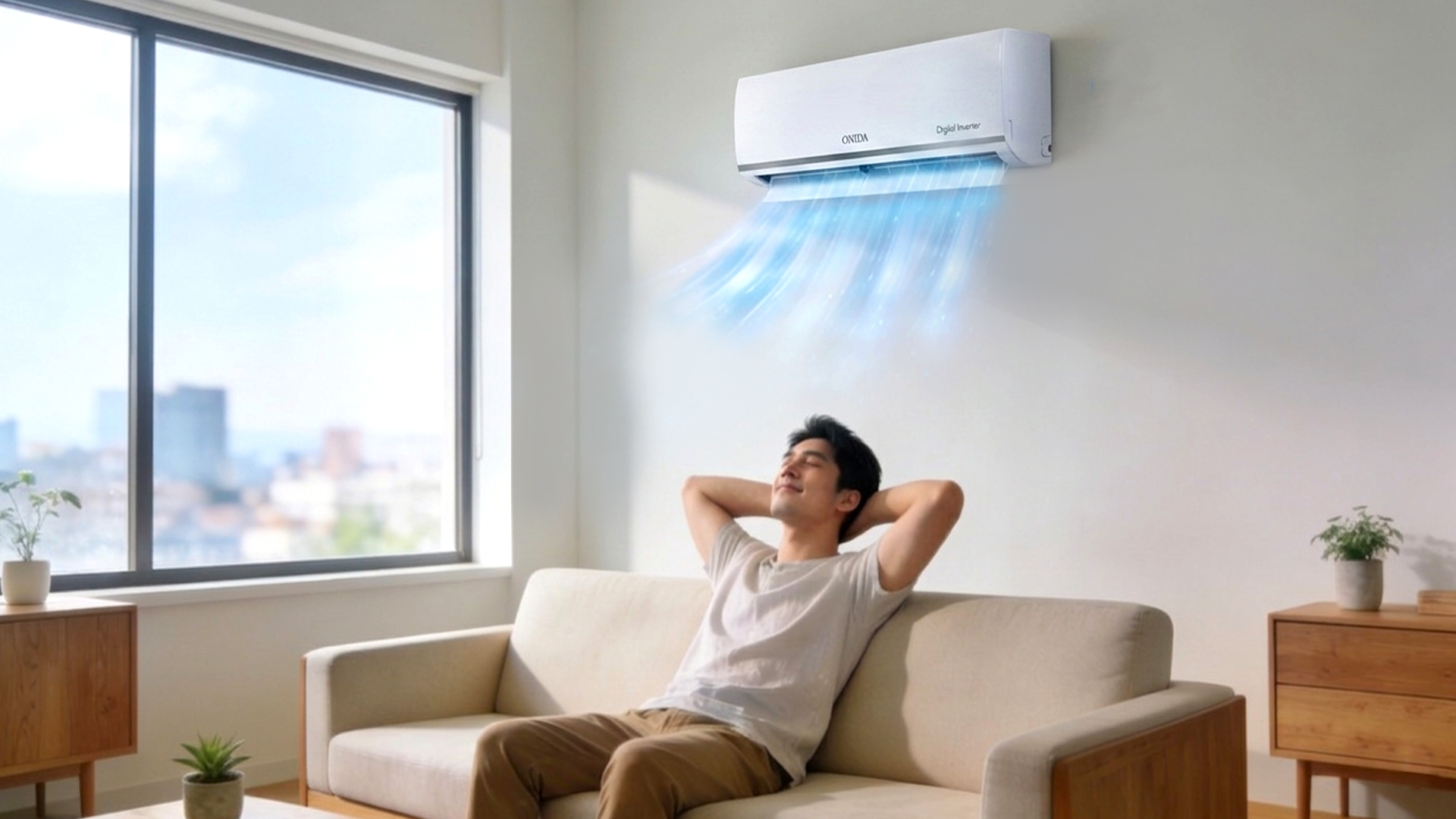
An inverter AC operates differently. Its compressor uses variable-speed technology. It runs continuously but adjusts its speed based on the room's cooling needs at that moment. When the room is almost at the right temperature, the compressor slows down instead of turning off. When the room warms up, it speeds up. There are no energy-hungry restarts, no temperature swings, and no loud compressor noise, just steady, efficient cooling.
Think of it this way: a non-inverter AC is like driving in stop-and-go traffic, while an inverter AC is like cruising on a highway at a consistent speed. The highway driver uses significantly less fuel over the same distance.
Data from the Bureau of Energy Efficiency (BEE) shows that inverter technology offers seasonal efficiency 20 to 30% higher than that of fixed-speed models. Inverter ACs now make up over 75% of all new AC sales in India, a huge increase from less than 1% in 2015.
ISEER (Indian Seasonal Energy Efficiency Ratio) is simply a measure of how much cooling you get per unit of electricity used—higher numbers mean better efficiency.
Onida offers both 3-star and 5-star rated inverter AC models. Here’s how they break down in the Indian context:
3-Star Inverter AC: Good for moderate use (4-7 hours per day). The annual electricity consumption for a 1.5-ton model is about 900-1,100 kWh. At ₹7 per unit, that’s roughly ₹6,300 to ₹7,700 each year.
5-Star Inverter AC: Better for heavy use (8 to 12 hours per day). The annual consumption drops to about 650 to 850 kWh for a 1.5-ton model, saving you ₹1,500 to ₹2,500 a year compared to the 3-star model, which often recovers the price difference within 18 months.
Important note: BEE periodically raises its ISEER thresholds. An AC labelled 5-star in 2022 may be rated as a 3-star model under the 2025-2026 standards. Always check the label date when comparing models. Onida's inverter ACs have current BEE-certified star ratings, with 5-star models achieving ISEER values of 5.2 and above.
The table below compares a standard non-inverter AC, a generic inverter AC, and the Onida inverter split AC range across the important factors for Indian households: electricity cost, voltage tolerance, heat performance, and warranty.
| Feature | Non-Inverter AC | Inverter AC (General) | Onida Inverter Split AC |
| Compressor type | Fixed speed (on/off) | Variable speed (adjusts continuously) | Variable speed — smarter & quieter |
| Energy consumption | 30–50% more electricity | 30–50% less than non-inverter | 30–50% less; up to 60% with 5-star ISEER |
| BEE star rating | 2–3 stars (ISEER up to 3.49) | 3–5 stars (ISEER 3.50–5.20+) | 3-star & 5-star inverter range available |
| Annual electricity cost (1.5T, 8 hrs/day) | ₹14,000–₹18,000 | ₹8,000–₹11,000 | As low as ₹8,000 on 5-star models |
| Voltage fluctuation tolerance | Sensitive — needs stabiliser | Stabiliser-free operation (140V–270V) | Stabiliser-free; built for Indian power grids |
| Cooling in extreme heat (45°C+) | Struggles at high ambient temps | Handles up to 52°C–55°C ambient | Handles up to 55°C ambient temperature |
| Noise level | Louder (frequent start/stop) | Quieter (continuous low speed) | As low as 18 dB on select Onida models |
| Compressor warranty | 1–5 years typical | 5–10 years typical | 10-year compressor warranty |
| Best suited for | Low usage (under 4 hrs/day) | Daily usage 6–12+ hours | Indian summers with 8–12 hrs daily use |
India's summer climate is not just hot; it is extreme, variable, and long. Rajasthan, UP, and Delhi regularly see temperatures above 45°C. Coastal cities like Mumbai and Chennai face heat combined with high humidity. Voltage fluctuations are common in most Indian cities, with supply dropping below 200V during peak load hours. An AC bought without considering these factors may underperform, fail early, or quietly raise your electricity bill.
When looking for the best AC for the Indian climate, pay attention to three key features beyond the star rating:
High ambient-temperature rating: According to the Indian Bureau of Energy Efficiency (BEE), ACs must be tested at up to 43°C, but top-quality models can cool at 52°C to 55°C. Onida's inverter split ACs, such as the Gloria Refresh, are rated to operate efficiently up to 55°C, ranking them among the best cooling air conditioners in India during heat waves.
Stabiliser-free operation: India's grid voltage fluctuates between 140V and 270V in many areas. Onida's inverter ACs are designed for stabiliser-free operation across this range, protecting the compressor without the need for a separate stabiliser that consumes power and raises your bill.
Copper condenser coils: Copper offers 25% better heat transfer than aluminium and has far greater corrosion resistance, which is crucial in coastal cities like Mumbai, Chennai, and Kochi. All Onida inverter split ACs come with copper condenser coils as standard. This increases the unit's lifespan and reduces the need for frequent condenser repairs.
The biggest controllable factor in your AC electricity bill isn't the brand or star rating; it’s the temperature you set. Setting your AC to 24°C instead of 18°C saves you about 24% on your monthly bill, based on real-world tests in Indian households. Each degree lower than the recommended setting increases energy use by 3 to 5%.
The Bureau of Energy Efficiency suggests a default setting of 24°C as the best balance between comfort and efficiency. At 24°C to 26°C with a ceiling fan running, most people feel as comfortable as they would at 20°C to 21°C on AC alone because moving air raises the felt temperature tolerance by 2°C to 3°C. Onida's inverter split ACs include Sleep Mode, which adjusts the temperature through the night to keep you comfortable without overcooling. This feature alone can reduce overnight electricity use by 10-15%.
In humidity-heavy cities like Mumbai, Kolkata, and Chennai, using Dry Mode instead of Cool Mode during warm evenings can dehumidify the room without running the compressor at full capacity, thereby further reducing energy use.
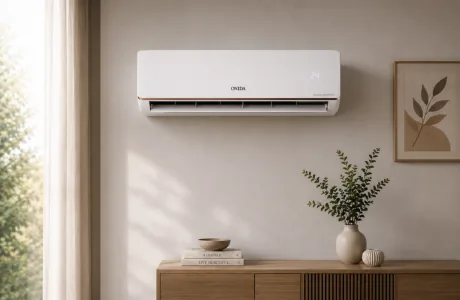
Onida's inverter AC range includes capacities from 0.8 ton to 2 tons, with 3-star and 5-star BEE ratings. All models have copper condenser coils, operate without a stabiliser, and come with a 10-year compressor warranty, which is one of the longest in India.For a standard 120 to 150 sq. ft. bedroom or study, the Onida 1-ton 3-star inverter split AC (IR123MJS) is ideal for moderate daily use (up to 7 hours) and competitively priced.
For a 150 to 200 sq. ft. bedroom or living room with over 8 hours of daily use, the Onida Gloria Refresh 1.5-ton 3-star inverter split AC (IR183PRSG) is a strong choice. It has 5-in-1 convertible cooling (adjustable between 40% and 110% capacity), an iFeel sensor, a deep-cleaning function, and can cool at ambient temperatures up to 55°C. It is built for the extended use typical of Indian homes from March to July.
For a large living area (200 sq. ft and above) or a south-facing room with heavy sun exposure: The Onida 2-ton 3-star inverter split AC (IR243MJS) is designed for high-load cooling. It features a four-way swing, auto-restart, sleep mode, and durable copper coil construction. Starting at around ₹34,990, it provides good performance for your money.
Onida offers discounts of up to 46%on select inverter AC models through major e-commerce platforms during the summer. Always check the current BEE label year when buying to ensure the model has updated efficiency ratings.
Explore the full range of Onida inverter split ACs, read Onida's detailed buying guide, or check the product page for the Onida Gloria Refresh 1.5-ton 3-star inverter split AC for complete specifications.
An inverter split AC with a 5-star BEE rating, copper condenser coils, and stabiliser-free operation is the best option for Indian conditions. High temperatures (often exceeding 45°C in northern states), frequent voltage fluctuations, and long cooling seasons of 5 to 6 months make these features essential. Onida's inverter split ACs operate efficiently at temperatures up to 55°C and can handle input voltage between 140V and 270V without needing a separate stabiliser.
For high-humidity cities like Mumbai, Chennai, and Kolkata, the best choice is an inverter split AC with a Dry Mode function and copper condenser coils. Inverter ACs with Dry Mode dehumidify without overcooling, reducing power use on humid but mild evenings. Copper coils resist corrosion from salty sea air, which can damage aluminium coils in coastal areas within 2 to 3 years.
24°C is the ideal setting recommended by the Bureau of Energy Efficiency for comfort and efficiency during Indian summers. Lowering the temperature to below 22°C provides minimal comfort gain while increasing power use by 3 to 5% for every degree lower. Using a ceiling fan with your AC allows you to raise the set temperature by 2 to 3°C without feeling any warmer, reducing your monthly bill by up to 24%.
Cool Mode at 24 to 26°C is ideal for hot, dry days; Dry Mode works best for humid evenings when temperatures are moderate, but moisture levels are high. Sleep Mode, available on Onida inverter ACs, gradually adjusts the temperature throughout the night to prevent overcooling and cuts overnight electricity use by roughly 10 to 15%. Avoid running in Fan-Only Mode during peak summer, as it does not dehumidify.
Yes. Inverter ACs use 30-50% less electricity than non-inverter models of similar capacity. Real-world tests in Indian homes show a 1.5-ton 5-star inverter AC uses 950 to 1,200W at a steady state, compared to 1,500 to 1,650W for a similar non-inverter model. Over 8 hours of daily use for a 5-month Indian summer, this difference can save ₹5,000 to ₹8,000 in electricity costs.
A 5-star inverter AC is the right choice if you plan to use your AC for 7 or more hours each day during summer. The higher initial cost of a 5-star model compared to a 3-star typically pays off within 18 months through electricity savings, after which the 5-star unit continues to save you money for the rest of its 8 to 12-year lifespan. For lighter use (under 5 hours daily), a 3-star inverter AC offers a better cost-to-savings ratio.
Onida is a trusted mid-to-premium brand for inverter ACs in India. The products are designed for Indian voltage conditions, high temperatures, and long summers. All Onida inverter split ACs come with copper condenser coils, stabiliser-free operation from 140V to 270V, and a 10-year compressor warranty, which is better than the industry-standard 5-year warranty. The brand has over 1,200 service centres across India for reliable post-purchase support.



Please dispose of e-waste and plastic waste responsibly.
For more information or e-waste pick up, please call 7490 9555 55 or
click here for more details.