
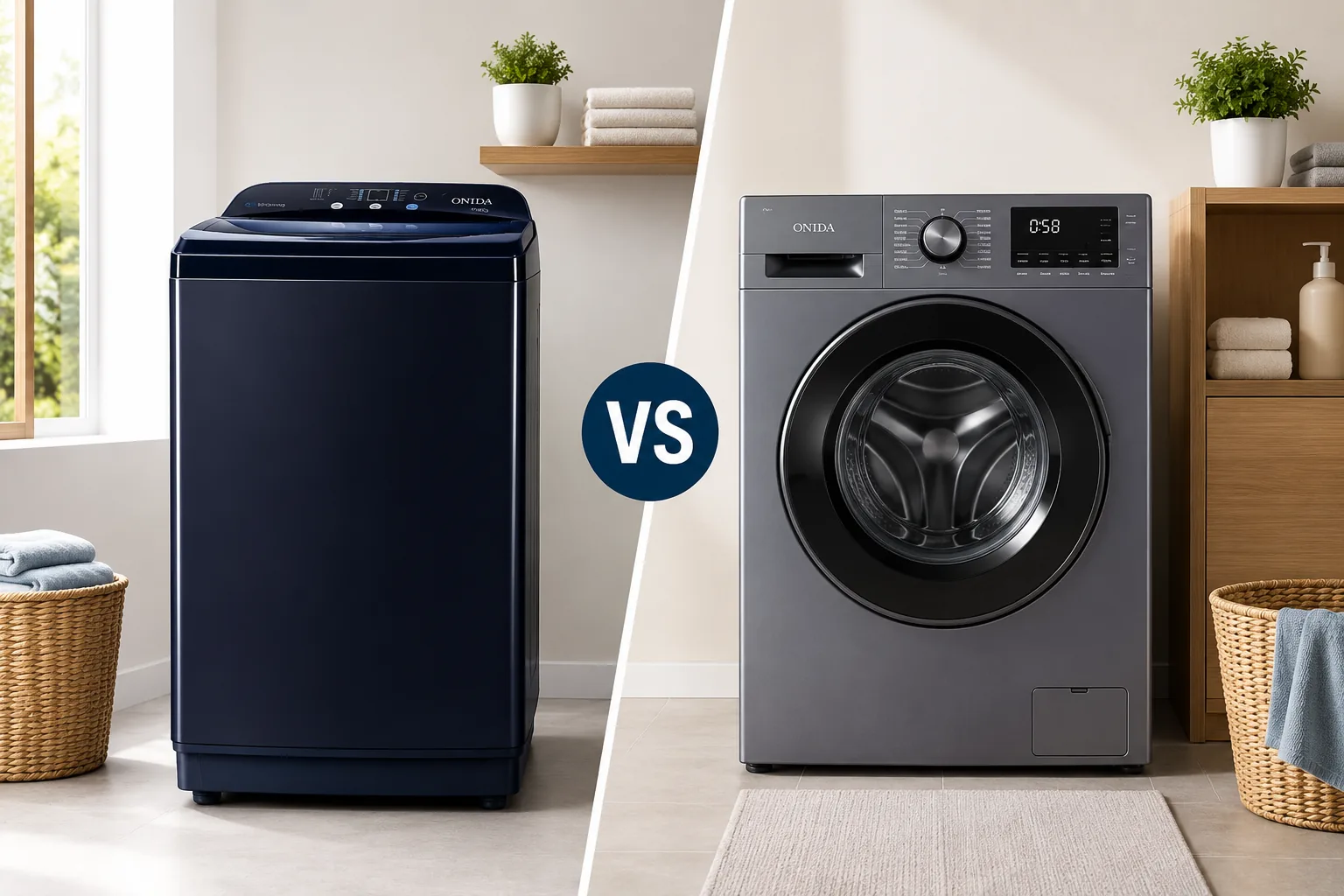
Walk into any appliance store in India and you'll be asked one question almost immediately: front load or top load? It's one of the most common — and most confusing — decisions buyers face when shopping for a new washing machine. Both formats get your clothes clean, but they differ significantly in water usage, wash quality, price, and everyday convenience.
Here's a clear, practical comparison to help you decide, along with a look at what Onida's front load and top load ranges bring to the table.
This fundamental difference in wash mechanism is what drives most of the practical differences between the two.
Because a front load washing machine only needs to fill water partway up the drum — rather than fully submerging clothes like a top load machine does — it typically uses significantly less water per cycle. Less water to heat also means lower energy consumption, which is part of why front load machines are generally positioned as the more water- and energy-efficient option, as reflected in Onida's front load range being built around low water consumption and energy-efficient operation.
If your household is conscious about water bills or lives in an area with water restrictions, this is one of the clearest arguments in favour of front load.
The gentler tumbling action of a front load machine tends to be kinder to delicate fabrics, reducing wear on clothes over repeated washes. Onida's front load models use a Hexa Bubble Drum, engineered to generate dynamic water currents that lift dirt away from fabric without being harsh on it — a deep clean without unnecessary fabric stress.
Top load machines, by contrast, use more vigorous agitation, which can clean heavily soiled items effectively but may cause slightly more wear on delicate garments over time.
Onida's front load range is built around a BLDC (Brushless DC) motor, which delivers quieter operation, reduced vibration, and improved durability compared to conventional motors — while also consuming less energy. This matters especially in apartments or homes with utility areas close to living spaces, where a noisy spin cycle can be genuinely disruptive.
Front load machines typically spin at higher RPMs than top load machines — Onida's front load models reach spin speeds of up to 1200 RPM. A higher spin speed extracts more water from clothes during the final spin cycle, which means less residual moisture and faster drying time afterward, whether you're air-drying or using a dryer.
Front load washing machines are generally more space-efficient in terms of footprint and can often be installed under a kitchen counter or utility shelf, since you don't need clearance above for a lid to open. Top load machines need vertical clearance above the machine for loading and unloading, which matters in smaller utility areas.
On the flip side, top load machines don't require bending down to load or unload laundry, which many users — especially those with back or knee concerns — find more comfortable for everyday use.
Front load washing machines, including Onida's range, generally sit at a higher price point than comparable top load models, reflecting the more complex drum mechanism, higher spin speeds, and advanced motor technology involved. If budget is the primary concern and you don't need the water-saving or fabric-care benefits, a top load fully automatic machine remains a strong, cost-effective choice.
Choose a front load washing machine if:
Choose a top load washing machine if:
Front load washing machines generally use less water per cycle, since they only partially fill the drum instead of fully submerging clothes the way top load machines do. This also means lower energy use for heating water.
Yes. The tumbling wash action in a front load machine, such as Onida's Hexa Bubble Drum, is gentler on fabric compared to the more vigorous agitation used in top load machines, reducing wear over repeated washes.
A BLDC (Brushless DC) motor delivers quieter operation, reduced vibration, and greater durability while consuming less energy compared to conventional motors — a feature found in Onida's front load washing machine range.
Higher spin speeds extract more water during the final cycle, reducing drying time. Onida's front load washing machines offer spin speeds of up to 1200 RPM, which is on the higher end for household machines.
Yes. Because front load machines don't require clearance above for a lid to open, they can often be installed under a kitchen counter or utility shelf, making them a good fit for compact spaces.
Front load washing machines generally cost more than comparable top load models, due to the more advanced drum mechanism, motor technology, and higher spin speeds involved.
Yes. Onida's 7.5 kg front load range is well-suited to families of 3–4 members, offering enough capacity for daily wear, towels, and jeans while maintaining water and energy efficiency.
There's no universal "better" choice between front load and top load — it comes down to what matters most for your household: water savings and fabric care, or upfront cost and everyday convenience. Onida offers a strong lineup in both formats, so whether you choose the water-efficient, BLDC-motor-powered front load range or the fast, easy-to-use top load range, you're getting a washing machine engineered specifically for Indian laundry needs.
Ready to choose your ideal washing machine? Explore Onida's full range of front load and top load washing machines at onida.com.



Please dispose of e-waste and plastic waste responsibly.
For more information or e-waste pick up, please call 7490 9555 55 or
click here for more details.