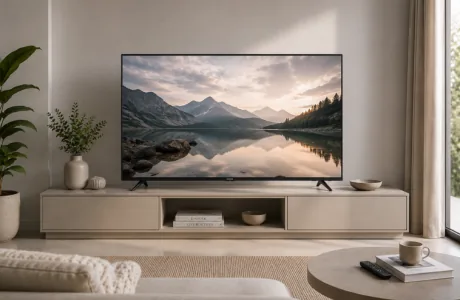

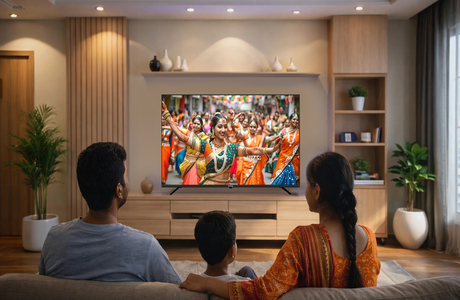
watching on modern televisions requires more than sharp visuals—eye health depends on technologies that reduce PWM flicker and blue light exposure, common concerns with Mini LED TV backlights that pulse at 240-1440Hz to manage brightness. As India's screen time increases by 37% during the pandemic, Mini LED TV innovations such as high-frequency dimming and spectral filters provide an 11-43% increase in corrected visual acuity, 27-34% increase in contrast sensitivity function (CSF) for all frequencies and a marked reduction in glare sensitivity, making them suitable for 4K marathons without headaches or fatigue.
Onida examines PWM, blue-light dynamics, and endurance features in Mini LED Smart TV displays, highlighting why its best Mini LED Smart TV in India is ideal for family viewing. This detailed guide includes technical analyses, user insights, and criteria for selecting the latest Smart TV that emphasises eye health alongside a cinematic experience.
PWM (Pulse Width Modulation) dims Mini LED TV backlights by rapidly switching LEDs on and off—low frequencies (<500Hz) trigger subconscious flicker detection, causing viewers to experience dry eyes or migraines, according to Reddit PWM-Sensitive forums (2025). Mini-LED 4K TVs typically operate at 720-1440Hz, which is safer than OLED's 120-480Hz, but modulation depth near 100% at low brightness can emphasise issues during night use.
Blue light (460-500nm) from 4K Mini LED TV suppresses melatonin, disrupting sleep cycles. Smart TV phosphors exacerbate this; without filters, peak emission reaches 30% of the white-light spectrum. Onida's Mini LED TV India counters this with Low Blue Light Technology designed for eye comfort, especially during long binge-watching sessions or in dark/dull environments.
If you look at an LED whose duty cycle is linearly varied from 0% to 100%, you won’t perceive a uniform change in brightness. Human flicker fusion threshold averages 60Hz, but PWM-sensitive individuals detect up to 2000Hz, experiencing phantom images or strain. Mini-LED TV arrays (thousands of zones) enable finer control, but global dimming synchronises pulses across the screen.
High-frequency PWM in top Mini LED TV models, such as Onida's 2025 series, is imperceptible to most users, unlike the low-PWM risks of OLED. The Onida Mini LED Smart TV employs a DC-dimming hybrid at low brightness levels. Certain areas of the television screen can be dimmed or brightened with greater precision, improving accuracy. Mini LEDs, therefore, represent a significant performance upgrade in lighting. This feature, allowing individual control of specific regions of the screen for adjusting brightness and darkness, is known as “Full Array Local Dimming (FALD)" and is the main factor behind the brilliance of Mini LED TV.
| PWM Metric | OLED TVs | Mini LED TV (Onida) | Eye Comfort Score |
| Frequency | 120-480Hz | 1440Hz+ | High |
| Depth @10% Bright | 100% | 15-30% | Superior |
| Flicker-Free Range | Narrow | 0-100% | Optimal |
Mini-LED 4K TVs with quantum dots enhance blue peaks for vividness, but Eye Comfort modes use spectral filters that reduce 415-455nm by 40-60%. Onida's latest Smart TV automatically activates after sunset via ambient sensors, with Dolby Vision IQ for dynamic adjustments.
Mini-LED TVs in India compete with OLED TVs by offering flicker-free, uniform backlighting that prevents dark-zone strobing. OLED's pixel-level PWM (low Hz) causes eye strain and discomfort. 4K Mini LED TVS can achieve high-frequency PWM dimming, which is less noticeable to the human eye, without compromising lifespan or reliability. They are thus ideal for bright rooms and reducing eye strain.
| Aspect | Mini Led Tv | OLED |
| PWM Risk | Low (high Hz) | High (low Hz) |
| Blue Light | Filterable 40% | Persistent |
| Burn-In | None | Possible |
Onida's Mini LED Smart TV features Low Blue Light Technology with precise local dimming across over 140 zones, providing deeper blacks and brighter highlights without harsh glare or flicker that can strain your eyes during long viewing sessions. Models like MZ50MIN and MZ55MIN QLED blend quantum dot colour vibrancy with advanced backlighting for cinematic experiences without the risk of OLED burn-in.
Smart voice control through built-in Alexa and Google Assistant enables hands-free adjustments to Eye Comfort modes, while
Dolby Vision guarantees frame-by-frame optimisation
ideal for Mini LED TV homes in India that balance entertainment and wellness.
Calibrate the Mini LED TV to 100-120 nits for dim-room brightness, enable Filmmaker Mode, and disable motion smoothing (25% strain reducer). Set the colour temperature to 6500K for daytime and 2700K for evening.
Picture > Expert > PWM-Free Low Bright
Blue Light Filter: Auto
Local Dimming: High (500 zones)
TCL blue filter setup reduces emissions by 50%. Pair the Onida 4K Mini LED TV with anti-blue glasses (Felix Gray), cutting exposure by 30%.
Ambient bias lighting (Philips Hue) increases perceived contrast, making pupil adjustment easier.
The 2026 Mini LED Smart TV promises Micro-LED hybrids that eliminate PWM through current modulation. Onida prototypes reach 2000Hz, resulting in zero flicker.
Onida's Mini LED Smart TV includes Low Blue Light Technology to help prevent eye strain.
Use Night Mode for 4-6 hours; take breaks every 2 hours as advised.
Mini LED is considered superior due to its high PWM frequency and lack of burn-in.
Yes, activate it in the evening to reduce blue light naturally; using it during the day preserves colour accuracy without filters.
Absolutely—local dimming and high-frequency PWM in Mini LED Smart TV help prevent glare and flicker, which are absent in standard LED panels.



Please dispose of e-waste and plastic waste responsibly.
For more information or e-waste pick up, please call 7490 9555 55 or
click here for more details.