
In this blog, Onida explains the changes to the 2026 BEE star rating. We will discuss what these changes mean, why they were introduced, and how they impact every AC purchase in India starting January 2026. If you recently noticed a 3-star label on a new air conditioner and questioned if it is still a good buy, this guide provides clear answers. We include specific ISEER numbers, bill savings data, and a step-by-step guide to help you choose the most energy-efficient AC under the updated system.
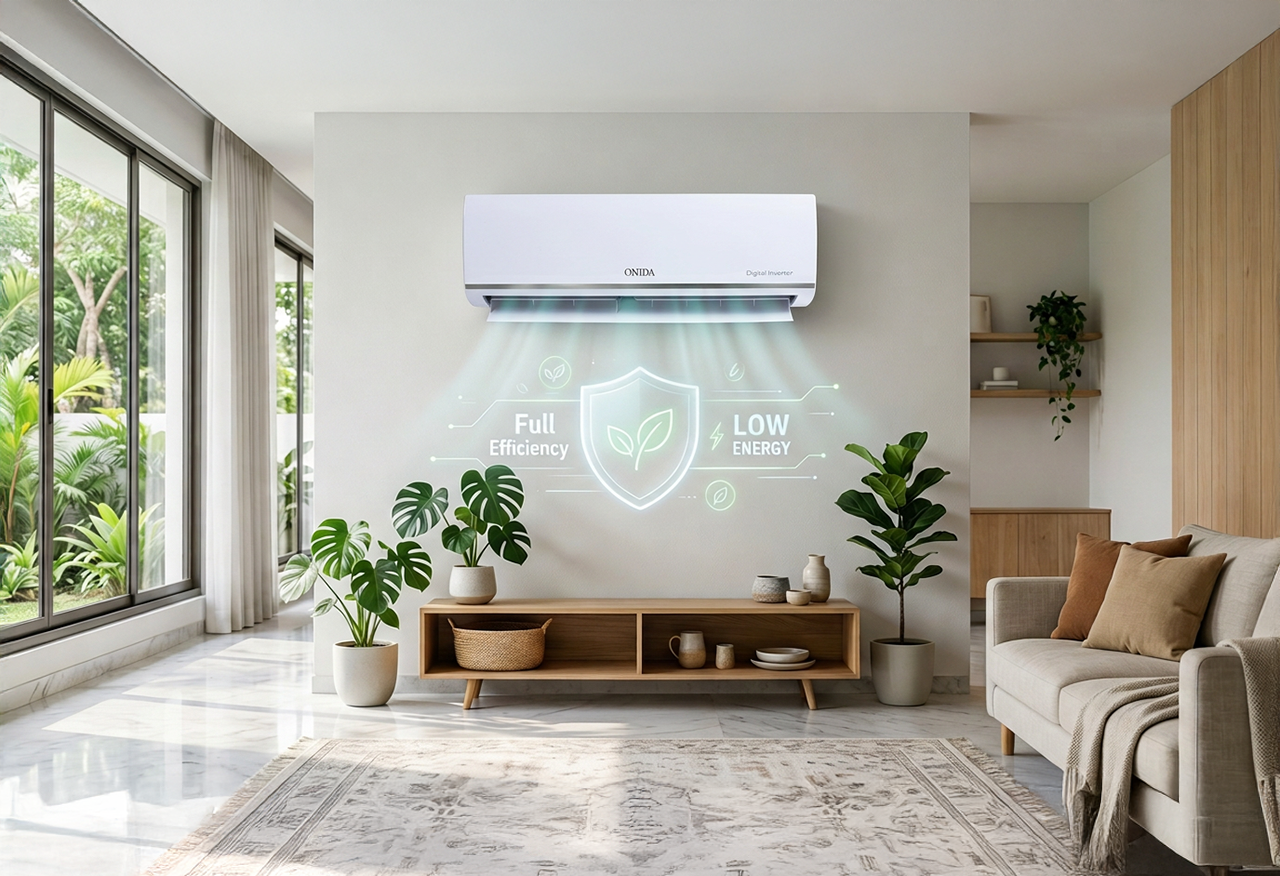
India's Bureau of Energy Efficiency (BEE) has revised AC star rating thresholds periodically since 2006. The 2026 update raises the ISEER bar for each star band by 10-14%. As a result, earning a label is now tougher and a more reliable indicator of real-world electricity savings. Onida's inverter AC range fully complies with the 2026 BEE standards.
The AC star rating is an energy-efficiency label given by the Bureau of Energy Efficiency (BEE), part of India's Ministry of Power. Every split AC sold in India must show this label, which features a star band from 1 to 5. More stars indicate less electricity use for the same cooling output. The key metric is the ISEER, or Indian Seasonal Energy Efficiency Ratio. Introduced in 2018, ISEER replaced the older EER system, which measured AC performance only at 35°C. ISEER tests performance across eight temperature bands from 24°C to 43°C, reflecting conditions in 54 Indian cities. This makes it a much better predictor of your actual electricity bill.
The crucial number to look for on the BEE label is the ISEER value, not just the star count. Two ACs with the same star label can have significantly different ISEER values. A higher ISEER always means a lower electricity bill. Onida's 5-star inverter ACs achieve an ISEER of 5.2 and above. Since 2015, India's split AC efficiency at the 5-star level has improved by 61%, thanks to periodic BEE updates like this one.
| What the BEE Label Shows | What It Tells You | What to Do With It |
| Star band (1–5) | Efficiency tier vs other ACs of the same size | Aim for 3-star minimum; 5-star for daily use |
| ISEER value | Actual ratio of cooling output to energy used | Compare this number across models |
| Annual kWh estimate | Projected electricity use at 1,600 hrs./year | Lower kWh = lower running cost |
| Label validity period | Which BEE standard is the rating based on | Always check the label year |
| Compressor type | Inverter or fixed-speed | Inverter uses 30–50% less power |
The 2026 BEE standards, effective from January 1, 2026, include three key changes to the AC star rating system. First, the ISEER thresholds for each star band have been raised by 10-14%. This means an AC must now be truly more efficient to get the same label. A model that qualified as 5-star under the 2025 standards is now rated as 4-star, not because it is less efficient, but because the requirements have increased. Second, testing conditions now account for rising ambient temperatures and longer operating hours, better reflecting India's changing climate. Third, label validity periods have been shortened to keep star claims current.
The practical outcome for buyers is clear: a 2026 3-star AC offers the real-world efficiency of a 2025 4-star model. A 2026 5-star AC is about 10% more efficient than its 2025 counterpart and is equivalent to a 6- or 7-star model under older standards. The essential rule is to avoid comparing star labels from different years; always refer to the ISEER number and check the label validity period.
| Old Rating (up to Dec 2025) | New Rating (from Jan 2026) | Actual Efficiency Change | ISEER Threshold (5-star, split AC) |
| 5-star | 4-star | Unchanged — label shifted | Was 5.0+ → Now 5.6+ |
| 4-star | 3-star | Unchanged — label shifted | — |
| 3-star | 2-star | Unchanged — label shifted | — |
| New 5-star (2026) | 5-star | 10% more efficient than the old 5-star | Now 5.6+ |
Under the 2026 BEE standards, a 3-star split inverter AC needs an ISEER of 4.0–4.99. This band used to qualify as a 4-star performance. For 4 to 5 hours of daily use, a 3-star inverter is cost-effective. For 6 to 8 hours a day, the 5-star model recoups costs faster. A 5-star 1.5-ton inverter AC uses 700 to 850 kWh annually compared to 900 to 1,100 kWh for a 3-star, saving ₹1,750 to ₹2,800 per year at ₹7/unit.
The price difference for a 5-star Onida inverter AC over a 3-star model is usually ₹5,000 to ₹8,000. With annual savings of ₹2,000 to ₹2,800, the extra upfront cost recovers within 2 to 3 years. Onida offers both 3-star and 5-star inverter models with ISEER 5.2+ for the 5-star variants and a 10-year compressor warranty across the entire range. For heavy use (8+ hours daily), Onida recommends the 5-star inverter range. For moderate use or guest rooms, the 3-star inverter offers strong value without overspending.
| Factor | 3-Star Inverter (2026) | 5-Star Inverter (2026) |
| ISEER range | 4.0–4.99 | 5.6+ |
| Annual consumption (1.5T) | 900–1,100 kWh | 700–850 kWh |
| Annual bill at ₹7/unit | ₹6,300–₹7,700 | ₹4,900–₹5,950 |
| Annual savings vs 3-star | — | ₹1,750–₹2,800 |
| Typical price premium over 3-star | — | ₹5,000–₹8,000 |
| Cost recovery period | — | 2–3 years |
| Best for | 4–5 hrs./day, moderate climate | 6–8+ hrs./day, hot regions |
The 2026 BEE revision raises the requirements for new models to earn each star rating. This change does not affect how your existing AC performs. A 3-star buyer in 2026 is more efficient than a 3-star buyer in 2024, even if the label appears the same. A 5-star 1.5-ton AC saving ₹2,000 to ₹2,800 per year adds up to ₹20,000 to ₹28,000 over its lifetime.
Onida's inverter ACs achieve this efficiency through variable-speed compressors that reduce to 20% capacity once cooled, copper condenser coils, and R32 refrigerant. Onida's stabiliser-free operation between 160V and 290V also directly cuts running costs. In areas with frequent voltage fluctuations, a separate stabiliser can add ₹2,000 to ₹4,500 in upfront costs and use extra power. Onida's built-in wide-voltage design removes both.
Selecting the best AC for your home under the 2026 BEE guidelines involves a four-step process. The star label alone is not enough; you need to consider the label year and ISEER value, and match them to your usage patterns and room conditions.
For most Indian households, the best AC under the 2026 BEE norms is a 1.5-ton 5-star inverter split AC with an ISEER of 5.0 or more for daily use, or a 3-star inverter AC for less than 5 hours per day. Onida offers both options: 3-star models priced under ₹30,000 and 5-star variants priced between ₹42,000 and ₹45,000.
The revision of the 2026 BEE standards is a clear win for Indian consumers. Every new AC entering the market, regardless of its star rating, is more efficient than older models. The star label itself has become more reliable. A 3-star AC in 2026 performs similarly to a 4-star AC from 2025. A 5-star AC in 2026 is about 10% more efficient than the 2025 model, making it the most energy-efficient residential cooling option available in India.
Onida's inverter split AC range completely meets the 2026 BEE standards. Whether you want a budget-friendly 3-star inverter or a high-end 5-star model with ISEER 5.2 or higher, Onida's air conditioner range offers BEE-certified efficiency, robust tropical performance up to 55°C, stabiliser-free operation, and a 10-year compressor warranty. Read the Onida AC selection guide at how to choose an ac.



Please dispose of e-waste and plastic waste responsibly.
For more information or e-waste pick up, please call 7490 9555 55 or
click here for more details.