
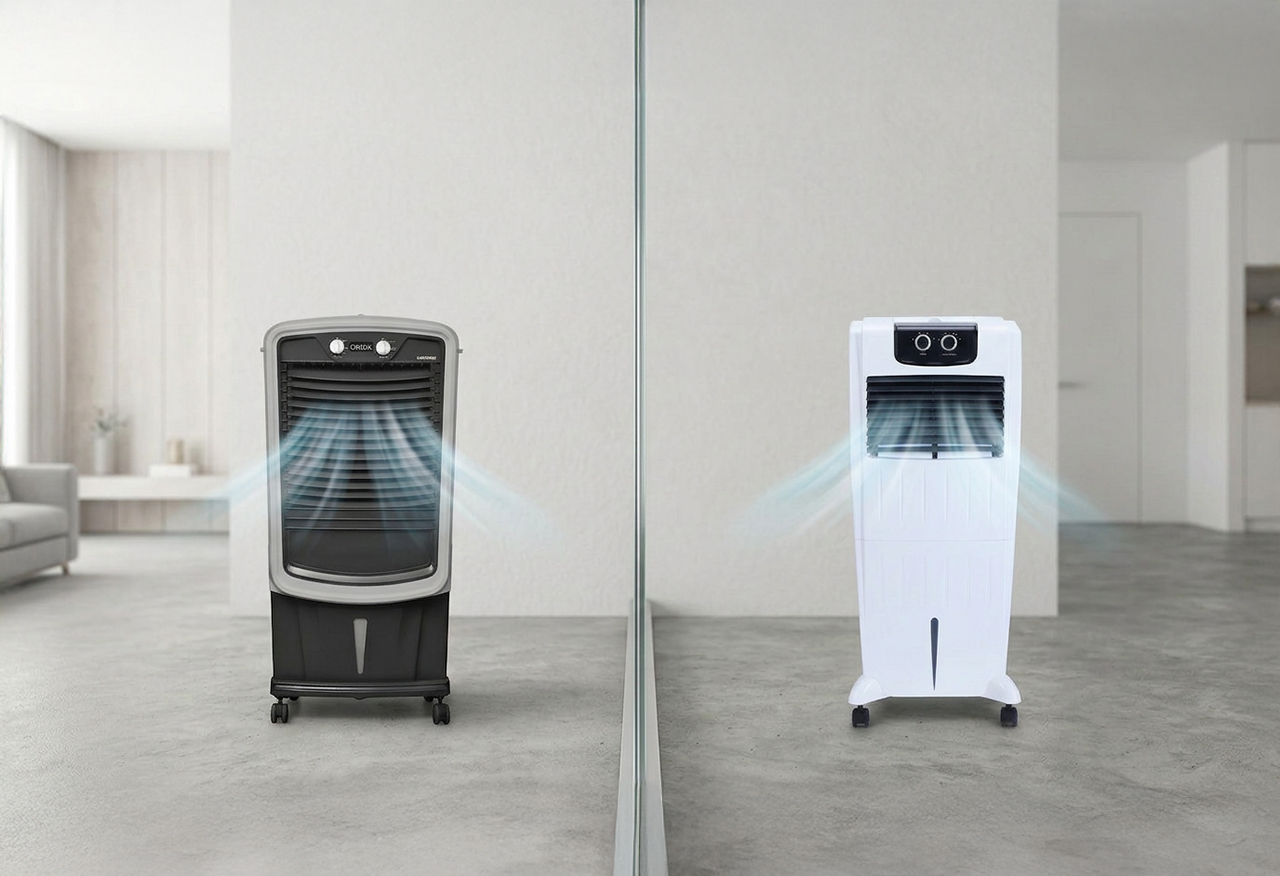
If you visit any Indian electronics store from March to June, you will see rows of desert coolers and personal coolers on display. Both promise relief from the heat, but they differ greatly in price, size, and cooling ability. For someone new to shopping for coolers, the differences may seem technical and unclear. Are these not just two types of air coolers? Yes, they are, but knowing how they differ is crucial for making the right choice for your home. At Onida, we have created a variety of cooling solutions for Indian households. We understand that selecting the wrong type of cooler for your room is a common mistake that can easily be avoided.
In this blog, Onida explores the personal cooler vs desert cooler comparison based on key factors: cooling output, room size suitability, water use, electricity consumption, portability, and climate fit. Whether you need an air cooler for a large hall or a compact model for a bedroom, this guide will help you find the best option and explain why.
A desert cooler offers better performance and is suitable for large rooms and open spaces in dry climates. A personal cooler is more practical for smaller rooms, bedrooms, and situations where being portable matters.
A desert cooler usually holds 40 to 100 litres of water and uses a powerful pump along with large honeycomb or wood wool pads to distribute cooled air over a wide area, often lowering temperatures by 10–15°C in dry conditions for rooms measuring 400 to 600 square feet. A personal cooler, on the other hand, holds 15 to 30 litres, consumes less power, and is meant for smaller spaces of 150 to 250 square feet. In raw cooling efficiency, the desert cooler is the clear winner, but that comes with higher water use, greater electricity consumption, and a bulky design that may not fit every home. For bedrooms, rental apartments, and smaller households, a personal cooler from a brand like Onida delivers a better balance of cooling, ease of use, and affordability.
A desert cooler, also known as a window or room cooler, is the larger version of an evaporative cooler. As its name implies, it was designed for hot, arid climates with low humidity and high temperatures. It operates on the basic evaporative principle found in all air coolers: warm air is drawn through water-saturated pads, the water evaporates to absorb heat, and cooler air is released into the room.
What sets a desert cooler apart is its size. Typical specifications include:
- Water tank capacity: 40–100 litres
- Air throw: 25–40 feet
- Power consumption: 150–300 watts
- Cooling area: 400–600 square feet
- Pad type: Thick wood wool (aspen) or honeycomb cellulose pads that retain more water and enable prolonged evaporation
The larger pad surface area and high-capacity fan give the desert cooler a notably greater cooling output than smaller models. Most desert coolers are installed in windows or placed against exterior walls, relying on a steady supply of fresh outdoor air rather than recirculating indoor air. Onida's desert cooler range is specifically designed for high-volume cooling in spacious Indian homes, halls, and semi-open areas.
A personal cooler is a compact, portable evaporative cooler designed for individual or small-room use. Unlike a window-mounted desert cooler, a personal cooler stands alone, requires no fixed installation, and can be easily moved from room to room, making it a great choice for rented homes and urban apartments with limited wall space.
Key specifications for a personal cooler include:
- Water tank capacity: 15–30 litres
- Air throw: 15–25 feet
- Power consumption: 100–200 watts
- Cooling area: 150–250 square feet
- Pad type: Honeycomb or wood wool, smaller surface area than desert cooler pads
Personal coolers often feature auto-fill, multi-speed fans, remote controls, and wheels for easy mobility. They are ideal for bedroom use, where a full-sized desert cooler would be too big and unwieldy. A personal cooler is perfect for providing focused cooling in specific rooms rather than cooling an entire house.
Onida's personal cooler range offers compact sizes, efficient honeycomb cooling pads, and low power consumption, making them a good fit for the space limitations of Indian apartments and the cooling needs of individual rooms.
When looking into different types of air coolers, you'll typically find four categories. Knowing where desert and personal coolers fit within this broader array helps clarify which product to consider.
These are the largest and most powerful types, suitable for big rooms, halls, and semi-open areas in dry, hot climates. They are generally mounted in windows or positioned against exterior walls for fresh-air intake.
These are compact, portable class coolers designed for individual rooms, bedrooms, and small offices. Box coolers are shorter; tower coolers have a taller design with multi-directional airflow.
This is a subtype of personal cooler with a vertical shape. They distribute air more widely in rooms where floor space is limited, but height is available.
These units are fitted into a window frame and are permanently connected to provide fresh air. They function similarly to desert coolers but are intended as a permanent fixture, commonly found in older homes and commercial spaces in India.
For most Indian buyers deciding between a desert and a personal cooler, the choice often comes down to the size of the room and the need for portability. Onida offers models across both categories, with specifications available at onida.com/air-coolers to help you select the right type for your needs.
| Factor | Desert Cooler | Personal Cooler |
| Tank capacity | 40–100 litres | 15–30 litres |
| Cooling area | 400–600 sq. ft | 150–250 sq. ft |
| Air throw | 25–40 feet | 15–25 feet |
| Power consumption | 150–300W | 100–200W |
| Running cost (8 hrs/day) | ~₹170–340/month | ~₹110–225/month |
| Portability | ❌ Low (fixed/bulky) | ✅ High (castors, lightweight) |
| Installation | Window fitting needed | Plug and use |
| Water refill frequency | Every 6–12 hours | Every 4–8 hours |
| Best room size | Large hall, living room | Bedroom, small room |
| Performance in a dry climate | ✅ Excellent | ✅ Good |
| Performance in a humid climate | ❌ Poor | ❌ Poor |
| Price range (India) | ₹6,000–₹18,000 | ₹4,000–₹12,000 |
| Noise level | Higher (large fan motor) | Lower (compact motor) |
| Ideal for | Open homes, halls, dry regions | Bedrooms, rented flats, urban use |
A desert cooler is a great option if you live in a dry, hot area like Rajasthan, Gujarat, Haryana, Uttar Pradesh, or inland Madhya Pradesh, where humidity before the monsoon usually stays below 50%. It is also better for cooling large living rooms, open-plan halls, or covered verandas, where a personal cooler may not have the power to circulate cool air throughout the entire space.The desert cooler is the top choice for large homes in dry climates where maximum cooling is more important than portability.Households with steady access to water will find the larger tank capacity of a desert cooler useful. Fewer refills provide uninterrupted cooling during long afternoons. Onida's desert cooler range is designed for high-demand scenarios with robust features and efficient honeycomb pads suited for the dusty, dry areas of northern and central India. Explore Onida's desert cooler options to find the right size for your space.
A personal cooler is ideal for people in urban apartments, rented homes, or smaller rooms when a desert cooler would be too large and impractical. A personal cooler is almost always the better choice for bedroom use, as it provides targeted cooling where you sleep, uses less power, and can be moved easily to other rooms during the day.They also work well in semi-humid regions, such as parts of Maharashtra, Karnataka, and Telangana, where dry summers give way to a humid monsoon. During the dry months of April and May, a personal cooler offers valuable relief at low running costs.A personal cooler is a smart investment for urban Indian households that need flexible, room-specific cooling without a permanent installation. Onida's personal cooler models combine quiet operation, efficient honeycomb pads, and generous tank sizes for their category, providing reliable cooling in the compact designs that modern Indian living demands. Check out Onida's personal cooler options to compare sizes, airflow ratings, and features.
India's varied geography and climate mean there is no one-size-fits-all answer for the best air cooler in the country. The right choice depends on your city and home.In hot, dry areas like Rajasthan, Gujarat, and parts of Uttar Pradesh and Madhya Pradesh, humidity dips below 30 to 40% from March through June. Both desert and personal coolers work well here, but desert coolers provide better cooling for larger rooms. Evaporative cooling is highly effective in these conditions because the dry air can absorb moisture quickly.In semi-arid inland cities such as Delhi, Lucknow, Nagpur, and Hyderabad, humidity is usually moderate, typically between 35 to 55% before the monsoon. Personal coolers are suitable for bedrooms and smaller spaces, while desert coolers work well in larger areas, such as living rooms, during dry periods.In coastal cities like Mumbai, Chennai, Kolkata, and Kochi, humidity often exceeds 65-80% starting in April. In these conditions, evaporative cooling is much less effective for both types of coolers since the air cannot absorb much more moisture. During high-humidity months, neither desert nor personal coolers can replace an air conditioner. Knowing your city’s typical humidity before the monsoon is the best way to determine how well your cooler will perform and how many months you can expect real comfort.
A desert cooler is a large, high-capacity evaporative cooler made for big rooms and dry climates. Its tank sizes range from 40 to 100 litres, and it can throw air 25 to 40 feet. A standard personal or room cooler is smaller, portable, and designed for individual rooms up to 250 square feet. While both use the same technology, evaporative cooling, there are significant differences in scale and output.
A desert cooler provides more powerful cooling than a personal cooler, but it is not always better. In large rooms in dry climates, a desert cooler outperforms smaller coolers by a significant margin. For bedrooms, rental apartments, or if you need to move it around, a personal cooler is more practical. The best option depends on the size of your room, your climate, and your need for portability.
A desert cooler offers the highest cooling output among evaporative coolers due to its large water tank, high-capacity fan, and large pad surface area. It can lower the room temperature by 10 to 15°C in dry conditions and cover 400 to 600 square feet. Tower coolers and personal coolers provide less raw output but allow for more targeted cooling in individual rooms.
Yes, a desert cooler can lower the room temperature by 10-15°C in dry climates with humidity below 50%. However, it cannot match the precise control of an air conditioner, and its effectiveness decreases significantly when humidity exceeds 60%. For best results, use a desert cooler in a room with one or two partially open windows to allow for fresh air circulation.
For large rooms in dry regions of northern and central India, a desert cooler is the best option. For bedrooms, urban apartments, and semi-humid areas, a personal cooler is a better choice. Onida offers a variety that covers both types, with models designed for Indian climates, voltage changes, and the dust and humidity common in Indian summers, making Onida a reliable option across both cooler types.
A personal cooler is best for a bedroom. Its small size, quieter motor, lower power use, and portability make it much more suitable for overnight use than a large desert cooler. Look for a model with a tank of at least 20 litres and honeycomb pads to provide consistent cooling throughout the night without needing a water refill.
Air coolers can be used by people with asthma, but it’s wise to be cautious. Evaporative coolers add moisture to the air, which can help ease dry-air irritation. However, unclean, damp cooling pads can harbour mould and bacteria, which can be harmful to asthma sufferers. If you have asthma, clean and dry your cooler's pads at least once a week, and choose models with anti-bacterial pads. Consult your doctor for personalised advice.



Please dispose of e-waste and plastic waste responsibly.
For more information or e-waste pick up, please call 7490 9555 55 or
click here for more details.