
In this blog, Onida discusses the most overlooked factor behind high summer electricity bills: your AC temperature setting. Many households in India set their ACs to 18°C or 20°C out of habit, thinking a lower temperature means faster cooling. However, this habit can raise monthly electricity costs by up to 36% compared to running your inverter AC at the Bureau of Energy Efficiency's (BEE) recommended 24 °C setting.
Onida will guide you on the ideal AC room temperature for summer, the best thermostat setting for sleeping, and practical energy-saving tips for different climates in India, whether you're in humid Mumbai, dry Delhi, or coastal Chennai. You will also find a quick-reference comparison table and answers to common questions about AC temperature and power consumption.
The best AC temperature for saving electricity in India is 24°C. The Bureau of Energy Efficiency (BEE), under India's Ministry of Power, has set 24°C as the default factory setting for all new air conditioners sold in India since 2020. This figure is not arbitrary; it falls within the human thermoneutral zone of 22°C to 26°C, where the body maintains comfort without extra effort. Reducing the temperature by just 1°C below 24°C raises energy consumption by about 6%. This means a household running its AC at 18°C uses roughly 36% more electricity than one operating at 24°C.
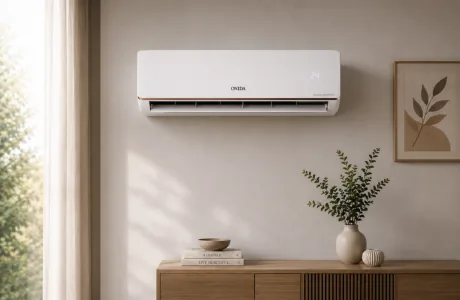
Onida's inverter split AC range is designed to maintain 24°C with high accuracy, thanks to variable-speed compressors that can slow to as low as 20% capacity once the room reaches the target temperature. This low-power mode is where inverter ACs deliver the greatest benefits over fixed-speed units, resulting in more noticeable energy savings.
| Temperature Setting | vs 24°C Baseline | Monthly Impact (est.) * | Practical Verdict |
| 18°C | +36% power consumption | +₹600–₹900 extra | Avoid — no comfort benefit |
| 20°C | +24% power consumption | +₹400–₹600 extra | Rarely justified |
| 22°C | +12% power consumption | +₹200–₹300 extra | Acceptable for sleeping |
| 24°C | Baseline (BEE standard) | Baseline | Recommended — best balance |
| 26°C | ~8% less | Save ₹130–₹200 | Ideal with a ceiling fan |
India's climate varies widely, so the best inverter AC temperature changes by region. In dry states like Rajasthan, Delhi, and Punjab, where peak summer temperatures can reach 44°C to 48°C, 24°C to 25°C is comfortable, as the low humidity makes the air feel cooler. In humid coastal cities like Mumbai, Chennai, and Kolkata, 26°C may feel warmer than the thermostat reading because high humidity prevents sweat from evaporating. In these areas, 22°C to 24°C is more suitable, or you might switch to Dry Mode at 26°C to remove moisture without aggressive cooling.
Onida's Tropical Heavy Duty inverter split AC range can effectively work at ambient temperatures up to 55°C, one of the highest ratings available in the Indian market. Its stabiliser-free operation between 160V and 290V is also essential: voltage fluctuations are common in Tier 2 and Tier 3 cities, and a separate stabiliser usually costs ₹2,000 to ₹4,500. Onida's wide-voltage design eliminates that cost.
| Region / Season | Climate Challenge | Recommended Setting | Best AC Mode |
| North India (Apr–Jun) | Dry heat up to 48°C | 24°C–25°C | Cool + Auto |
| Coastal cities (year-round) | High humidity | 22°C–24°C | Dry or Cool |
| Monsoon (Jun–Sep) | Humidity, moderate heat | 26°C–28°C | Dry Mode |
| Hills / Mild climates | Moderate heat | 26°C+ | Fan / Auto |
| Night (all regions) | Body temp drops during sleep | 20°C–23°C | Sleep Mode |
Yes. When your AC is set to 18°C on a 42°C afternoon, the compressor works hard to bridge a 24-degree gap, running at near full capacity nonstop. At 24°C, the difference drops to 18 degrees, allowing the compressor to reach the target faster and switch to a low-draw maintenance mode. Research across 200 Indian households found that switching from 20°C to 24°C reduced monthly cooling costs by 20% to 24%.
With a monthly cooling bill of ₹ 3,000, you could save ₹ 600-₹ 720, totalling ₹ 4,320 over a six-month season. An Onida 5-star inverter AC amplifies these savings, using 30% to 50% less power than a 3-star non-inverter model of the same size.
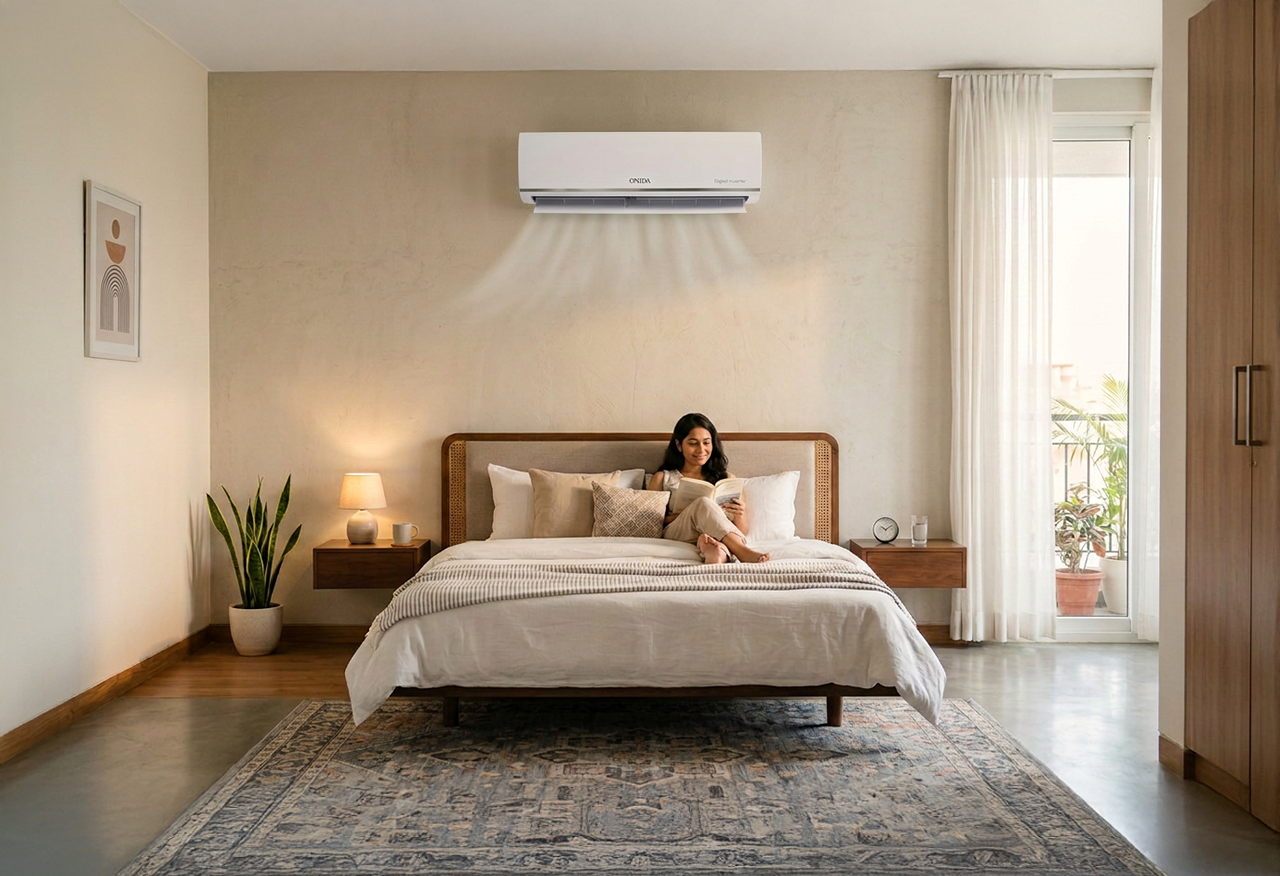
The perfect AC temperature for sleeping is 20°C to 23°C. When we sleep, our body's core temperature falls naturally, so a cooler room helps promote better rest. Setting the AC to 22°C at bedtime with a thin cotton sheet works well for most adults. For children and elderly family members, 23°C to 24°C is safer, since both groups are more sensitive to temperature changes.
The most energy-efficient nighttime approach is to use Sleep Mode. Onida inverter ACs have a Sleep Mode that gradually increases the set temperature by 1°C each hour after the first 2 hours. This feature reduces overnight power consumption by 20% to 30% without waking you up. Pair this with a timer that turns off the AC around 4 to 5 AM when outdoor temperatures drop, allowing for natural ventilation. Over a 30-day month, this routine can save you 40 to 60 units of electricity.
| Household Member | Recommended Temp | Suggested Mode | Key Tip |
| Adults | 20°C–22°C | Sleep Mode | Use a thin cotton sheet |
| Children | 23°C–24°C | Sleep Mode + Timer | Avoid direct airflow |
| Elderly | 23°C–24°C | Auto Mode | Keep the door slightly ajar |
| Hot sleepers | 20°C–21°C | Sleep Mode + Fan | The fan distributes air evenly |
Getting the best AC settings for comfort and energy efficiency involves more than just adjusting the thermostat. Your habits surrounding that setting also significantly impact your monthly bill.
The type of AC you have affects how much you save at any given temperature. A non-inverter (fixed-speed) AC compressor runs at full power until the room reaches the set temperature, then shuts off, cycling on and off repeatedly. This causes temperature swings of 2°C to 3°C and higher energy use. An inverter AC slows the compressor rather than turning it off, keeping the room within 0.5°C of the target while using as little as 30% to 40% of its peak power.
Over a six-month season of 8 hours each day, an Onida 5-star 1.5-ton inverter split AC saves ₹4,000 to ₹8,000 annually compared to a 3-star non-inverter model of the same capacity. Onida's inverter series offers ISEER ratings up to 5.0 and a 10-year compressor warranty. For rooms sized 131 to 190 sq. ft, the Majestic 1.5-ton (3-star) only uses 1,012 units annually. The higher cost of a non-inverter unit usually pays off in two to three seasons.
| Feature | Inverter AC | Non-Inverter AC |
| Compressor operation | Variable speed | Fixed speed (on/off) |
| Temperature accuracy | Within ±0.5°C of set point | Fluctuates ±2°C–3°C |
| Energy saving vs non-inverter | 30–50% less power | Baseline |
| Annual unit consumption (1.5T) | ~1,000–1,200 kWh (5-star) | ~1,400–1,600 kWh (3-star) |
| Best for | Daily use, 4+ hrs./day | Seasonal/infrequent use |
| Onida warranty (compressor) | 10 years | 10 years |
| Stabiliser required | No (160V–290V operation) | No (up to 290V on Onida) |
The ideal room temperature for your AC is 24°C, the BEE standard. For sleeping, 22°C to 23°C works best, while Dry Mode should be set to 26°C to 28°C during the monsoon. Using these settings, along with a ceiling fan, sealing rooms, and regularly cleaning filters, can help maximise efficiency year-round.
Onida's inverter split AC range is designed for these requirements: stabiliser-free operation from 160V to 290V, Sleep Mode, Turbo Cooling, 5-in-1 convertible capacity, and tropical performance up to 55°C. Visit onida.com to find the right Air conditioner model for your home and climate.



Please dispose of e-waste and plastic waste responsibly.
For more information or e-waste pick up, please call 7490 9555 55 or
click here for more details.