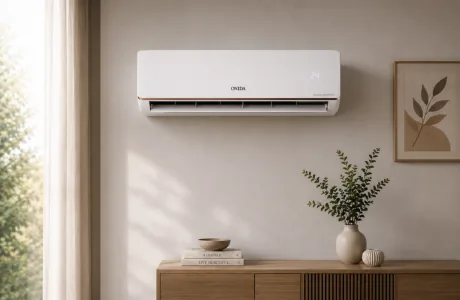


Choosing the best AC for India is not simply about picking the highest-rated model on a shopping app. The country's climate is especially challenging. You face scorching summers above 45°C in the north, constant coastal humidity in Mumbai and Chennai, and unstable voltage supplies in smaller towns and cities. What works well in temperate climates may fail in an Indian summer within a couple of seasons. Within a couple of seasons. In this guide, Onida explains what to look for when buying an air conditioner designed for Indian conditions, including BEE star ratings, inverter technology, tonnage, voltage protection, and long-term running costs.
Onida has spent decades making cooling solutions specifically for Indian homes and weather patterns. This guide draws on decades of field experience across Indian climates, voltage conditions, and usage patterns. Whether you want the best AC for Indian summer, need a unit for high humidity, or are deciding between inverter and non-inverter models, you will find clear answers here. We will also guide you through the Onida product range designed to address these specific challenges, helping you make a confident, informed purchase.
For most Indian homes, a 5-star BEE-rated inverter AC with a built-in voltage stabiliser and a high-ambient-temperature rating of at least 52°C is the best choice. This combination ensures the unit continues to cool effectively during peak summer, manages the common voltage fluctuations across India, and keeps electricity bills reasonable throughout the six-to-seven-month cooling season.
Onida's inverter AC range, available at onida.com, is built to meet these precise requirements. Their stabiliser-free operating range and high-ambient-cooling mode make them well-suited for the extreme heat and voltage fluctuations that Indian households experience every summer.
India has one of the most diverse and thermally extreme climates in the world. According to the India Meteorological Department, peak summer temperatures in states like Rajasthan, Telangana, and Maharashtra often exceed 45°C, with some areas recording over 50°C during heat waves. The IMD Heat Wave report from 2024 noted that heat wave days have increased by over 15 days per decade in several northern states. Source: India Meteorological Department (imd.gov.in).
In addition to temperature, India's power infrastructure adds complexity. Voltage fluctuations, which can dip to 140V or spike to 280V, are common in tier-2 and tier-3 cities. A standard air conditioner without built-in voltage protection can damage its compressor within a single summer under such conditions. This is why any list of the best ACs to purchase in India must include stabiliser-free operation as a basic feature, not just an option.
Humidity is the third major factor. Coastal cities like Mumbai, Kochi, and Chennai see relative humidity between 70% and 90% for much of the year. The best AC for high humidity must also dehumidify effectively. Otherwise, the room feels uncomfortable even at low temperatures. Onida ACs feature a dedicated dry mode that manages moisture levels in high-humidity environments, which is especially useful during the pre-monsoon and monsoon seasons.
This is the question most Indian buyers struggle with. The upfront price difference between an inverter and a non-inverter model can range from ₹8,000 to ₹15,000, but the long-term picture is quite different. Below is a direct comparison to help you decide.
| Feature | Inverter AC | Non-Inverter AC | Best for the Indian Climate? |
| Compressor Type | Variable speed | Fixed speed | Inverter ✓ |
| Energy Efficiency | 3–5 Star BEE rated | 1–3 Star BEE rated | Inverter ✓ |
| Power Consumption | 30–50% less power | Higher, constant draw | Inverter ✓ |
| Performance in Heat | Maintains cooling at 48°C+ | Struggles above 43°C | Inverter ✓ |
| Voltage Fluctuation Handling | Better tolerance | More sensitive | Inverter ✓ |
| Upfront Cost | ₹35,000–₹80,000+ | ₹25,000–₹45,000 | Non-Inverter (budget) |
| Noise Level | Quieter (variable speed) | Louder (on/off cycling) | Inverter ✓ |
| Ideal Usage Hours/Day | 6–10 hours+ | Up to 6 hours | Inverter ✓ |
| Long-term Savings | Saves ₹3,000–₹8,000/year | Higher annual bills | Inverter ✓ |
For anyone planning to run their AC for more than four to five hours a day, which is the reality for most Indian households from April through September, an inverter AC is both a practical and financially smarter choice. The annual savings on electricity bills alone (₹3,000 to ₹8,000, depending on usage) usually recover the price difference within 2 to 3 years.
Onida's inverter range also supports a wide operating voltage range without requiring a separate stabiliser. This alone can save you money, given that stabilisers typically cost ₹2,000 to ₹4,500 in India.
A non-inverter AC may make sense if your budget is under ₹30,000, you use the AC for fewer than four hours a day, or you live in a region with a stable power supply and moderate summer temperatures (below 38°C). For all other situations, which cover most Indian households, the best air conditioner to buy in India is an inverter model.
The Bureau of Energy Efficiency (BEE) star rating system is India's official benchmark for energy efficiency of air conditioners. Ratings range from 1 star (least efficient) to 5 stars (most efficient). The difference in power consumption between a 1-star and a 5-star unit can be as much as 40% to 50%. Source: Bureau of Energy Efficiency, Ministry of Power (beeindia.gov.in).
A 5-star inverter AC is the most cost-effective choice for Indian conditions, especially if you run it for 6 or more hours daily. For a 1.5-tonne inverter AC, the difference in annual electricity consumption between a 3-star and 5-star model can be 250 to 400 units (kWh), which translates to savings of about ₹2,000 to ₹3,500 per year at average Indian electricity rates.
Onida offers 3-star, 4-star, and 5-star inverter split ACs across its range. For households in high-usage states like Maharashtra, UP, and Tamil Nadu, Onida's 5-star models are worth considering for the long-term savings on power bills. You can compare models and their exact BEE ratings on onida.com.
Many buyers invest in a cooling air conditioner in India, then unknowingly run it on settings that cost more to operate. Here is a quick overview of the key modes and when to use them:
Onida ACs include dedicated Turbo Cool, Sleep, and Dry modes across their split AC range, providing users the flexibility to manage comfort and running costs across different seasons.
Not all air conditioners can operate in extremely high temperatures. Standard ACs usually cool efficiently up to 43°C. In places like Rajasthan, parts of Gujarat, Vidarbha, and Delhi NCR during peak May and June, a standard AC will struggle. This struggle reduces cooling output and puts excessive strain on the compressor.
If you live in a high-heat area, look for an AC with a maximum ambient temperature rating of 52°C or higher. This is often labelled as 'strong cooling' or 'high ambient mode' in AC specifications in India. Onida's inverter models are designed to maintain effective cooling in conditions up to 52°C, covering the temperature extremes in India's hottest regions.
It's important to check this feature when comparing air conditioners available in India. Many budget models may not reveal this limitation upfront, leaving buyers to discover the issue when their AC underperforms during the peak summer months.
Tonnage indicates how much heat an AC unit can remove from a room each hour. An undersized unit will run constantly without adequately cooling the space, while an oversized one will cool quickly but leave excess humidity in the air.
Consider increasing the tonnage if your room gets direct sunlight for more than 4 hours a day, is on the top floor, or has high ceilings. In Indian conditions, it's generally better to choose a slightly larger unit than risk an undersized unit that doesn't reach the desired temperature.
Onida offers a full range of tonnage options: 1 ton, 1.5 ton, and 2 ton inverter split ACs, making it easy to find the best AC for India for your specific room. Product specifications and energy ratings are available in detail at onida.com.
Onida has been a trusted name in Indian electronics for over 40 years. Its range of ACs is tailored to the unique challenges of Indian living and is not just adapted from designs meant for milder climates. Key features across Onida's inverter split AC range include:
Onida's ACs are sold through major retail outlets and online platforms across India. For detailed model specifications, energy ratings, and current pricing, visit onida.com/air-conditioners. Onida also has models specifically designed for coastal areas, addressing the combination of salt air and persistent humidity that can harm lesser units over time.
Onida's inverter ACs provide a balanced solution to the question of the best AC for India. They combine energy efficiency, heat tolerance, voltage resilience, and durability at a price point suited for the Indian market.
For the Indian climate, look for an inverter AC with a 4- or 5-star BEE rating, R-32 refrigerant, and a compressor rated for at least 52°C ambient temperature. These features help the unit stay effective during scorching northern summers, manage coastal humidity in the south, and handle the inconsistent voltage supply seen in many Indian cities.
Cool mode set at 24°C–26°C is the most efficient for Indian summers, according to the Bureau of Energy Efficiency. Use Turbo mode for the first 10–15 minutes to cool the room quickly, then switch to Auto mode to let the inverter compressor adjust. Running at 18°C–20°C increases energy consumption by 25–30% compared to 24°C.
An inverter split AC with a dedicated Dry mode works best for high humidity, especially along India's western and eastern coasts. Dry mode reduces moisture without extreme cooling, which is more comfortable and efficient during the monsoon. Onida ACs include a Dry mode function that actively dehumidifies rooms, making them suitable for cities like Mumbai, Kochi, and Chennai.
24°C is the temperature recommended by the Bureau of Energy Efficiency for comfort and energy efficiency in Indian summers. Every degree below 24°C increases electricity consumption by about 6%. For sleeping, many users find 26°C with Sleep mode comfortable and noticeably cheaper to run overnight.
No AC is certified to cool at a 60°C outdoor temperature, as this exceeds the design limits of all current consumer air conditioners. For areas that experience peaks of 48°C–52°C, like parts of Rajasthan and Telangana, choose an AC rated for a maximum ambient operating temperature of 52°C. Onida's high-ambient inverter models are effective at temperatures up to 52°C.
A 5-star inverter AC provides the best electricity savings for Indian summers. It consumes 30–50% less power compared to a non-inverter model of the same tonnage. Over a six-month cooling season with eight hours of daily use, a 5-star 1.5-tonne inverter AC can save ₹4,000–₹8,000 annually compared to a 3-star non-inverter unit at average Indian electricity rates.



Please dispose of e-waste and plastic waste responsibly.
For more information or e-waste pick up, please call 7490 9555 55 or
click here for more details.