
Summer in India can be intense. When temperatures rise above 40°C in many areas, choosing between an air cooler and an air conditioner becomes an important home-buying decision. Both devices cool your living space, but they operate on different principles, have distinct price ranges, and suit various climates, room sizes, and budgets. At Onida, we have extensive experience helping Indian families select the right cooling solution. We understand that using the wrong appliance not only results in subpar performance but also increases your monthly electricity bill.
In this blog, Onida compares air conditioner vs air cooler based on factors that matter to Indian buyers: upfront cost, running costs, cooling efficiency, suitability for different Indian climates, and long-term value. Whether you're considering a portable air cooler for a rented flat or an inverter split AC for your home, this guide will help you make an informed financial choice.
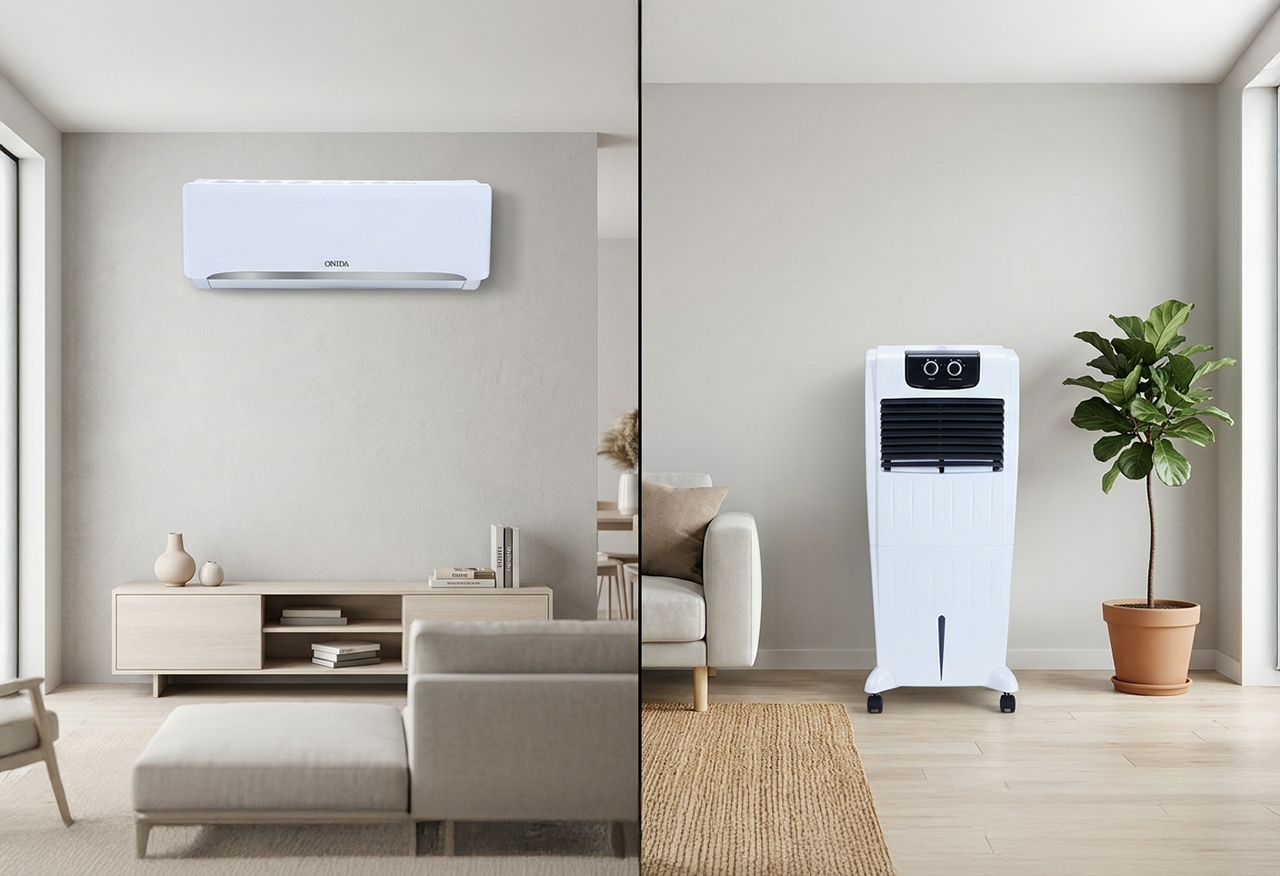
An air conditioner is better for closed rooms, humid areas, and consistent cooling throughout the day. An air cooler is better suited to dry climates, open spaces, and households with limited budgets.
An air conditioner, especially an inverter split AC, provides precise temperature control regardless of the weather and performs well in humid cities like Mumbai, Chennai, and Kolkata. A 1.5-tonne 5-star inverter split AC costs between ₹32,000 and ₹55,000 and consumes around 900-1,200 watts per hour. In comparison, a good desert cooler or personal cooler costs between ₹4,000 and ₹18,000 and uses only 150 to 250 watts, consuming approximately 80 to 90% less electricity than an air conditioning unit. However, air coolers become less effective when humidity ranges from 60 to 65%, making them unsuitable for coastal and monsoon regions. If you live in a dry, hot area like Rajasthan, Gujarat, or inland Maharashtra, an air cooler can effectively replace an AC for much of the summer.
Understanding how each appliance works helps you choose the right one for your home.
An air cooler, whether it's a desert cooler, personal cooler, or portable air cooler, relies on evaporative cooling. Warm air passes through water-soaked pads; as the water evaporates, it absorbs heat, reducing the temperature by 5 to 15°C. This process adds moisture to the air, which is why coolers perform best in dry conditions and require windows or doors to be slightly open to facilitate airflow.
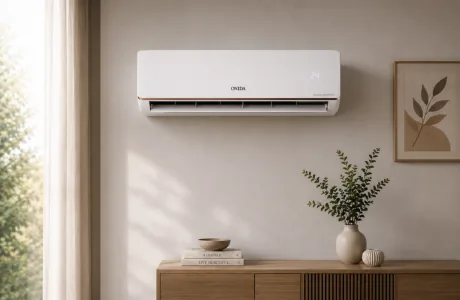
An air conditioner operates on a refrigerant-based vapour compression cycle. A compressor moves refrigerant between indoor and outdoor units, absorbing heat indoors and releasing it outside. Unlike an air cooler, an air conditioning unit removes humidity and functions in a sealed room, making it effective in all weather conditions, including India's high-humidity monsoon season.
The key difference is that an air cooler adds moisture, whereas an air conditioner removes it. This distinction helps you decide which appliance is best suited to your home.
The running costs are where the air conditioner vs air cooler debate truly matters for Indian households, and the difference is substantial.
A standard air conditioner (1.5 tonne, non-inverter) uses about 1,500 watts per hour. A 5-star inverter split AC consumes approximately 900 to 1,100 watts thanks to variable-speed technology, but it still consumes much more power than any air cooler. At an average electricity rate of ₹7 per unit across India, running a non-inverter AC for 8 hours a day costs about ₹84 a day, totalling over ₹2,500 per month.
Conversely, a desert cooler that runs for eight hours a day at 200 watts costs only ₹11.20 a day, which comes to around ₹340 monthly. A smaller personal cooler at 150 watts is even cheaper.
An air cooler uses 80 to 90% less electricity than a conventional air conditioner, making it much cheaper to operate throughout the summer.
The BEE (Bureau of Energy Efficiency) star rating system applies to air conditioners in India, with 5-star models offering the best efficiency. Onida's inverter split AC range has strong BEE ratings and significantly reduces the running-cost gap compared to non-inverter models. However, even the most efficient AC cannot compete with the power consumption of an evaporative cooler. In humid areas where a cooler doesn't function well, cooling efficiency per money spent favours the AC.
India's climate varies widely, and the best cooling choice differs by region.
In hot, dry regions like Rajasthan, Gujarat, Madhya Pradesh, and parts of inland Maharashtra, summer humidity remains below 40-50% for most of the pre-monsoon months. This creates the perfect environment for an air cooler. A desert cooler can reduce room temperature by 10 to 15°C in these conditions, providing real comfort at a fraction of the cost of an AC.
In coastal and humid cities like Mumbai, Chennai, Kochi, and Kolkata, humidity often exceeds 70-80%, especially from April onwards. In this case, evaporative cooling isn't effective since the air is already filled with moisture. An air cooler in a humid area will create uncomfortable dampness instead of cooling. Therefore, an air conditioner, particularly an inverter split AC from Onida, is a practical necessity for comfortable indoor temperatures.
The average humidity level in your city is the most crucial factor when choosing between an air conditioner vs air cooler. If your pre-monsoon humidity regularly exceeds 60%, an AC is a smart investment.
| Factor | Air Cooler | Air Conditioner |
| Upfront cost | ₹4,000–₹18,000 | ₹28,000–₹70,000+ |
| Running cost (8 hrs/day) | ~₹340/month | ₹1,500–₹2,500/month |
| Power consumption | 150–250W | 900–1,800W |
| Works in high humidity | ❌ No | ✅ Yes |
| Works in sealed rooms | ❌ No (needs ventilation) | ✅ Yes |
| Installation required | ❌ None (plug and use) | ✅ Yes (professional) |
| Portability | ✅ High (portable cooler) | ❌ Fixed unit |
| Humidity control | Adds moisture | Removes moisture |
| Maintenance | Weekly water refill, pad cleaning | Annual gas check, filter cleaning |
| BEE star rating | Not applicable | 1–5 stars (inverter models are most efficient) |
| Suitable climate | Dry, hot (below 60% humidity) | All climates, especially humid |
| Best for | Rented homes, dry regions, tight budgets | Permanent homes, humid regions, consistent comfort |
A portable air cooler, personal cooler, or desert cooler is the right option if you live in a dry area like Rajasthan, Gujarat, or inland Madhya Pradesh. It’s also great if you're renting and need a cooling solution that doesn’t require installation, or if your electricity budget can’t handle the costs of an air conditioner.
An air cooler also serves as a good supplementary appliance. Many Indian households use a cooler in bedrooms during dry pre-monsoon months and save the AC for peak summer humidity. Onida's air coolers are designed for this kind of flexible, cost-efficient use. Their tower and desert cooler models combine strong airflow with low power consumption, making them a smart choice for budget-conscious buyers.
Air coolers are also suitable for semi-open spaces like covered verandas, workshops, and large halls, where an AC may not operate efficiently without sealed walls and insulated ceilings.
An air conditioner, especially an inverter split model, is the right choice for those living in humid coastal or semi-coastal cities. It's ideal if you need reliable cooling throughout the day, regardless of the weather. Additionally, if you own your home and can justify the upfront installation cost in terms of long-term comfort and property value, an AC is a good investment.
An inverter split AC is a wise long-term choice for any household that needs cooling for more than 4 months a year. Unlike fixed-speed models, inverter compressors modify their output based on the room temperature, cutting electricity use by 30 to 50% compared to non-inverter options, resulting in significant savings during the summer. Onida's inverter split AC range includes 1-tonne, 1.5-tonne, and 2-tonne capacities, featuring high BEE star ratings and built-in voltage protection to suit India's varying power supply conditions.
Voltage fluctuations are a real concern in many Indian cities and rural areas. Onida's air conditioning units feature stabiliser-free operation across a wide voltage range, eliminating the need for an external stabiliser and reducing the risk of compressor damage during power surges.
Explore Onida's full range of inverter split ACs and air coolers to compare models by capacity, star rating, and price before making your choice.
After comparing both appliances in every important way, it's clear that neither is better for everyone. The best choice depends on your location and lifestyle. For dry northern and central India, a solid Onida desert cooler or personal cooler provides great value and much lower running costs. In humid coastal cities where comfort is key, Onida's inverter split AC range offers accurate and reliable cooling, along with excellent BEE efficiency ratings and voltage protection designed for Indian conditions.
Many Indian households benefit from both types of cooling: a cooler for the dry months and an AC for the peak summer and monsoon. Whatever you decide, check out Onida's full cooling range from compact personal coolers to large split ACs to find the appliance that fits your room, region, and budget.
An air conditioner works better in humid climates and sealed rooms, while an air cooler is more effective in dry climates and open spaces. The right choice depends on where you live in India. Coastal cities with humidity over 60% need an AC, while dry inland areas can be cooled well with a desert cooler at a much lower cost.
Yes, air coolers can reduce a room's temperature by 5 to 15°C in dry conditions where humidity is below 60%. They pull warm air through water-soaked pads, lowering the temperature through evaporation. However, their effectiveness declines in high-humidity situations, making them unsuitable for coastal cities during and after the monsoon.
Air coolers can replace air conditioners in dry regions like Rajasthan, Gujarat, and inland Maharashtra during most of the pre-monsoon summer period. In humid areas such as Mumbai or Chennai, they cannot substitute for an AC because they add moisture to already saturated air, which decreases comfort.
No, air coolers use very little electricity compared to air conditioners. A typical personal cooler or desert cooler uses 150 to 250 watts, while an air conditioner requires 900 to 1,800 watts. Running a cooler for 8 hours a day costs about ₹340 per month at standard Indian rates, roughly 80-90% less than operating an AC for the same duration.
In dry conditions, an air cooler provides cool, fresh airflow, but it doesn’t match the sealed-room precision of an air conditioner. A cooler adds moisture and requires ventilation, while an AC removes humidity and works in a closed space. In dry climates, the difference in comfort is smaller; in humid climates, it is much larger.
Yes, significantly less. An air cooler uses 150 to 250 watts, while a 1.5-tonne non-inverter AC consumes around 1,500 watts. Even a 5-star inverter split AC, which uses about 900 to 1,100 watts, consumes four to six times as much electricity as a cooler. This difference in running costs is crucial for budget-conscious households in dry climates.
Opt for a desert cooler or portable air cooler if you live in a dry area, rent your home, or have a limited monthly electricity budget. Choose an inverter split AC if you reside in a humid city, need all-day cooling regardless of the weather, or plan to stay in your home long-term. Onida offers strong options in both categories, with models designed for India’s diverse climate zones and voltage conditions.



Please dispose of e-waste and plastic waste responsibly.
For more information or e-waste pick up, please call 7490 9555 55 or
click here for more details.