
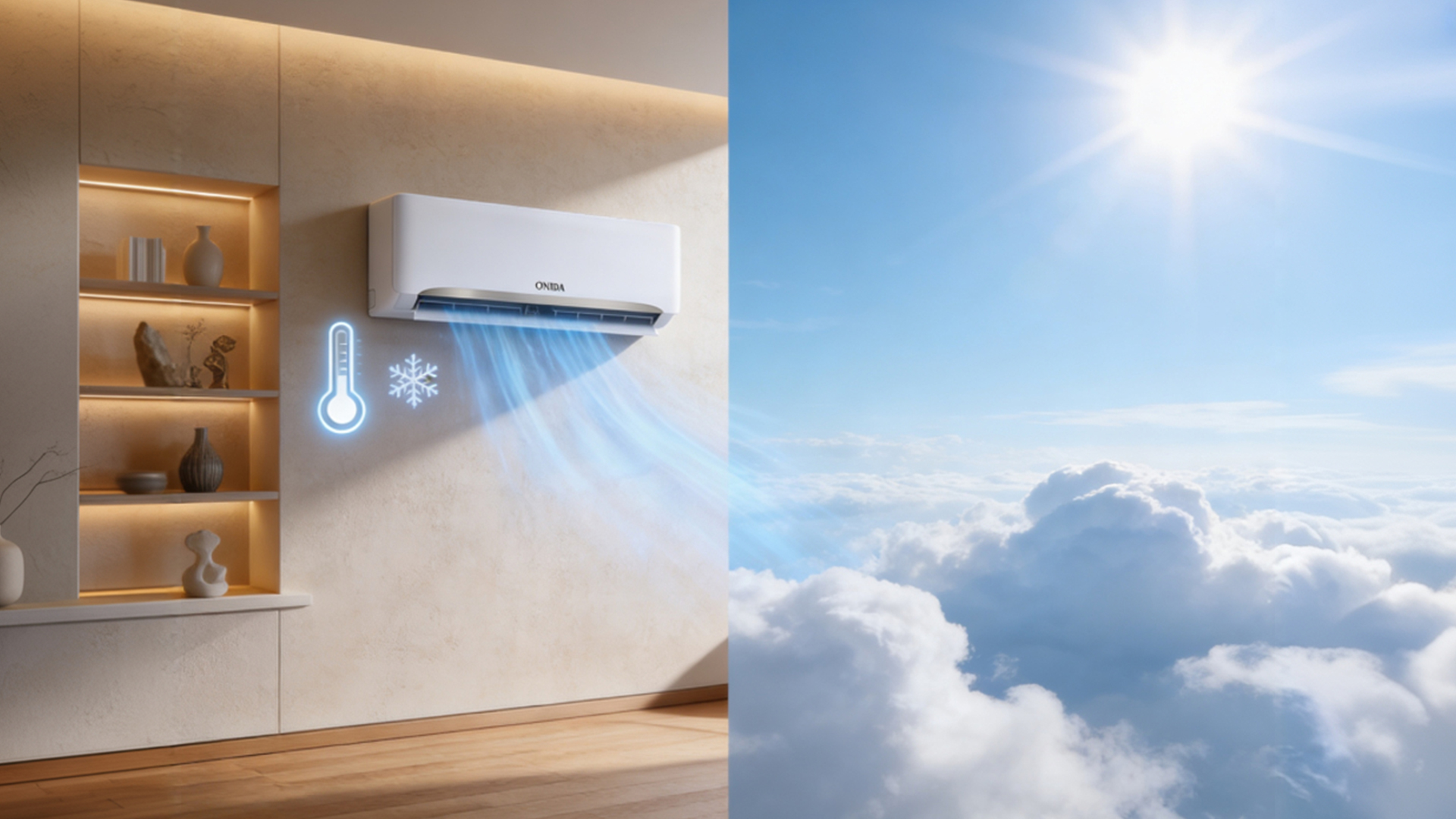
In this guide, Onida highlights the cooling features that set a good inverter AC apart from a great one when temperatures soar to 45°C and higher. Most buyers in India focus on tonnage and star rating when selecting an AC, and both are important. However, the features listed on the spec sheet will determine whether your home remains comfortable during the peak of an Indian summer or if the unit struggles when you need it most.
The direct answer: for Indian conditions, the four key features in choosing the best AC for India are a high ambient temperature rating (55°C or higher), 5-in-1 convertible cooling for efficient energy use across seasons, Turbo Mode for quick cooling upon arrival, and stabiliser-free voltage tolerance between 140V and 290V. Each Onida inverter split AC in the current lineup meets all these criteria, confirmed on onida.com. This guide explains what each feature does in practice, why it matters for Indian homes, and how to read a spec sheet to ensure you are truly getting what you pay for.
India's cooling challenge is not just about heat; it involves several factors that would test even the most advanced air conditioner. Ambient temperatures in Rajasthan, Uttar Pradesh, Vidarbha, and Telangana regularly surpass 45°C during peak summer. The India Meteorological Department's 2024 heat wave data revealed that heat wave days have increased by more than 15 days per decade in several northern states. Coastal cities add humidity to the mix; Chennai, Mumbai, and Kochi experience wet heat that makes discomfort worse than what a temperature reading alone suggests.
Moreover, India's power grid presents a mechanical challenge. Voltage fluctuations, with supply dipping to 140V or spiking to 280V, are common in tier-2 and tier-3 cities during peak load hours. AC models designed for standard temperate climates are tested at 43°C ambient and engineered for a relatively stable 220V–240V supply. They function differently from an AC built for Indian conditions. The gap between these two categories is what the best inverter air conditioner for Indian use must close. The features described below highlight this gap.
Turbo Cooling is the feature that most buyers notice first, and it is often misunderstood. When you activate Turbo Mode, either from the remote or the AC's panel, the unit pushes the compressor to its maximum speed while running the indoor fan at its highest setting. This results in a much quicker drop in room temperature than normal operation would achieve.
The practical value for Indian homes is clear: when you return home after a day out, and the room has been soaking up heat all afternoon, you want it comfortable within minutes, not half an hour. Turbo Mode provides a quick cool-down and then switches back to normal inverter operation, so the energy spike is brief rather than continuous. In Onida's inverter line, Turbo Cooling is designed to reach the desired temperature even at 55°C ambient heat, as specified on the Onida product pages for the Gloria Refresh, Rio, Ziva, Olympus, Gale, Majestic, Fiesta, and Elegance models.
One oversight in many AC buying guides is the difference between Turbo Mode and simply running the AC at its highest manual fan speed; they are not the same. Turbo Mode runs both the compressor and the fan at a higher-than-normal speed, unlike regular high-fan operation. Verify in the product specifications that the model explicitly lists Turbo Mode, not just a high fan speed setting.
The convertible cooling mode, offered as 5-in-1 across Onida's current inverter air conditioner range, allows the AC to operate at different percentages of its rated capacity: typically, 40%, 60%, 80%, 100%, and 110% (for Turbo). This might seem like a gimmick, but it is one of the most practical features for Indian households, and here's why.
India's summer is not consistent. March and November are warm but not extreme. June and July are humid and moderately hot rather than sweltering. October often brings residual heat that needs cooling, but not at full strength. Running a 1.5-ton AC at 100% capacity in a room that only needs 60% cooling wastes electricity. A convertible AC adjusts its output to match actual demand; the compressor runs slower, consumes less power, and extends its lifespan.
The numbers speak for themselves: independent analysis shows that a convertible AC running at 40% capacity uses significantly less power than the same unit at full load. An ideal AC for a household with varying room occupancy, a couple during the week, and a full family on weekends, should operate at reduced capacity during low-occupancy times. Onida's 5-in-1 convertible range handles this automatically with a single mode selection. All current Onida models, from the Fiesta (1T, 3-star) to the Ziva and Olympus (1.5T, 5-star), include convertible cooling.
For buyers comparing the best cooling air conditioners in India across different models and brands, the table below lists the key cooling features, their practical applications, and which Onida models include them all, verified on onida.com.
| Feature | What It Does | Onida Models with This Feature |
| Turbo Cooling | Blasts compressor and fan at max speed for instant rapid cool-down | Onida inverter range — all current 1T, 1.5T, 2T models |
| 5-in-1 Convertible Cooling | Adjusts capacity between 40% and 110% to match room occupancy and heat load | Fiesta (1T), Gloria Refresh, Rio, Majestic, Olympus, Ziva, Gale (all 1.5T models) |
| 55°C Max Ambient Rating | Maintains effective cooling even when the outdoor temperature reaches 55°C | All Onida 1T and 1.5T inverter models confirmed on onida.com |
| AI Sensing / iFeel Sensor | Reads temperature at the remote location rather than the wall unit; adjusts output for genuine comfort | Gloria Refresh, Olympus, Gale, and select models with AI auto mode |
| AI Deep Clean / Frost Clean | Self-cleans evaporator coils by removing moisture and bacteria buildup automatically | Gloria Refresh, Majestic, Olympus, Ziva, Gale, Everest (2T) |
| Magic Neem Filter | Neem-treated anti-allergen, anti-viral, anti-inflammatory filter for healthier indoor air | Standard across all Onida inverter split AC models |
| Stabiliser-Free Operation | Handles input voltage between 140V and 290V without an external stabiliser | All Onida inverter models — confirmed range 160V–290V on onida.com |
| Sleep Mode | Gradually raises temperature through the night; reduces overnight electricity use by 10–15% | Standard across all Onida inverter models |
| 4-Way Swing | Distributes cool air horizontally and vertically for uniform room coverage | Standard on Gloria Refresh, Olympus, Ziva, Gale, Everest, Majestic |
| 10-Year Compressor Warranty | Industry-leading warranty, most brands offer 5 years; Onida offers 10 years | All Onida inverter models |
Standard Bureau of Energy Efficiency (BEE) test conditions for AC efficiency ratings use 35°C indoors and 43°C outdoors. This is the environment in which a unit's ISEER score is determined. When outdoor temperatures exceed 43°C, which is common in many parts of northern and central India during May and June, a standard inverter AC without a high-ambient rating starts to operate outside its tested range.
The practical consequences are clear: the compressor has to work harder to push refrigerant against a larger temperature difference, which lowers efficiency. Thermal protection may also activate automatic shutdowns to prevent damage. An air conditioner rated for a maximum ambient temperature of 55°C is built and tested to provide effective cooling at these extremes, not just to withstand them for a short time. Every Onida 1-ton and 1.5-ton inverter model in the current lineup meets this 55°C rating, making them among the best air conditioners to buy in India for hot states like Rajasthan, Telangana, Vidarbha, and Delhi NCR.
Look for "Max Ambient: 55°C" in the product specifications instead of relying on phrases like "suitable for Indian conditions" in marketing materials. The first is a measurable specification, while the second is not. All Onida inverter split AC product pages on onida.com clearly display this rating.
The electricity consumption of an inverter AC depends mainly on three factors: BEE star rating (ISEER), daily usage hours, and outdoor temperature during operation. The star rating is the most controllable factor when purchasing; the other two depend on how you use the unit.
For context, a 1.5-ton 3-star inverter AC uses about 900–1,100 kWh annually under BEE test conditions. A 5-star equivalent reduces that to about 650–850 kWh. At ₹7 per unit (Maharashtra DISCOM rate), the annual savings range from ₹1,750 to ₹3,150 in electricity costs. This difference is enough to recover the higher price of a 5-star model over a 3-star unit within 18 to 24 months of regular use. Inverter ACs use 30–50% less electricity than fixed-speed non-inverter models of the same capacity.
Temperature settings greatly influence consumption. Setting your AC to 24°C instead of 20°C can lower consumption by about 12–20%. Each degree decrease increases the compressor load by 3–5%. Since 2020, the BEE has required 24°C as the default factory temperature for all new ACs sold in India. Onida's Sleep Mode, standard on all inverter models, automatically raises the temperature by 0.5–1°C per hour overnight, reducing overnight consumption by about 10–15% without disrupting sleep comfort.
The most crucial decision regarding AC sizing is tonnage, which refers to the cooling capacity. Unfortunately, this is often made incorrectly. The basic guideline (1 ton per 120–150 sq. ft) is just a starting point. Due to India's climate, high ambient heat, south-facing walls, proximity to a kitchen, and ceilings taller than 9 ft, the actual heat load in a room often increases, requiring a larger unit.
As a simple guide for Indian conditions, for a room up to 120 sq. ft with standard ceiling height and moderate sun exposure, a 1-ton inverter AC will suffice. For spaces between 120–180 sq. ft, like a typical Indian bedroom or living room, start with a 1.5-ton unit. For 180–240 sq. ft, especially in south-facing rooms or rooms adjoining kitchens, a 2-ton unit is more suitable. Undersizing is a common mistake that causes more harm: an undersized AC runs non-stop at full load, fails to reach the set temperature during peak heat, and significantly wears out the compressor.
Onida's inverter AC range includes capacities of 0.8T, 1T, 1.5T, 1.6T, and 2T, allowing buyers to select the appropriate size without being limited to standard tonnages. Onida also provides a thorough AC buying guide on onida.com, which features a room-size calculator based on ASHRAE-standard heat-load principles worth checking before making a purchase.
After considering the demands of Indian summers, 55°C ambient tolerance, stable voltage operation without a stabiliser, convertible cooling for efficiency, Turbo Mode for quick cooling, AI sensing for comfort, and a filter system capable of managing the allergen levels in Indian cities, the outcome is clear.
For a 1-ton bedroom (up to 120 sq. ft): The Onida Fiesta or Elegance (1T, 3-star inverter) includes all key features: 55°C ambient, 5-in-1 convertible, Turbo Mode, Magic Neem Filter, copper coil, and a 10-year compressor warranty at competitive prices.
For a 1.5-ton bedroom or medium living room (120–180 sq. ft) with moderate use: The Onida Gloria Refresh 1.5T 3-star inverter is the best option 5-in-1 convertible, AI sensing, Deep Frost Clean, 55°C ambient, Magic Neem Filter, and 4-way swing at a price that allows you to recover the star premium within two summers of regular use.
For 8 or more hours of daily use, or in a south-facing room in a hotter city: The Onida Ziva or Olympus (1.5T, 5-star inverter) provides ISEER 5.2+ performance, using about 700 kWh annually, the lowest in Onida’s 1.5-ton category. At ₹7 per unit, this means running costs of under ₹5,000 per year. The extra cost for a 5-star model over a 3-star is typically recouped within 18 to 24 months through savings on electricity.
For a 2-ton hall or large space: The Onida Everest (2T, 3-star or 4-star Wi-Fi inverter) offers the same feature set, 55°C ambient, 5-in-1 convertible, Turbo Mode, and Deep Frost Clean for larger rooms. The 4-star Wi-Fi version adds app and scheduling control at an additional cost of about ₹2,000–₹5,000 over the standard model.
The best inverter AC for Indian summers is one that is rated for 55°C ambient temperature, with 5-in-1 convertible cooling, Turbo Mode, and stable operation without a stabiliser between 140V and 290V. Onida's 1.5-ton inverter range, including the Gloria Refresh (3-star) and Olympus (5-star), meets all four criteria, addressing the main needs for Indian heat, humidity, and grid conditions.
The five key features for Indian conditions are: high ambient temperature rating (55°C), 5-in-1 convertible cooling for seasonal efficiency, Turbo Mode for quick cooling, stable voltage operation, and 100% copper condenser coils for durability in humid and coastal environments. The BEE star rating affects running costs and should be selected based on daily usage hours: 5-star for over 8 hours a day, 3-star for moderate use of 4–6 hours a day.
Yes, as long as the AC has a confirmed 55°C max ambient rating. This means it has been designed and tested to operate at these temperatures, not just to withstand them for short periods. Standard BEE test conditions assume an outdoor temperature of 43 °C. Models that lack a high ambient specification begin to lose efficiency above this point. All Onida 1-ton and 1.5-ton inverter models currently rated at 55°C are noted on their product pages.
Yes, inverter ACs use 30–50% less electricity than fixed-speed non-inverter models of similar capacity because the compressor adjusts its speed to meet cooling demand rather than fully cycling on and off. A 1.5-ton 5-star inverter AC consumes about 700 kWh annually and costs under ₹5,000 to run, compared to ₹8,000–₹10,000 for an equivalent non-inverter model.
For Indian conditions, use 1 ton for rooms up to 120 sq. ft, 1.5 tons for 120–180 sq. ft, and 2 tons for 180–240 sq. ft, making adjustments for south-facing rooms, high ceilings above 9 ft, or kitchens nearby. Undersizing is a more damaging mistake. An underpowered AC runs continuously at 100% load during peak heat, cannot achieve the desired temperature, and wears the compressor out much faster than a properly sized unit.
Turbo cooling drives the compressor and indoor fan to their highest speeds for a short time. This quickly lowers the room temperature, usually in 5 to 10 minutes instead of the usual 20 to 30 minutes. It is especially helpful when you come home to a hot room. Once the desired temperature is nearly reached, the unit automatically switches to normal inverter operation. This means the energy spike from Turbo Mode is brief, not lasting.
Smart inverter ACs are worth the extra ₹2,000 to ₹5,000 if someone is out of the house for 8 or more hours a day. Remote scheduling stops the AC from running when it's not needed, which can save ₹1,700 to ₹2,900 per season at standard rates. For households with a fixed schedule, the energy savings are not as great, but app control and sleep scheduling add real convenience even without typical commuting patterns.
In high-humidity cities like Mumbai, Chennai, and Kolkata, the best AC is an inverter split with a Dry Mode function, 5-in-1 convertible cooling, and 100% copper condenser coils. Dry Mode runs the compressor at a low, constant speed to remove moisture without overcooling. This is most effective for humid but moderate evenings during the monsoon season. Copper coils resist salt-air corrosion in coastal cities, while aluminium coils may develop pinhole leaks in just 2 to 3 years.
A 1.5-ton, 5-star inverter AC running for 8 hours daily consumes around 9 to 12 units (kWh) each day, or ₹1,800 to ₹3,200 per month, depending on state rates. Maharashtra charges ₹8 per unit, which is higher, while Goa charges ₹3.80 per unit, which is lower. Setting the temperature to 24°C instead of 20°C saves 12-20% of that monthly usage. Using Sleep Mode can cut down the overnight energy use by another 10 to 15%.



Please dispose of e-waste and plastic waste responsibly.
For more information or e-waste pick up, please call 7490 9555 55 or
click here for more details.