
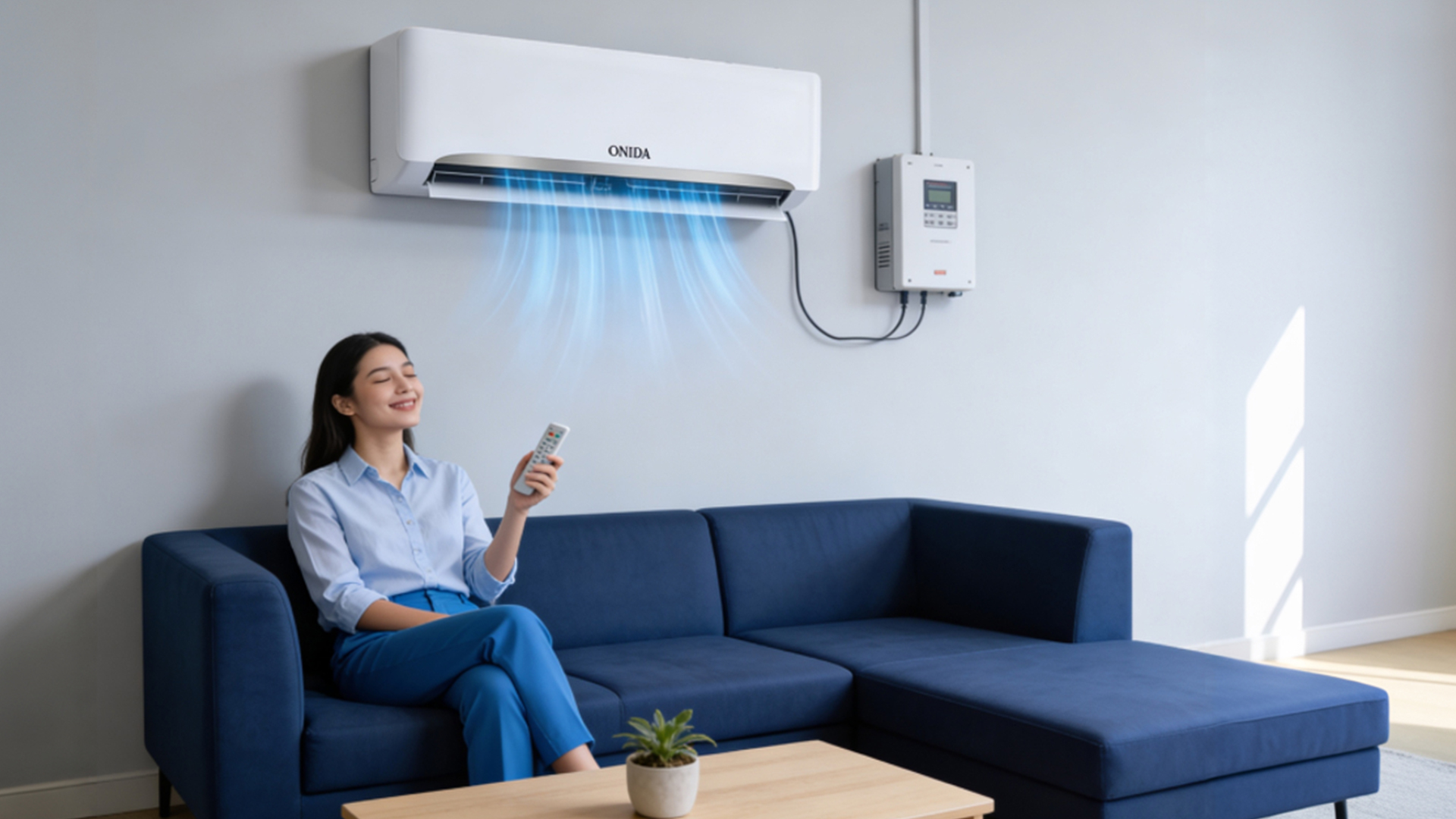
If you have bought a modern inverter AC, you almost certainly do not need a separate AC stabiliser. Most inverter ACs made since 2018 come with built-in voltage regulation that handles input voltages between 140V and 290V, well beyond the fluctuation range in most Indian cities. Adding an external stabiliser for inverter AC costs ₹2,500 to ₹6,000 upfront, draws 30 to 100W continuously, and adds ₹1,500 to ₹4,200 to your annual bill without providing extra protection. The exception is when the voltage regularly dips below 140V or surges above 290V, which is usually the case in rural or industrial areas. In those cases, an external stabiliser may still be worthwhile.
In this blog, Onida explains how the AC with an inbuilt stabiliser works, when the built-in protection is enough and when it is not, the real cost difference between running a split AC with and without a stabiliser, and a practical guide for Indian households.
A voltage stabiliser for AC is a device that corrects incoming mains voltage by boosting it when it drops too low and reducing it when it surges. Older fixed-speed, non-inverter ACs were designed to operate within a narrow range of about 180V to 250V. Any voltage outside this range caused the compressor to run under strain or shut down. Voltage-stress failures were common in towns and rural areas with weak power grids.
The AC stabiliser connection was necessary for those units. However, the AC market changed significantly after 2015. BEE made inverter AC labelling mandatory, and the share of inverter models jumped from under 1% to over 75% of all Indian AC sales by 2022. These modern inverter ACs have voltage regulation built into their electronics, making external stabilisers unnecessary in most cases.
The AC with an inbuilt stabiliser feature in inverter models is not a separate unit; it is part of how inverter technology operates. The main inverter circuit converts the incoming AC mains to DC, then back to AC at the correct frequency to drive the compressor at variable speed. This process isolates the compressor from direct mains voltage exposure and allows the inverter to handle voltage variations within its range without losing performance.
Onida's inverter split ACs function without a stabiliser from 140V to 290V, as confirmed across the entire product line on onida.com. Fixed-speed models also have stabiliser-free ratings up to 290V. For most Indian urban and semi-urban households, this built-in protection is entirely sufficient.
The table below compares a modern inverter AC with built-in voltage protection to an older or non-inverter AC that relies on an external AC stabiliser. It covers protection, running cost, and practicality:
| Factor | Modern Inverter AC (built-in stabiliser-free) | Older / Non-Inverter AC + External Stabiliser |
| Voltage handling | 140V–290V built-in (Onida inverter range) | Narrow range; stabiliser needed for protection |
| External stabiliser needed? | No — for most Indian urban/semi-urban areas | Yes — required for safe operation |
| Power consumed by the stabiliser | Zero — no separate unit | 30–100W additional draw constantly |
| Annual cost of stabiliser | Nil | ₹1,500–4,200/yr (at ₹7/unit, 8 hrs/day) |
| Installation complexity | Simpler — one fewer component to install | Additional wiring, wall space, and cost |
| PCB protection | Built into the inverter circuit — auto voltage regulation | The stabiliser provides an external protection layer |
| Risk if the voltage exceeds the range | Auto cut-off or derating prevents damage | Without stabiliser: potential PCB / compressor damage |
| Best for | Metro and Tier-1/2 cities; standard grid supply | Rural areas with chronic dips below 140V |
The external stabiliser adds an annual electricity cost of ₹1,500 to ₹4,200 for no extra protection if your inverter AC's built-in range already covers your local voltage conditions. The only scenario where an external stabiliser proves beneficial is in areas where voltage consistently falls below 140V or exceeds 290V. The built-in circuit cannot fully compensate for those conditions.
Most buyers in Indian metros and Tier-2 cities can skip the external stabiliser for AC. However, certain situations make it worthwhile:
Use the table below to help determine if you need a separate AC stabiliser based on your location, AC type, and local grid conditions:
| Your situation | AC type | External stabiliser needed? |
| Metro/Tier-1 city; stable grid | Modern inverter AC (140V–290V) | No |
| Semi-urban; occasional dips to 150V | Modern inverter AC (140V–290V) | Optional — check voltage with an electrician first |
| Rural; frequent dips below 140V | Any AC | Yes — external stabiliser recommended |
| Older non-inverter AC (any location) | Fixed-speed / window AC | Yes — mandatory for protection |
| Industrial zone; extreme surges | Any AC | Yes — invest in a servo stabiliser |
If you decide to buy a stabiliser for an inverter AC, choose an ISI-marked unit rated at least 4kVA for a 1.5-ton AC. A digital display showing live input and output voltage can confirm whether your area's fluctuations fall outside the AC's built-in range. If the readings stay within 140V–290V, the stabiliser does not provide useful protection.
It is easy to check if your AC has an in-built stabiliser feature. Look for the term "stabiliser-free operation" on the product label or specification sheet, and note the quoted voltage range. A range of 140V–290V, or wider, confirms built-in voltage regulation across the entire grid variation in India. Onida publishes the operating voltage range on each AC model page at onida.com.
If the label shows a voltage range starting at 140V or lower, you typically do not need a separate stabiliser in most Indian conditions.
No, if you have a modern inverter AC with built-in stabiliser-free operation rated at 140V–290V. Most Indian inverter ACs, including Onida's full range, work safely within this range without needing an external unit. You only need a separate stabiliser for AC if your local voltage consistently falls below 140V or exceeds 290V.
An AC with an inbuilt stabiliser (any modern inverter AC) has built-in voltage regulation that covers 140V–290V. It does not require an external device. An older or non-inverter AC without this feature needs a separate voltage stabiliser to protect the compressor and PCB. The external stabiliser also consumes 30–100W of power continuously, adding ₹1,500–4,200 to the yearly electricity bill.
Yes, for most Indian households. The built-in voltage regulation in modern inverter ACs manages 140V–290V, covering about 90% of urban and semi-urban grid conditions. It is only insufficient in rural or industrial areas with regular voltage drops below 140V or severe surges above 290V. In those cases, an external stabiliser for the inverter AC is recommended.
Yes, any inverter AC with stabiliser-free operation rated at 140V–290V can work without an external AC stabiliser. Onida's full inverter range is designed for this. For non-inverter or fixed-speed ACs in areas with unstable supply, removing the stabiliser risks damage to the PCB and compressor. Always check your AC's operating voltage range in the manual or on the product page before making a decision.
A modern inverter AC operates safely without a stabiliser; its built-in circuit manages voltage variations within its rated range (typically 140V–290V). If the voltage falls below the minimum, the auto cut-off activates to prevent damage. Running an older non-inverter AC without a stabiliser at low or high voltage can cause the compressor to draw excess current, risking permanent damage.
No, not for most Indian households with a modern inverter AC. Over 75% of ACs sold in India are now inverter models with built-in voltage protection spanning 140V–290V. An external AC stabiliser is needed only if your local supply regularly falls outside this range, usually in rural or industrial areas with ongoing grid issues.
Onida's full inverter AC range offers built-in stabiliser-free operation from 140V to 290V across all models, confirming this on onida.com. This applies to 3-star and 5-star variants from 1 ton to 2 tons. The Gloria Refresh, Majestic, and Olympus are popular 1.5-ton choices, and fixed-speed models also have stabiliser-free ratings up to 290V.



Please dispose of e-waste and plastic waste responsibly.
For more information or e-waste pick up, please call 7490 9555 55 or
click here for more details.