

Staying cool and comfortable all year round is not a luxury; it is a necessity for an elevated lifestyle, and choosing the best AC for your space is not just about grabbing an excellent deal. It involves selecting the best brand, the ideal type of AC, and most importantly, the correct capacity of AC to suit your cooling needs.
This blog by Onida is a comprehensive guide to choosing the right capacity of inverter split AC (the most trending and the most upgraded AC in the market today) for your dear space. Whether it is a compact bedroom, a comfortable studio apartment, a luxurious living room, or a decent-sized office, Onida has a solution for every air conditioning requirement.
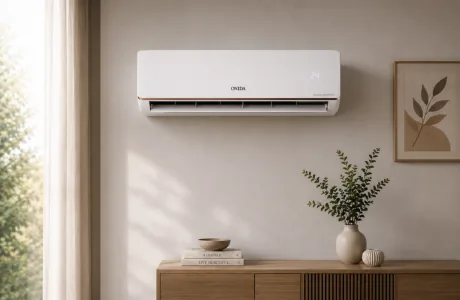
As the word ‘split’ suggests, an inverter split AC comprises two separate units - an indoor unit which is mounted inside a room for air circulation, and an outdoor unit, installed outside, housing the compressor and condenser. It uses the inverter technology that operates with pulse-width modulation (PWM) required to regulate the speed of the compressor motor, adjusting the cooling output dynamically based on your room’s needs. Rather than turning off once the desired temperature is reached, the compressor slows down, maintaining a steady climate unlike in non-inverter ACs that operate in a fixed on/off mode. Key differences between an inverter AC and a non-inverter AC may be summed up as under:
Inverter AC features: Variable speed, continuous operation, smooth temperature regulation, reduced energy consumption.
Non-inverter AC features: Fixed-speed, and frequent on / off cycles resulting in power spikes and temperature swings.
In short, inverter ACs are smarter, quieter, and more economical (ideal for Indian households with extended AC usage).
Choosing the right category (type) of AC is not enough to enjoy the best results; going for the right capacity of Inverter Split AC is equally important to have a relaxing experience inside a space.
Measure Your Room Size (capacity recommended for sq.ft)
(Tip: Multiply your room’s length × width to calculate square footage)
Room size should not be the sole determinant of inverter split AC’s capacity for a space, other factors that need consideration are as follows:
Room Characteristics
Spaces in hot and humid climatic zones such as Mumbai, Chennai, or Delhi need to be fitted with AC of slightly higher capacities as compared to places that have cooler climates or are based on higher-altitudes.

When it comes to smart home cooling, Onida is a trusted name for Indian households. Here's why:
Now you know (after going through this guide) that choosing the right capacity for Inverter Split AC is not just about calculating your room’s square footage; it is about understanding other characteristics of your room, local climatic conditions, and suitability to your lifestyle habits.
Whether you want to make your house summer ready or install a new AC in your office, store, or gym, Onida has a solution for every air conditioning requirement. Its wide range of inverter split AC offers the perfect blend of performance, style, and reliability, making it an ideal choice for any Indian space.
An inverter uses pulse-width modulation (PWM) to control the compressor’s motor speed. The compressor slows down rather than turning off once the desired temperature is reached.
Yes! Onida inverter split AC (Air Conditioner) as well as other Onida Electronics and Home Appliances are sold and delivered in all Indian cities, suburbs, and small towns, whether experiencing hot climate or cold.
Onida offers inverter split AC models of 1 ton, 1.5 tons, 1.6 tons, and 2.0 tons capacities and 3-star and 5-star energy efficiency ratings.
Yes! Onida inverter split AC uses 100% copper in the AC's condenser, pipes, and installation kit, emphasizing its corrosion resistance and reliability.
Ceiling height, sunlight exposure, occupancy (no. of persons in a room), and heat-producing appliances in the house are some of the factors that must be taken into account.



Please dispose of e-waste and plastic waste responsibly.
For more information or e-waste pick up, please call 7490 9555 55 or
click here for more details.