
As Indian summers grow severe, picking the right AC capacity prevents both under-cooling and wasted electricity. Onida breaks down the 1 ton vs 1.5 ton AC debate with precise room size guidelines, power consumption facts, and real Indian home examples. We'll show you how to match tonnage to your space for optimal comfort.
Whether your bedroom measures 100 sq. ft or your living room spans 200 sq. ft, this blog delivers the formula, BEE-rated options like AC 1.5 ton 5 star and 1 ton split AC 5 star, and Onida picks that balance price with performance. Expect clear tables, calculators, and FAQs drawn from top search queries.
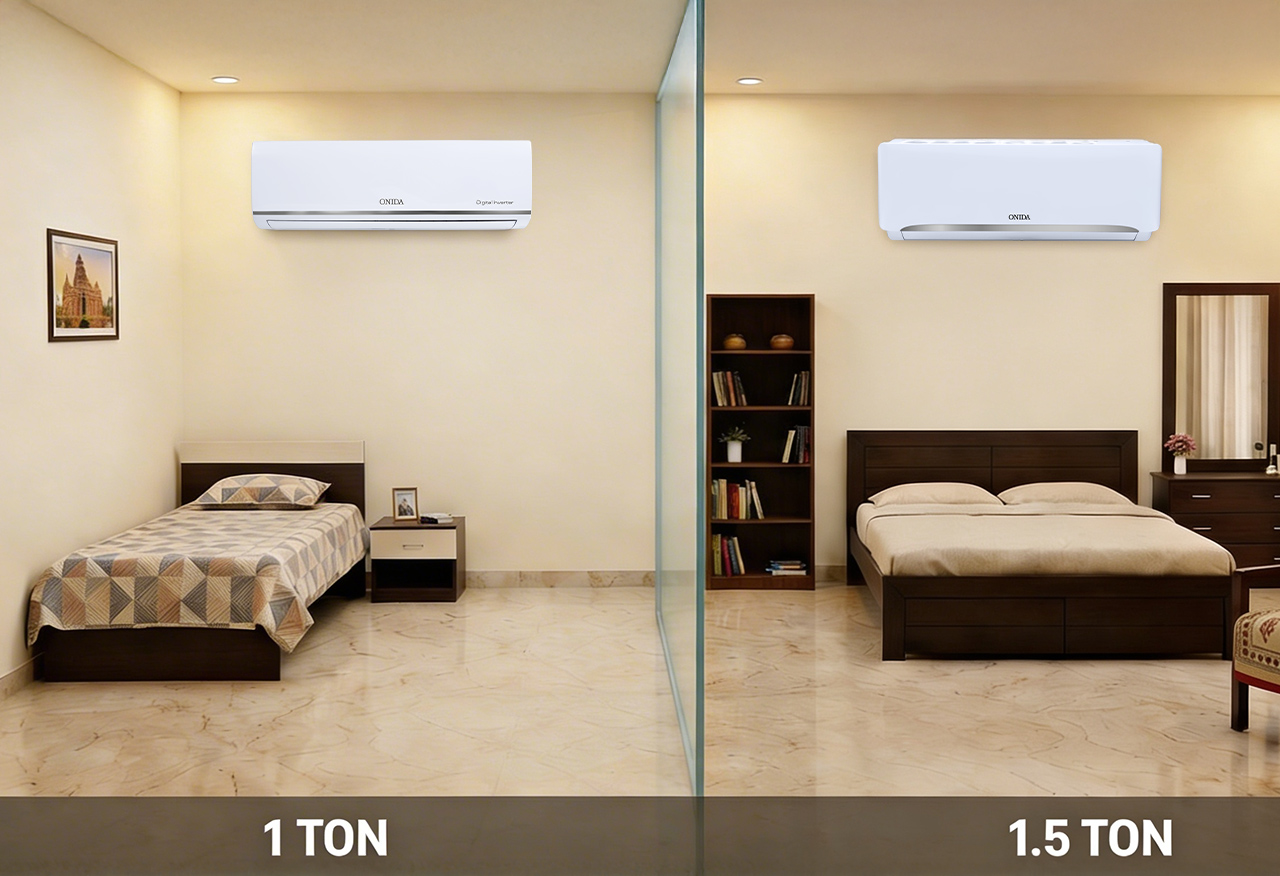
Direct Answer: Choose 1 ton AC for rooms up to 120 sq. ft (bedrooms, small offices). Go 1.5 ton AC for 150-220 sq. ft (living rooms, master bedrooms). 1 ton AC uses 900-1,200W; 1.5 ton AC draws 1,200-1,800W, but only buy larger if needed, as oversizing hikes bills 20-30%.
| Room Size | Recommended AC Capacity | Onida Example |
| Up to 120 sq. ft | 1 ton AC | IR163VITN (1 ton 3 star inverter AC) |
| 150-220 sq. ft | 1.5 ton AC | IR185CLS (AC 1.5 ton 3 star) |
1 ton AC cools 80-120 sq. ft effectively in Indian conditions (sunny windows, 2-4 people). Up to 120 sq. ft gets steady 24°C cooling without overworking. Bedrooms (10x12 ft) or home offices fit perfectly in 12x10 ft spaces with one window.
In Mumbai's humidity, add 10% capacity for south-facing walls. 1 ton split AC 5 star like Onida IR165VINV (ISEER 5.0, ₹28,000) sips 0.9-1.1 kWh/hour. Undersizing causes a 15-20% increase in runtime; Onida's copper coils handle voltage swings (140-280V).
Key formula: Area (sq. ft) ÷ 600 = basic tons. 100 sq. ft = 0.17 tons → round to 1 ton AC.
1.5 ton AC tackles 150-220 sq. ft living rooms, large master bedrooms (15x15 ft). Master bedrooms or 14x16 ft halls stay cool even at 45°C ambient. Kitchens add 4,000 BTU (0.3 tons extra) for appliances.
How many sq. ft can a 1.5 ton AC cool? 200 sq. ft insulated; 180 sq. ft sunny. Onida's AC 1.5 ton 5 star IR185VITN (₹38,000, 1.2 kWh/hour) includes stabiliser-free operation. Delhi users report 25% faster pull-down vs 1 ton AC in 200 sq. ft spaces.
Is 1.5 ton AC enough for 250 square feet? Marginal, needs heavy curtains, else upsize to 1.8 tons.
Does 1 ton AC consume less power than 1.5 ton AC? Yes, 1 ton AC averages 1 kWh/hour vs 1.5 ton AC's 1.4 kWh (8 hrs/day = ₹48 vs ₹67 at ₹8/unit).
| AC Capacity | Power Draw | 8-hr Cost | Monthly Bill (30 days) |
| 1 ton AC | 900-1,200W | ₹48-64 | ₹1,440-1,920 |
| 1.5 ton AC | 1,200-1,800W | ₹64-96 | ₹1,920-2,880 |
1.5 ton inverter AC like Onida IR185PRSG saves 30% post-stabilisation. Which AC consume more electricity, 1 ton or 1.5 ton? Larger always uses more, but efficiency (ISEER 4+) closes the gap. Source: BEE lab data.
1 ton AC chills 100 sq. ft to 24°C in 15 minutes; 1.5 ton AC does 180 sq. ft in the same time. Match tonnage to area: 1.5 tons in small rooms; cycles waste energy (15% extra power).
Onida split air conditioners use R32 refrigerant for 20% faster heat exchange. Inverter split AC variants maintain ±1°C vs fixed-speed swings. User tests: 1 ton 3 star AC holds bedroom temps; 1.5 ton split AC inverter excels in open halls.
split AC 1 ton 5 star price starts at ₹26,000 (Onida IR165CLS); AC 1.5 ton 3 star ₹32,000 (IR185GRD). 1.5 ton costs 20-25% more upfront, justified for bigger spaces.
| Model | Stars | Price | Best Room Size |
| 1 ton 3 star inverter AC | 3-star | ₹24,000 | 100 sq. ft |
| AC 1.5 ton 5 star | 5-star | ₹38,000 | 200 sq. ft |
Smart AC 1.5 ton Onida IR185VITN adds Wi-Fi (₹39,000). Prices 2026, post-GST tweaks.
| Factor | 1 Ton AC | 1.5 Ton AC |
| Room Size | 80-120 sq. ft | 150-220 sq. ft |
| Power (kWh/hr) | 0.9-1.2 | 1.2-1.8 |
| 8-hr Cost | ₹48-64 | ₹64-96 |
| Price Range | ₹22k-₹30k | ₹30k-₹42k |
| Cooling Time (150 sq. ft) | 25 mins | 12 mins |
| Best For | Bedrooms | Living rooms |
Onida offers strong options in both categories — the IR16x series for smaller rooms and the IR18x series for larger spaces. Both ranges feature copper condensers and come with a 5-year compressor warranty.
Is 1 ton AC enough for what room size? Up to 120 sq. ft., single-occupant or kids' rooms: choose 1 ton; saves ₹800/month vs an oversized unit.
Onida 1 ton split AC 5 star IR165VINV cools 10x12 ft bedrooms silently (40dB). Is 1 ton AC sufficient for a bedroom? Yes, with curtains.
What size room is needed for 1.5 ton AC? 150+ sq. ft. Families with living rooms or sunny master bedrooms need a 1.5-ton unit to prevent a 20% efficiency loss from undersizing.
Onida 1.5 ton split AC inverter IR185PRSG (5-star) handles 18x12 ft halls. Which ton AC is best for a room? Measure first.
How to decide on AC tonnage? Length × Width × Height (ft) ÷ 1,000 = base tons; +0.5 sunny walls, +0.25 people. 12x12 room (144 sq. ft)? 1.2 tons → 1.5 ton AC.
Onida's inverter split AC page helps you choose the perfect air conditioner basis your requirements. What size AC for a 12x12 room? 1 ton AC borderline; prefer 1.5 ton for comfort.
1 ton AC suits 80-120 sq. ft. Perfect for 10x12 bedrooms with 2 people. Larger needs 1.5 ton AC to avoid strain.
No. opt for 1.8-2 tons. 250 sq. ft exceeds 1.5 ton AC limits; expect 15-20% higher bills from overwork.
Match to room: 1 ton AC under 120 sq. ft; 1.5 ton AC 150-220 sq. ft. Onida IR165VITN for small, IR185CLS for medium.
1.8-2 ton AC. 1.5 ton AC struggles; add insulation or choose Onida 2-ton for even cooling.
150-220 sq. ft. Sunny rooms drop to 180 sq. ft; use Onida AC 1.5 ton 5 star for best results.
Yes—30-40% less. 1 ton AC 1 kWh/hr vs 1.5 ton 1.4 kWh; savings compound yearly.



Please dispose of e-waste and plastic waste responsibly.
For more information or e-waste pick up, please call 7490 9555 55 or
click here for more details.